
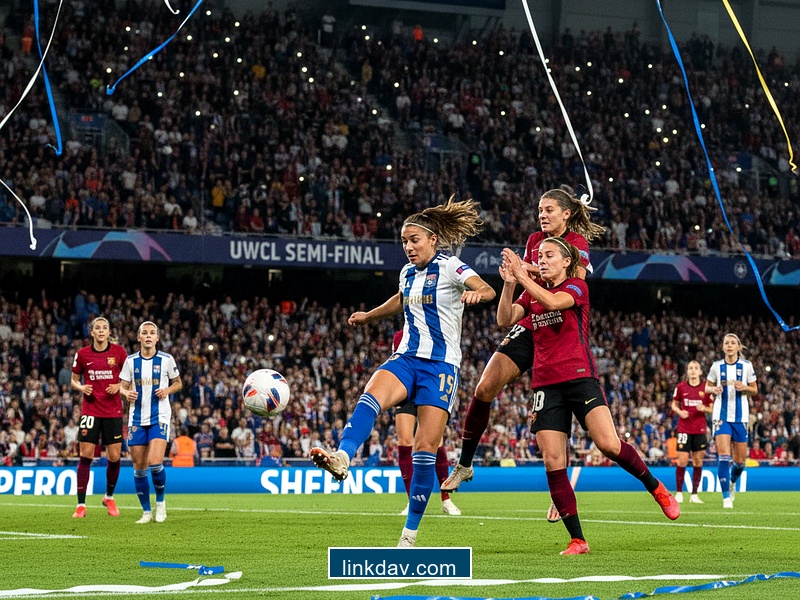
The Contrast: Five years ago, the role of the fullback in the women’s game was defined almost exclusively by athleticism and linearity. You ran the touchline, you crossed, and you recovered. Today, watching Lucy Bronze operate for Chelsea, we are witnessing the complete death of that archaic positional manual. The snippet from the weekend's Women's Champions League action highlights "beautiful" goals, but to view them simply as aesthetic moments is to miss the structural evolution occurring right in front of us.
When the BBC highlights reel leads with a defender chipping a goalkeeper, we aren't just watching a highlight; we are watching a case study in spatial interpretation. The goals from Bronze, Real Madrid's Linda Caicedo, and Lyon's Melchie Dumornay this week are not coincidences. They are the product of systems that are increasingly demanding technical perfection in the tightest areas of the pitch.
The Evolution of the 'Inverted' Threat
Let’s dissect the Lucy Bronze goal first. Why is a right-back in a position to execute a delicate chip from the edge of the area? This is where the tactical analysis gets interesting. Traditional coaching logic suggests a fullback provides width to stretch a low block. However, under Sonia Bompastor, Chelsea is exhibiting a fluid rotation that mirrors the most progressive sides in Europe.
Bronze’s positioning wasn't accidental. It was a recognition of the "half-space"—that vertical corridor between the opposition's fullback and center-back. By drifting inside, she creates a numerical overload in the midfield, forcing the opposition defense to narrow. When the ball falls to her, the execution of the chip is audacious, yes, but it is the decision to be there that matters.
"The chip isn't just flair; it is the most efficient solution to a crowded box. Power gets blocked. Placement gets saved. Elevation removes the variables."
This goal signals a warning to the rest of the competition. If Chelsea’s defenders are contributing goals of this technical caliber, their attacking variability becomes a nightmare to defend. You cannot simply man-mark their forwards when the threat is coming from the defensive line.
Caicedo and the Isolation Principle
Moving to Linda Caicedo, we see a different, yet equally devastating tactical concept: Qualitative Superiority. Real Madrid understands that in a structured 4-4-2 or 4-3-3 defensive shape, the structure is only as strong as its weakest individual duel.
Caicedo’s inclusion in the "goals of the week" is a testament to her ability to exploit isolation. In modern analysis, we often obsess over passing triangles and possession stats. But sometimes, the tactic is simple: Give the ball to the player who creates chaos. Caicedo operates effectively as an "outlet"—a player capable of receiving the ball under pressure, turning, and driving at a retreating defense.
- Gravity: She draws two defenders, opening space centrally for teammates.
- Tempo Manipulation: The ability to stop and start, freezing the defender's feet before striking.
- Ball Striking: High-velocity finishes that negate goalkeeper positioning.
Her strike reminds us that while systems win leagues, individual brilliance often decides Champions League knockout ties. Real Madrid’s reliance on her is not a weakness; it is a calculated gamble on her individual ceiling.
Dumornay: The Prototype of the Modern #10
Then we have Melchie Dumornay. If Bronze represents experience and Caicedo represents flair, Dumornay represents the terrifying physical and technical future of the sport. Playing for Lyon, the aristocrats of European football, demands a level of efficiency that crushes opponents.
Her goal highlights the transition game. We are seeing a shift away from slow, methodical build-up in the UWCL towards rapid, vertical transitions. Dumornay is the engine of this shift. Her ability to receive the ball in the pocket, turn, and execute a strike from distance changes the defensive geometry. Defenders must step up to engage her, and the moment they step up, the space behind them opens for the likes of Kadidiatou Diani or Tabitha Chawinga.
The Statistical Imperative
Why do these long-range and difficult technique goals matter? Because defensive organization in the UWCL has improved drastically. The Expected Goals (xG) per shot in open play is trending downward as defenses become more compact. To score now, you need "low probability" converters.
The Wider Implication for the Season
What this week of stunning goals tells us is that the gap between the elite and the rest is maintained not just by budget, but by technical variety. Teams that rely solely on a target man or a rigid system are being phased out. The top contenders—Chelsea, Lyon, Real Madrid, Barcelona—are stacking their squads with players who can solve problems individually when the system stalls.
Lucy Bronze’s chip wasn't just a beautiful moment; it was a statement of intent. It says that Chelsea has the freedom and the cognitive sharpness to punish errors instantly. For opponents scouting these teams, the headache just got worse. How do you game-plan for a right-back who finishes like a number 10? How do you stop Caicedo without leaving gaps for others?
As we progress deeper into the group stages, look for this trend to continue. The "goal of the week" compilations are no longer filled with goalkeeping errors or scrappy deflections. They are filled with chips, long-range drives, and solo runs. The tactical landscape has shifted towards celebrating and necessitating technical audacity. And right now, Lucy Bronze is sitting comfortably at the head of that table.
The Contrast: Five years ago, the role of the fullback in the women’s game was defined almost exclusively by athleticism and linearity. You ran the touchline, you crossed, and you recovered. Today, watching Lucy Bronze operate for Chelsea, we are witnessing the complete death of that archaic positional manual. The snippet from the weekend's Women's Champions League action highlights "beautiful" goals, but to view them simply as aesthetic moments is to miss the structural evolution occurring right in front of us.
When the BBC highlights reel leads with a defender chipping a goalkeeper, we aren't just watching a highlight; we are watching a case study in spatial interpretation. The goals from Bronze, Real Madrid's Linda Caicedo, and Lyon's Melchie Dumornay this week are not coincidences. They are the product of systems that are increasingly demanding technical perfection in the tightest areas of the pitch.
The Evolution of the 'Inverted' Threat
Let’s dissect the Lucy Bronze goal first. Why is a right-back in a position to execute a delicate chip from the edge of the area? This is where the tactical analysis gets interesting. Traditional coaching logic suggests a fullback provides width to stretch a low block. However, under Sonia Bompastor, Chelsea is exhibiting a fluid rotation that mirrors the most progressive sides in Europe.
Bronze’s positioning wasn't accidental. It was a recognition of the "half-space"—that vertical corridor between the opposition's fullback and center-back. By drifting inside, she creates a numerical overload in the midfield, forcing the opposition defense to narrow. When the ball falls to her, the execution of the chip is audacious, yes, but it is the decision to be there that matters.
"The chip isn't just flair; it is the most efficient solution to a crowded box. Power gets blocked. Placement gets saved. Elevation removes the variables."
This goal signals a warning to the rest of the competition. If Chelsea’s defenders are contributing goals of this technical caliber, their attacking variability becomes a nightmare to defend. You cannot simply man-mark their forwards when the threat is coming from the defensive line.
Caicedo and the Isolation Principle
Moving to Linda Caicedo, we see a different, yet equally devastating tactical concept: Qualitative Superiority. Real Madrid understands that in a structured 4-4-2 or 4-3-3 defensive shape, the structure is only as strong as its weakest individual duel.
Caicedo’s inclusion in the "goals of the week" is a testament to her ability to exploit isolation. In modern analysis, we often obsess over passing triangles and possession stats. But sometimes, the tactic is simple: Give the ball to the player who creates chaos. Caicedo operates effectively as an "outlet"—a player capable of receiving the ball under pressure, turning, and driving at a retreating defense.
- Gravity: She draws two defenders, opening space centrally for teammates.
- Tempo Manipulation: The ability to stop and start, freezing the defender's feet before striking.
- Ball Striking: High-velocity finishes that negate goalkeeper positioning.
Her strike reminds us that while systems win leagues, individual brilliance often decides Champions League knockout ties. Real Madrid’s reliance on her is not a weakness; it is a calculated gamble on her individual ceiling.
Dumornay: The Prototype of the Modern #10
Then we have Melchie Dumornay. If Bronze represents experience and Caicedo represents flair, Dumornay represents the terrifying physical and technical future of the sport. Playing for Lyon, the aristocrats of European football, demands a level of efficiency that crushes opponents.
Her goal highlights the transition game. We are seeing a shift away from slow, methodical build-up in the UWCL towards rapid, vertical transitions. Dumornay is the engine of this shift. Her ability to receive the ball in the pocket, turn, and execute a strike from distance changes the defensive geometry. Defenders must step up to engage her, and the moment they step up, the space behind them opens for the likes of Kadidiatou Diani or Tabitha Chawinga.
The Statistical Imperative
Why do these long-range and difficult technique goals matter? Because defensive organization in the UWCL has improved drastically. The Expected Goals (xG) per shot in open play is trending downward as defenses become more compact. To score now, you need "low probability" converters.
The Wider Implication for the Season
What this week of stunning goals tells us is that the gap between the elite and the rest is maintained not just by budget, but by technical variety. Teams that rely solely on a target man or a rigid system are being phased out. The top contenders—Chelsea, Lyon, Real Madrid, Barcelona—are stacking their squads with players who can solve problems individually when the system stalls.
Lucy Bronze’s chip wasn't just a beautiful moment; it was a statement of intent. It says that Chelsea has the freedom and the cognitive sharpness to punish errors instantly. For opponents scouting these teams, the headache just got worse. How do you game-plan for a right-back who finishes like a number 10? How do you stop Caicedo without leaving gaps for others?
As we progress deeper into the group stages, look for this trend to continue. The "goal of the week" compilations are no longer filled with goalkeeping errors or scrappy deflections. They are filled with chips, long-range drives, and solo runs. The tactical landscape has shifted towards celebrating and necessitating technical audacity. And right now, Lucy Bronze is sitting comfortably at the head of that table.