
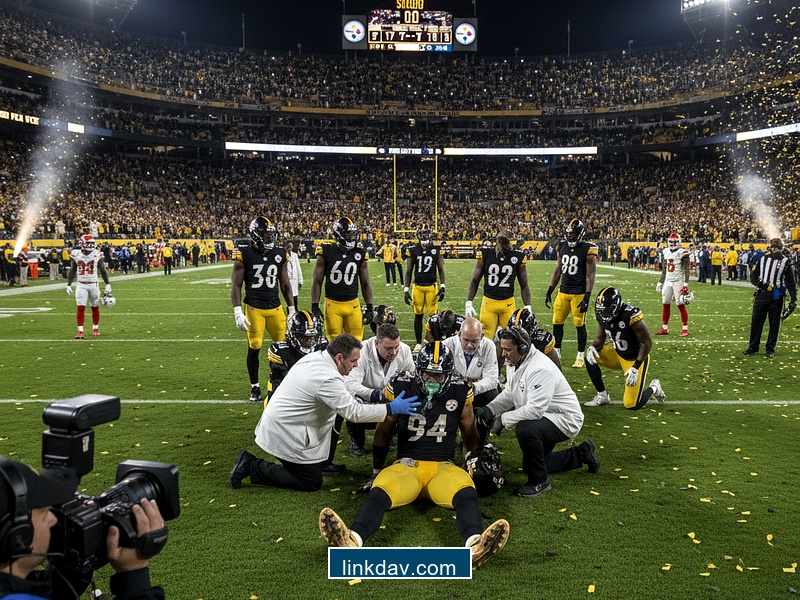
The history of the Pittsburgh Steelers is written in bruise-purple and coal-black ink. It is a narrative constructed on the backs of men who treated pain as a nuisance and opposing quarterbacks as prey. From the formidable days of the 1970s dynasty to the blitz-heavy schemes of the 2000s, the franchise has always adhered to a singular, brutal truth: the defense eats first. Yet, news that T.J. Watt, the modern heir to this violent throne, has undergone surgery for a collapsed lung—not from a clash of helmets, but from a therapeutic needle—serves as a jarring reminder of how precarious sporting dominance truly is.
It is almost Shakespearean in its irony. Here lies a gladiator who routinely engages in hand-to-hand combat with 330-pound offensive linemen, a man who throws his body into the chaotic machinery of an NFL trench without hesitation. And what fells him? Not a blindside block, nor a twisting of the knee on the turf, but a "dry needling" session—a recovery technique designed to heal, which instead punctured the very engine of his athleticism.
The Ghost of Defensive Lineages
To understand the gravity of a T.J. Watt setback, one must look back through the annals of Steelers lore. This organization does not merely employ linebackers; it canonizes them. In the 1970s, Jack Lambert and Jack Ham were not just players; they were the physiological embodiment of the city’s identity. When Mean Joe Greene suffered a pinched nerve in 1974, a palpable tremor went through Western Pennsylvania. The team survived, but the anxiety was real.
Fast forward to the 21st century. The defenses led by Troy Polamalu and James Harrison operated on a similar frequency. When Polamalu’s calf or Achilles failed him, Dick LeBeau’s complex zone blitzes often lost their teeth. The chaos vanished, replaced by a pedestrian predictability.
T.J. Watt stands as the solitary pillar of the current era. Unlike the teams of the 70s or the mid-2000s, which boasted Hall of Famers at multiple levels of the defense, the current Steelers roster is top-heavy. Watt is not just a piece of the puzzle; he is the picture itself. This collapsed lung, while reportedly a minor procedural hiccup in the long run, exposes the terrifying lack of structural integrity behind him. Without Watt, the Steel Curtain is merely a fabric drape, easily swept aside by the gusts of the modern AFC North.
The Stat Pack: A One-Man Army
We often speak in hyperbole regarding "MVP" candidates, but the data surrounding T.J. Watt’s impact on the Pittsburgh Steelers is unequivocal. It is rare in the history of the NFL to see a non-quarterback dictate the win-loss column with such absolute authority. The numbers below paint a stark portrait of dependency.
| Metric (Since 2017) | With T.J. Watt | Without T.J. Watt |
|---|---|---|
| Win Percentage | ~65% (Playoff Caliber) | ~9% (Top 3 Pick Caliber) |
| Sacks Per Game | 3.5+ | Under 1.5 |
| Points Allowed Per Game | ~20.5 | ~26.0 |
| Opponent QB Rating | Below League Avg | Elite Level |
The disparity is not merely statistical; it is existential. When Watt is absent, the Steelers transform from a perennial contender into one of the statistically worst teams in football. This is the context in which a "routine procedure gone wrong" must be viewed.
The High Wire of Modern Medicine
This incident necessitates a deeper conversation about the lengths to which modern athletes go to maintain their edge. Decades ago, recovery meant ice baths and rest. Today, players utilize hyperbaric chambers, cryotherapy, and invasive techniques like dry needling to accelerate muscle recovery.
Dry needling involves inserting filiform needles into trigger points in the muscle. It is generally safe, but as Watt discovered, the margin for error is razor-thin when working near the thoracic cavity. A pneumothorax (collapsed lung) occurs when air leaks into the space between the lung and chest wall.
The pursuit of perfection has its own casualty rate. Watt was attempting to optimize his body, to squeeze every ounce of performance out of his frame for the upcoming battles. Instead, he found himself in surgery. It is a cautionary tale for the league: as recovery science becomes more aggressive, the potential for iatrogenic injury—harm caused by the healer—increases. The Steelers are fortunate this occurred in the offseason, but it highlights a vulnerability in the machine. We treat these players as cyborgs, endlessly repairable, until a simple needle reminds us they are bags of air and blood.
Fan Pulse: The Yinzer Anxiety
Walk into any bar in the South Side or the Strip District, and the mood is not one of anger, but of weary resignation. The Pittsburgh faithful, arguably the most knowledgeable collective in the sport, suffer from a specific form of PTSD related to Watt's pectoral injury in 2022. They remember the seven-game stretch without him where the defense looked entirely toothless.
"We can survive a bad quarterback game. We can survive a fumble. We cannot survive T.J. Watt watching from the sideline in street clothes."
The reaction to this news was instant panic, followed by frantic Googling of "pneumothorax recovery time." While the medical timeline suggests a full return before training camp intensifies, the seed of doubt has been planted. The fanbase knows that their Super Bowl window, however slightly ajar it might be with Russell Wilson or Justin Fields under center, slams shut the moment #90 is unavailable.
<p style="foThe history of the Pittsburgh Steelers is written in bruise-purple and coal-black ink. It is a narrative constructed on the backs of men who treated pain as a nuisance and opposing quarterbacks as prey. From the formidable days of the 1970s dynasty to the blitz-heavy schemes of the 2000s, the franchise has always adhered to a singular, brutal truth: the defense eats first. Yet, news that T.J. Watt, the modern heir to this violent throne, has undergone surgery for a collapsed lung—not from a clash of helmets, but from a therapeutic needle—serves as a jarring reminder of how precarious sporting dominance truly is.
It is almost Shakespearean in its irony. Here lies a gladiator who routinely engages in hand-to-hand combat with 330-pound offensive linemen, a man who throws his body into the chaotic machinery of an NFL trench without hesitation. And what fells him? Not a blindside block, nor a twisting of the knee on the turf, but a "dry needling" session—a recovery technique designed to heal, which instead punctured the very engine of his athleticism.
The Ghost of Defensive Lineages
To understand the gravity of a T.J. Watt setback, one must look back through the annals of Steelers lore. This organization does not merely employ linebackers; it canonizes them. In the 1970s, Jack Lambert and Jack Ham were not just players; they were the physiological embodiment of the city’s identity. When Mean Joe Greene suffered a pinched nerve in 1974, a palpable tremor went through Western Pennsylvania. The team survived, but the anxiety was real.
Fast forward to the 21st century. The defenses led by Troy Polamalu and James Harrison operated on a similar frequency. When Polamalu’s calf or Achilles failed him, Dick LeBeau’s complex zone blitzes often lost their teeth. The chaos vanished, replaced by a pedestrian predictability.
T.J. Watt stands as the solitary pillar of the current era. Unlike the teams of the 70s or the mid-2000s, which boasted Hall of Famers at multiple levels of the defense, the current Steelers roster is top-heavy. Watt is not just a piece of the puzzle; he is the picture itself. This collapsed lung, while reportedly a minor procedural hiccup in the long run, exposes the terrifying lack of structural integrity behind him. Without Watt, the Steel Curtain is merely a fabric drape, easily swept aside by the gusts of the modern AFC North.
The Stat Pack: A One-Man Army
We often speak in hyperbole regarding "MVP" candidates, but the data surrounding T.J. Watt’s impact on the Pittsburgh Steelers is unequivocal. It is rare in the history of the NFL to see a non-quarterback dictate the win-loss column with such absolute authority. The numbers below paint a stark portrait of dependency.
| Metric (Since 2017) | With T.J. Watt | Without T.J. Watt |
|---|---|---|
| Win Percentage | ~65% (Playoff Caliber) | ~9% (Top 3 Pick Caliber) |
| Sacks Per Game | 3.5+ | Under 1.5 |
| Points Allowed Per Game | ~20.5 | ~26.0 |
| Opponent QB Rating | Below League Avg | Elite Level |
The disparity is not merely statistical; it is existential. When Watt is absent, the Steelers transform from a perennial contender into one of the statistically worst teams in football. This is the context in which a "routine procedure gone wrong" must be viewed.
The High Wire of Modern Medicine
This incident necessitates a deeper conversation about the lengths to which modern athletes go to maintain their edge. Decades ago, recovery meant ice baths and rest. Today, players utilize hyperbaric chambers, cryotherapy, and invasive techniques like dry needling to accelerate muscle recovery.
Dry needling involves inserting filiform needles into trigger points in the muscle. It is generally safe, but as Watt discovered, the margin for error is razor-thin when working near the thoracic cavity. A pneumothorax (collapsed lung) occurs when air leaks into the space between the lung and chest wall.
The pursuit of perfection has its own casualty rate. Watt was attempting to optimize his body, to squeeze every ounce of performance out of his frame for the upcoming battles. Instead, he found himself in surgery. It is a cautionary tale for the league: as recovery science becomes more aggressive, the potential for iatrogenic injury—harm caused by the healer—increases. The Steelers are fortunate this occurred in the offseason, but it highlights a vulnerability in the machine. We treat these players as cyborgs, endlessly repairable, until a simple needle reminds us they are bags of air and blood.
Fan Pulse: The Yinzer Anxiety
Walk into any bar in the South Side or the Strip District, and the mood is not one of anger, but of weary resignation. The Pittsburgh faithful, arguably the most knowledgeable collective in the sport, suffer from a specific form of PTSD related to Watt's pectoral injury in 2022. They remember the seven-game stretch without him where the defense looked entirely toothless.
"We can survive a bad quarterback game. We can survive a fumble. We cannot survive T.J. Watt watching from the sideline in street clothes."
The reaction to this news was instant panic, followed by frantic Googling of "pneumothorax recovery time." While the medical timeline suggests a full return before training camp intensifies, the seed of doubt has been planted. The fanbase knows that their Super Bowl window, however slightly ajar it might be with Russell Wilson or Justin Fields under center, slams shut the moment #90 is unavailable.
<p style="fo