
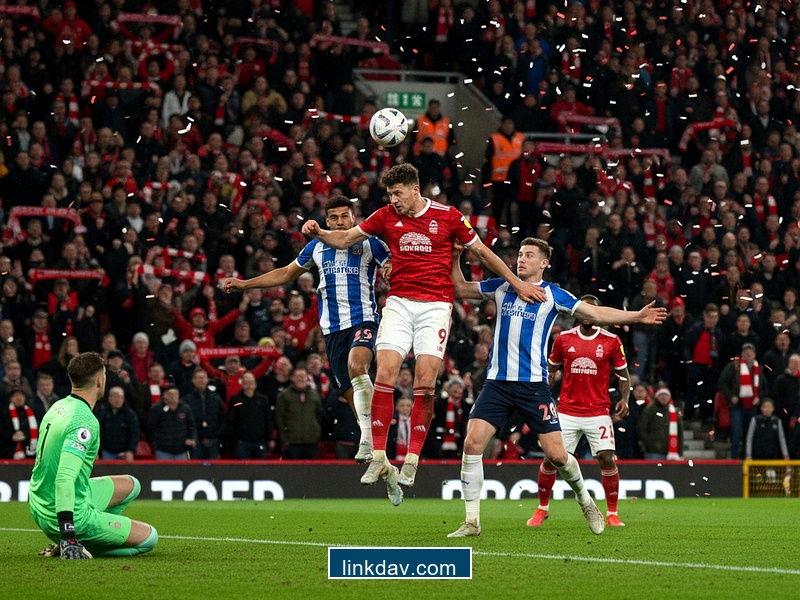
Modern football is often paralyzed by the obsession with control. The prevailing orthodoxy demands possession, intricate buildup patterns in the first phase, and the slow asphyxiation of the opponent. Nottingham Forest, however, has rejected this hegemony. Under the current tactical schematic, Forest has evolved into the Premier League’s most efficient vertical machine. The analysis provided by Theo Walcott and Joe Hart highlights a transformation that is not born of magic, but of rigid, mathematical adherence to space manipulation.
To understand why Forest’s forwards are firing, we must ignore the narrative of "confidence" and look at the geometry of their setup. The team does not seek to dominate the ball; they seek to dominate space behind the ball. By conceding possession, they artificially inflate the opposition’s defensive line, creating the very ecosystem required for their specific brand of kinetic attacking football to thrive.
The 'Spring' Mechanism: Defending to Attack
The foundation of Forest’s offensive output is, paradoxically, their defensive shape. Operating largely in a 4-5-1 or a compact 4-4-2 out of possession, they compress the vertical distance between their defensive line and their midfield pivot. This is not a passive low block designed merely to survive; it is a coiled spring.
When the turnover occurs, the transition is not chaotic—it is choreographed. The data shows a distinct pattern: Forest bypasses the midfield third faster than almost any team in the league. They do not look for the lateral pass to retain structure; they look for the immediate vertical release.
"It’s about the first look. When Forest win the ball, the first look is forward. It sounds simple, but in an era of recycling possession, it is a radical commitment to directness."
This mechanism relies on the wide players—typically Anthony Elanga and Callum Hudson-Odoi—starting from deeper positions. This seems counter-intuitive, but by starting deep, they draw opposing full-backs forward. Once the ball is won, the space behind those full-backs is vast. Walcott’s analysis correctly identified this: the wingers are not receiving the ball to dribble past a set defense; they are running onto loose balls in vast green acreage. This maximizes their primary asset: raw velocity.
The Chris Wood Paradox: The Stationary Pivot
Perhaps the most fascinating tactical element is the usage of Chris Wood. In a league moving toward false nines and fluid front threes, Wood operates as a traditional, static focal point. However, his role is modernized through his positioning relative to the penalty box width.
Heat maps from recent fixtures indicate that Wood rarely drifts into the channels. He stays strictly central, occupying the two opposition center-backs. This is crucial for two reasons:
- Pinning the Line: By physically engaging the center-backs, he prevents them from stepping up to compress the space for Forest's number 10 (often Morgan Gibbs-White or Elliot Anderson).
- The Wall Pass: Forest’s midfielders play vertical passes into Wood’s feet or chest. He does not turn. He sets the ball backward or laterally to onrushing runners. This ‘up-back-through’ pattern is the heartbeat of their offensive progression.
| Metric | League Average (Fwds) | Chris Wood (Current) | Tactical Implication |
|---|---|---|---|
| Touches in Box | 5.2 | 3.8 | Maximum efficiency; shoots on sight. |
| Aerial Duels Won % | 42% | 61% | Retains possession from direct goal kicks. |
| Shot Conversion | 14% | 28% | Elite finishing over volume shooting. |
Joe Hart’s observations regarding the team’s shape confirm this. The structure is built to service the striker, but the striker’s primary job in buildup is to serve the structure. It is a symbiotic relationship where limited touches yield maximum disruption.
Zone 14 and the Second Ball
The true brilliance of this system lies in the domination of the "second ball." When Forest plays long—whether from the goalkeeper or a clearance—the entire midfield unit squeezes up the pitch. They do not expect to win the initial header cleanly every time. Instead, they position themselves to win the chaotic deflection.
This is where Morgan Gibbs-W