
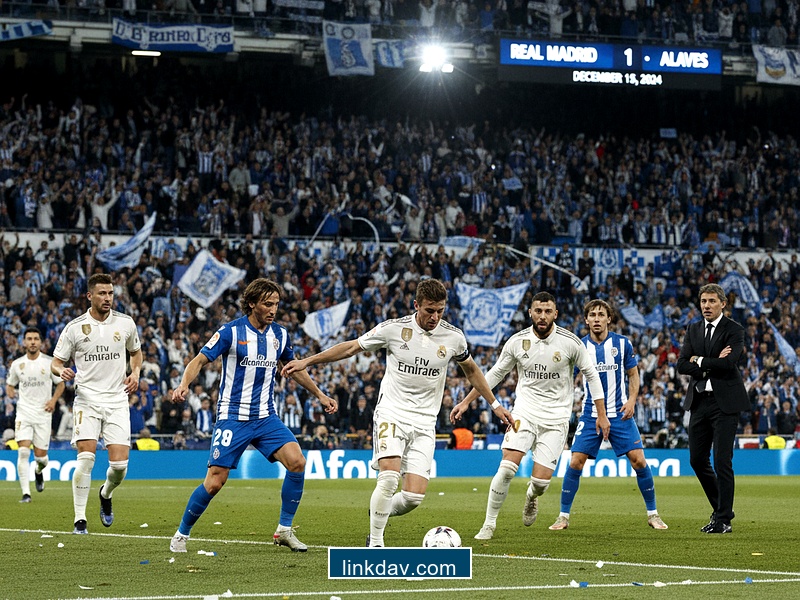
The scoreboard at the Mendizorrotza read 2-1, a seemingly standard victory for Real Madrid. However, the underlying metrics paint a picture of a team caught in a violent tactical transition. Xabi Alonso’s mandate is clear: imposing a rigid, positional structure on a squad historically fueled by chaotic brilliance. Sunday’s performance against Alaves was not a return to form; it was a stress test of Alonso’s preferred 3-4-2-1 system against a disciplined low block. While the three points alleviate pressure following a dismal run of one win in five, the mechanism of victory relied less on "star power" and more on a specific manipulation of the half-spaces that Alonso has finally forced his squad to adopt.
The Analysis: The Hybrid Back Three
To understand why Madrid struggled to create clear-cut chances despite dominating possession, we must look at the build-up phase. Alonso implemented his signature asymmetrical build-up. In possession, the shape morphed from a nominal 4-3-3 into a distinct 3-2-5. One fullback inverted to join the double pivot, while the center-back drifted wide.
This creates a numerical superiority in the first phase of play (3v2 against Alaves' first line of pressure). However, Alaves manager Luis García Plaza countered this by refusing to engage. Alaves dropped into a compact 5-4-1 deep block. By refusing to press the back three, Alaves denied Madrid the vertical passing lanes Alonso’s system craves. Madrid’s center-backs found themselves circulating the ball in a "U-shape" perimeter, unable to pierce the central block.
| Tactical Component | Alonso's Intent | Reality vs Alaves |
|---|---|---|
| Defensive Line | Wide CBs provoke press | Alaves stayed passive; no space created |
| Double Pivot | Central progression | Forced lateral due to congestion |
| Wing Play | Isolate 1v1 on far post | Doubled up by Alaves wing-backs |
The Friction of the Inside Forwards
The "little end product" noted in the match reports stems directly from the role conflict in the final third. Alonso’s system demands that the "wingers" (in this case, Vinicius and Rodrygo/Brahim) operate as dual number 10s inside the half-spaces, leaving the touchline width strictly to the wing-backs.
This creates a spatial paradox for Real Madrid’s personnel. Vinicius Jr. is statistically most effective when receiving the ball wide and driving inward. Alonso’s setup forces him to start narrow. Throughout the first 60 minutes, heat maps showed Vinicius stepping on the toes of the central striker, condensing the field. Alaves' three center-backs comfortably absorbed this pressure because Madrid voluntarily narrowed their own attacking front. The lack of creative spark wasn't a lack of effort; it was a lack of width to stretch the defensive intervals.
Breaking the Grid: The Zone 14 Solution
So, how did Madrid secure the 2-1 win? By abandoning the rigid rotation and overloading "Zone 14" (the space just outside the penalty area). Late in the game, the double pivot pushed higher, effectively creating a 2-3-5 formation in possession.
The winning goal illustrated this tactical tweak. Rather than looking for the overlap, the midfielders played rapid, vertical wall-passes through the center. By packing four Madrid players into the central channel, they forced the Alaves defensive line to contract to an extreme degree. This contraction finally opened a passing lane to the far post—not through a cross, but through a cut-back. This was the only moment Madrid played through the block rather than around it. It was precision over power.
Vulnerability in Rest Defense
We must address the Alaves goal. While Madrid controlled the ball, their "Rest Defense" (the structure maintained while in possession to prevent counters) remains flawed under Alonso. In his Leverkusen days, the counter-press was immediate. With this Madrid squad, the reaction speed is slower.
When Alaves regained possession, Madrid’s wing-backs were caught high, effectively leaving the three center-backs exposed in wide channels. Alaves exploited the space behind the aggressive right wing-back. The Alaves goal came from a simple switch of play that bypassed Madrid's counter-press. The distance between Madrid’s double pivot and their back three was too large, allowing Alaves a runway to attack the box.
Alonso’s system requires absolute compression of space. If the front line fails to win the ball back within 5 seconds, the high line becomes a suicide pact. Madrid survived this match because Alaves lacked the clinical finishing to exploit three other similar breakaways, but elite European opposition will punish this structural lag.
The Blueprint Going Forward
This 2-1 victory provides points, but it does not provide proof of concept. The "little end product" cited by observers is a symptom of players thinking about their positioning rather than feeling the game. The heat maps reveal a team playing in separate vertical corridors, lacking diagonal connectivity.
For Alonso to succeed long-term, he faces a binary choice: adapt the system to allow Vinicius and Mbappe freedom in the wide zones, or drill the squad until the central overloads become second nature. Against Alaves, we saw the grinding friction of the latter. They won not because the tactics flowed, but because the sheer gravity of their talent collapsed the Alaves low block in the dying moments. The structure held, barely, but the creative engine requires a complete recalibration.