
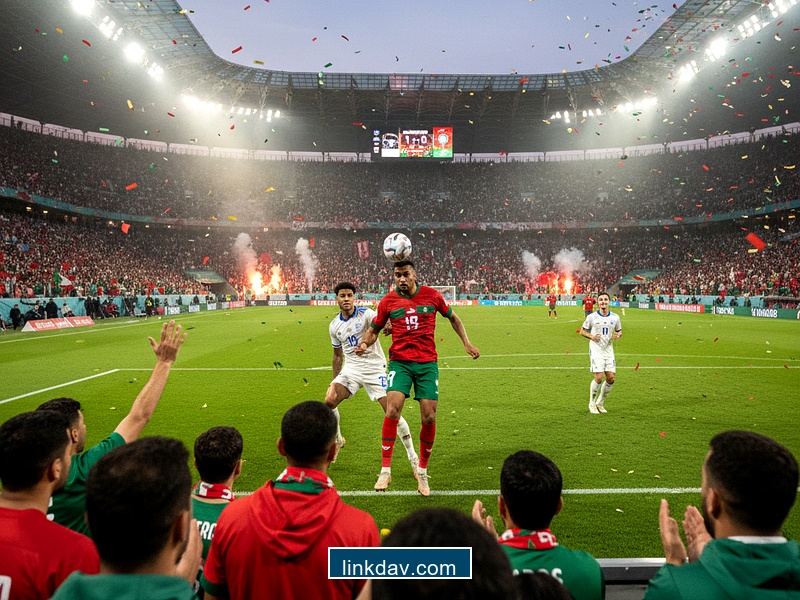
Walid Regragui’s Morocco stunned the world in Qatar not through magic, but through rigid, almost robotic structural discipline. They conceded an Expected Goals (xG) against of nearly zero in key knockout stages by compressing space between the lines. However, the Africa Cup of Nations (AFCON) presents a completely different variable set. Opponents sit deep, denying Morocco the counter-attacking space they thrived on against Spain or Portugal. To break these low blocks, Regragui requires tactical variance. This is where the Bundesliga contingent enters the equation. The inclusion of players conditioned in Germany’s high-velocity, transition-heavy league offers Morocco a solution to the "possession sterility" problem. We must strip away the emotion of the tournament and examine strictly how the specific profiles of Noussair Mazraoui and Amine Adli alter the team's geometry and heat map distribution.
Mazraoui and the Inverted Left Channel
The deployment of Noussair Mazraoui is the primary tactical anomaly in Regragui’s system. Naturally a right-back, his utilization on the left flank for the national team is often misconstrued as a mere personnel compromise to accommodate Achraf Hakimi. Tactically, however, it serves a distinct function known as "asymmetric inversion."
In the Bundesliga, specifically during his tenure at Bayern Munich, Mazraoui developed elite resistance to pressing and the ability to operate in central corridors. When Morocco possesses the ball, Hakimi stays wide and high on the right, operating as a traditional winger. Conversely, Mazraoui does not hug the left touchline. Instead, he tucks inside into the left defensive half-space.
"The modern fullback is no longer defined by the overlap, but by the underlap. Mazraoui acts effectively as a third central midfielder during the build-up phase."
This movement creates a 3-2-5 or 2-3-5 formation in possession. Mazraoui joins the defensive midfielder (often Sofyan Amrabat) to form a double pivot. This creates a numerical overload in the midfield engine room (4 vs 3 against standard mid-blocks), forcing the opposition wingers to narrow their shape. Once the opponent narrows, the switch of play to the isolated Hakimi on the far right becomes the kill-shot. Without Mazraoui’s Bundesliga-honed ability to play in 360-degree traffic, this structural manipulation fails.
The Adli Variable: Exploiting the Half-Spaces
Amine Adli represents the Xabi Alonso school of thought: verticality over horizontal safety. At Bayer Leverkusen, Adli operates in a system that emphasizes quick interplay in "Zone 14" (the area just outside the opponent's penalty box). Morocco historically struggles with chance creation against set defenses. Adli’s role is to destabilize these lines.
Analysis of Adli’s heat maps reveals he rarely stays wide. If he starts on the wing, his trigger movement is a diagonal run toward the penalty spot between the opposing fullback and center-back. This runs contrary to the "pausa" style of Hakim Ziyech. Adli offers kinetic energy. His reception of the ball is almost always progressive; he looks to turn and drive rather than hold and recycle.
| Metric (Per 90) | Amine Adli (Leverkusen Avg) | Morocco System Avg | Tactical Impact |
|---|---|---|---|
| Progressive Carries | 4.2 | 2.8 | Breaks defensive lines solo. |
| Pressures (Final 3rd) | 8.5 | 5.1 | Enables high turnover generation. |
| xG Assisted (xA) | 0.31 | 0.18 | Higher quality final ball delivery. |
The table above highlights the discrepancy between Adli’s Bundesliga output and Morocco’s general baseline. By integrating Adli, Regragui attempts to import the "Gegenpress." When Morocco loses possession high up the pitch, Adli’s instinct—drilled daily in Germany—is to immediately harass the ball carrier rather than drop into a shape. This tactical nuance is vital for AFCON, where pitch conditions often lead to defensive errors that high pressing can punish.
Structural Fluidity: From 4-1-4-1 to 3-4-3
The synergy between the Bundesliga players allows for fluid formation changes without substitutions. In defense, Morocco settles into their famously compact 4-1-4-1 low block. The lines are tight, denying entry passes into the center. However, the transition to attack is where the German influence shines.
Upon recovery, Mazraoui’s technical security allows him to bypass the first wave of pressure. He acts as the release valve. Simultaneously, Adli pushes high, effectively becoming a second striker or an inside forward. This morphs the shape into a 3-4-3 diamond in midfield.
This rotation causes confusion for opposition markers who utilize man-marking schemes—common in African football. If the opposing right-back tracks Adli inside, the flank opens for the overlap (or in Morocco's case, the left-sided midfielder drifting wide). If the defender passes Adli off to a center-back, it creates a 2v1 situation centrally. The Bundesliga education emphasizes "positional play" (Juego de Posición), where occupying the correct zones is more critical than touching the ball. Adli and Mazraoui execute this spacing instinctively.
The Pressing Trap Dynamics
One cannot discuss Bundesliga influence without addressing the pressing traps. German football prioritizes winning the ball back within 5 to 8 seconds of losing it. Morocco’s traditional style relies on patience, but the inclusion of these specific players signals a hybrid approach.
When the opposition builds from the back, Adli initiates the press, curving his run to cut off the passing lane to the sideline. This forces the opponent to play through the middle—straight into the crowded zone occupied by Amrabat and the inverted Mazraoui. This is a classic "pressing funnel." They guide the opponent into a specific area where Morocco holds a numerical superiority.
This tactic mitigates the risk of counter-attacks. By suffocating the opponent centr