
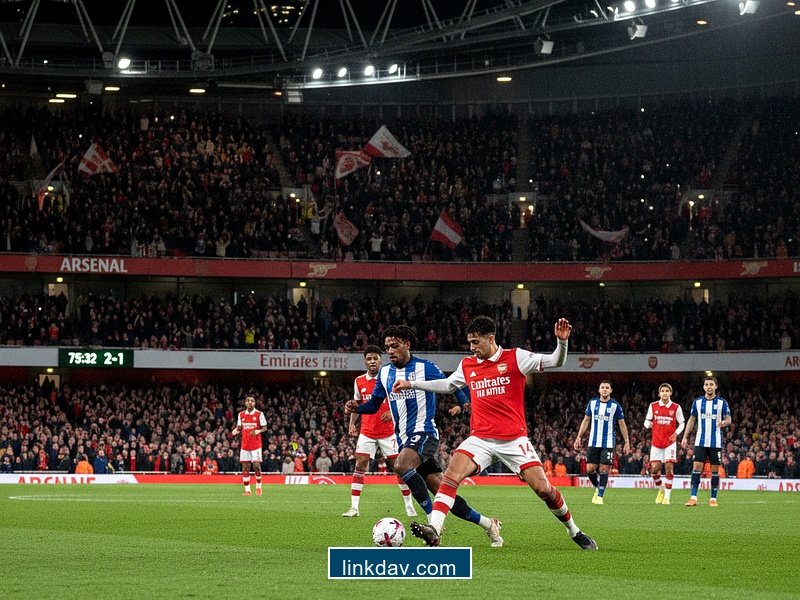
There is a specific kind of melancholy that hangs over a footballer who was promised the world, only to find his body and the cruel march of time conspiring against him. When Theo Walcott, a man who knows intimately the burden of unfulfilled potential at the Emirates Stadium, pointed out Arsenal's "big problem" in the Premier League title race, he did not explicitly destroy a reputation. He didn't need to. The silence between his words screamed a single name. That name is Gabriel Jesus.
Walcott’s assessment was clinical, detached, and painfully accurate. He highlighted the absence of that ruthless streak, the killer instinct that separates the aesthetic beauty of Arsenal’s buildup from the cold, hard currency of championships. While the pundits discuss systems and defensive fragility, the spotlight burns hottest on the man wearing the number nine shirt. This is not just a tactical issue; it is the personal tragedy of Gabriel Jesus, a player caught in the purgatory between brilliance and fragility.
The False Dawn of the Savior
To understand the depth of the current heartbreak, we must rewind to the summer of 2022. When Jesus arrived from Manchester City, he did not just bring his boots; he brought an electric current. He was the catalyst. He was the man who would teach a young, naive Arsenal side how to win. For those first five months, he was magnificent. He pressed like a feral dog, dribbled through phone boxes, and elevated Gabriel Martinelli and Bukayo Saka into world-beaters.
"He changed our world. He brought a belief, an energy, a chaos that the Emirates hadn't seen since the days of Alexis Sanchez. But chaos, without the finality of a goal, eventually becomes exhaustion."
That version of Jesus seems like a ghost now. The player who danced through the Leicester City defense on a sun-drenched August afternoon has been replaced by a figure who often looks labored, frustrated, and perpetually wincing. Walcott's identification of a "big problem" is essentially an observation that Arsenal lacks a focal point who guarantees 20 goals. Jesus was supposed to be that guarantee. Instead, he has become a symbol of "almost."
The Cruelty of the Knee
The villain in this biography is not a rival defender, but anatomy. The knee injury sustained against Cameroon at the 2022 World Cup was the turning point. Before that moment, Jesus played with a rubber-limbed fluidity. Since the surgery, and the subsequent minor procedures, the mechanics of his game have altered.
You can see it in the half-seconds. The hesitation before the shot. The slight reluctance to engage in the brutal physical duels he once relished. Walcott notes the team's inability to kill games off; this stems directly from a striker who spends more time drifting to the wing to find space than occupying the dangerous, painful areas inside the six-yard box.
| Metric | The Arrival (First 15 Games) | The Reality (Last 15 Games) |
|---|---|---|
| Take-on Success % | 58% | 41% |
| Goals Expected (xG) | 0.62 per 90 | 0.34 per 90 |
| Touches in Box | 9.4 per 90 | 6.1 per 90 |
The data paints a bleak picture of regression. Jesus has moved further away from the goal, both physically and metaphorically. When a legend like Walcott speaks of problems in the title race, he looks at Manchester City and sees Erling Haaland—a machine designed for the sole purpose of scoring. Then he looks at Arsenal and sees Jesus—a beautiful, tragic artist who paints the corners of the canvas but leaves the center blank.
The Psychological Erosion
Perhaps the most painful aspect of this downfall is the visible erosion of confidence. There is a specific look in Jesus's eyes when he misses a chance now—a resignation. In his debut season, a miss was followed by a roar of defiance. Now, it is followed by a slump of the shoulders. He knows the narrative. He hears the whispers that Kai Havertz, a midfielder by trade, offers more stability at the point of the attack.
Mikel Arteta defends him publicly, speaking of his "chaos factor" and his work rate. But work rate is the praise you give a defensive midfielder, not the striker meant to fire you to a title ahead of Pep Guardiola’s juggernaut. Walcott, having played with strikers like Robin van Persie and Thierry Henry, understands that "nice" does not win Premier Leagues. Ruthlessness wins.
The tragedy is compounded by the fact that Jesus left Manchester City to escape the rotation, to be the main man. He wanted to step out of the shadows. Yet, in seeking the light, he has exposed his own limitations. Arsenal requires a killer. Jesus is a creator. The dissonance between what Arsenal needs and what Jesus can physically provide is the "big problem" Walcott alludes to.
A crossroads in North London
We are witnessing a slow-motion changing of the guard, even if the player involved is only 27 years old. The rumors of Arsenal hunting for a new striker—a Gyökeres, an Isak, a Sesko—are not just transfer gossip; they are an indictment of Jesus's fitness and finishing.
Walcott’s words serve as a grim prophecy. If Arsenal fails to lift the trophy again this season, the autopsy will focus on the games where dominance was not converted into points. The finger will point at the lack of a 25-goal striker. It will point at Gabriel Jesus.
There is still time for a redemption arc. Football loves nothing more than a hero rising from the ashes. A run of goals, a winner in a crucial derby, a return to that electric form of 2022 could silence the doubts. But as the rain falls on North London and Jesus watches another 60 minutes pass from the bench or struggles to impact a low block, the window is closing.
Theo Walcott was right. Arsenal has a big problem. And his name, tragically, is the one they once sang as their savior. The boy from Brazil who just wanted to play has found that at the very top level, playing isn't enough. You have to execute.