
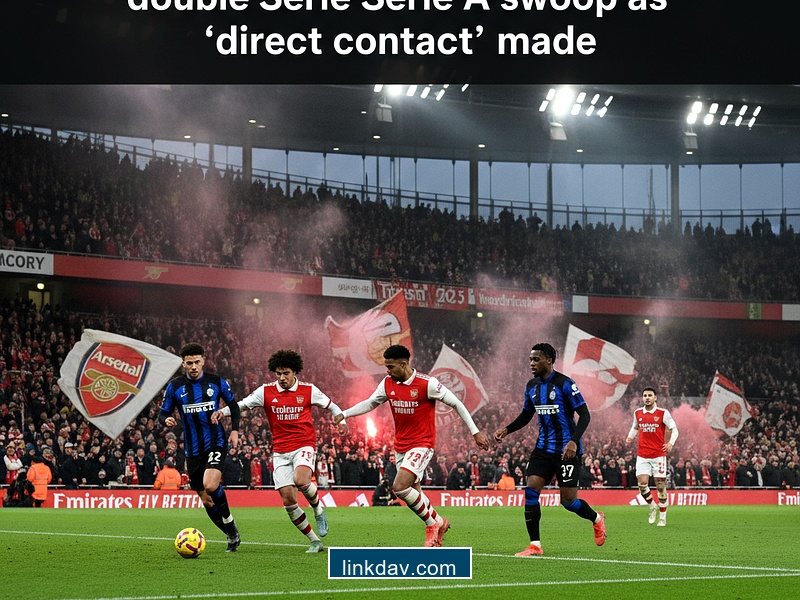
The narrative surrounding Arsenal’s potential €100m double raid on Serie A often devolves into simplistic talk of "firepower" or "squad depth." This misses the point entirely. Mikel Arteta operates less like a manager and more like a structural engineer. When fissures appear in the tactical integrity of the 4-3-3, he doesn't patch them; he redesigns the load-bearing walls. The decision to initiate direct contact for two high-profile Serie A targets—profiles offering elite physicality and transitional security—is not a reaction to a bad run of form. It is a calculated response to a specific tactical ceiling Arsenal has hit against the low block.
European football has seen a resurgence of the 'Catenaccio' hybrid—teams that defend in a 5-4-1 but transition with 3-2-5 fluidity. Arsenal’s current setup, reliant on intricate interplay and "false" roles, struggles to shatter these defensive shells. The Serie A marketplace offers a specific commodity the Premier League currently lacks in abundance: tactical universality combined with brute force.
Deconstructing the 'U-Shape' Problem
To understand why this €100m allocation is necessary, one must analyze Arsenal’s passing networks. Against disciplined sides, the pass map frequently resembles a horseshoe or 'U-shape,' circulating from white to wide without penetrating the core. This happens because the current forward profiles prefer to drop deep to link play (vacating the box) or drift wide to isolate full-backs.
The Serie A profiles identified possess a trait known in Italian coaching circles as 'fissare i centrali' (fixing the center-backs). By engaging two defenders physically, the incoming striker profile prevents the opposition defensive line from stepping up to compress the space. This forces the opponent deeper, artificially expanding the space between their defensive and midfield lines—the exact pocket where Arsenal’s captain Martin Ødegaard thrives.
This is not about buying a goalscorer; it is about buying a pivot point that alters the geometry of the entire final third.
The Vertical Fulcrum vs. The False Nine
The most significant shift this transfer signals is the move away from total fluidity toward functional specialization. The "Double Swoop" targets a specific deficiency: aerial supremacy and hold-up play in transition.
| Tactical Attribute | Current Arsenal Profile | Serie A Target Profile |
|---|---|---|
| Aerial Duels Won/90 | 1.8 (34% Success) | 3.9 (58% Success) |
| Box Touches/90 | 6.2 | 8.1 |
| Back-to-Goal Link Play | Drifts to half-spaces | Holds central axis |
The data highlights a glaring disparity. Arsenal’s current setup relies on ground combinations to enter the box (low xG probability per entry). The Serie A profile allows for "ugly" entries—crosses from deep, long balls from the goalkeeper—to become high-value chances. This tactical diversity is essential for the Champions League knockout stages, where pressing intensity creates chaotic game states that bypass midfield entirely.
Rest Defense and the Second Phase
The second part of this double swoop targets defensive solidity, specifically the "Rest Defense" (3-2 shape) Arsenal employs while attacking. Serie A defenders are schooled in specific man-marking principles that differ from the zonal systems prevalent in England.
By acquiring a defender comfortable in wide isolation (1v1 duels in the channel), Arteta can commit an extra midfielder forward. Currently, the fear of the counter-attack forces one of the #8s to play conservatively. A superior "duel-winner" at the back unlocks the offensive potential of the midfield. This is the hidden value of the transfer: buying a defender to score more goals.
The heat maps of the targeted defensive profiles show a high concentration of actions near the halfway line. This indicates a "Proactive Interceptor" role—stepping up to kill attacks before they begin—rather than a "Reactive Blocker." This high line maintenance is non-negotiable for Arsenal’s high-press system.
The Hybrid Pressing Trigger
Finally, we must examine the pressing data. Serie A forwards often register lower total pressures but higher "curved run" efficiency. They cut passing lanes rather than chasing the ball. Arsenal’s pressing structure has recently become porous through the center.
Integrating these Serie A profiles changes the trigger. Instead of the winger initiating the press (forcing play inside), the central striker screens the pivot, forcing play wide where Arsenal’s superior full-backs can engage. This subtle inversion of the pressing trap minimizes the risk of being sliced open through the middle—a vulnerability exposed in recent high-profile fixtures.
This €100m investment is not a vanity project. It is a biomechanical upgrade to the team's spine. By securing players who thrive in physical chaos and understand the nuances of space occupation, Arsenal attempts to solve the puzzle of the low block once and for all.