
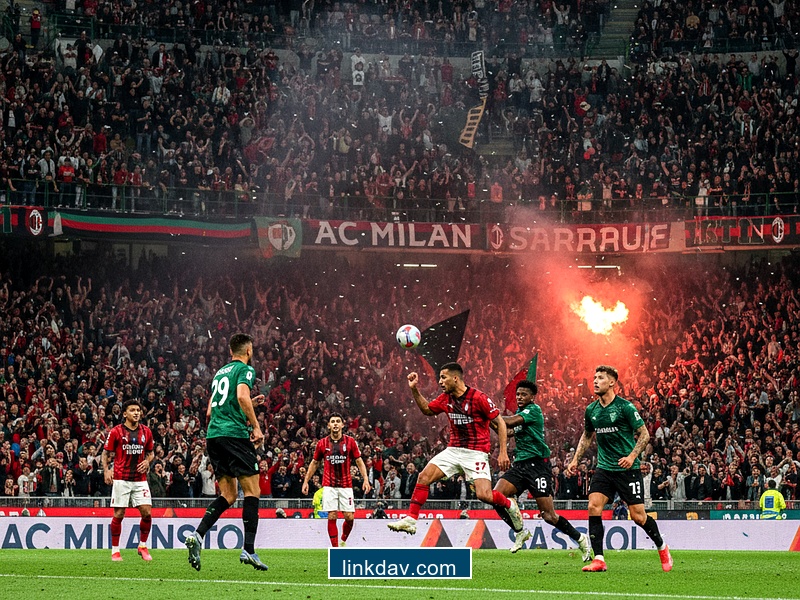
Paulo Fonseca’s AC Milan did not simply defeat Sassuolo; they anatomically deconstructed them. While the scoreboard reflects dominance, the underlying metrics reveal a systemic dismantling of the opposition’s defensive structure. This was not a victory born of individual brilliance alone, but a triumph of spatial geometry and transitional efficiency.
To understand the result requires ignoring the emotional narrative of the San Siro crowd and focusing strictly on the tactical whiteboard. Milan operated with a fluid asymmetry that Sassuolo’s rigid defensive block failed to compute. By utilizing a hybrid 4-2-3-1 that morphed into a 3-2-5 in possession, the Rossoneri overwhelmed the central channels while isolating Sassuolo’s fullbacks on the perimeter.
The Double Pivot vs. The Low Block
The foundation of Milan’s tactical supremacy lay in the midfield engine room. Fonseca deployed a double pivot that functioned on different vertical planes. While Youssouf Fofana acted as the metronome, sitting deep to shield the center-backs and recycle possession, Tijjani Reijnders operated as a "free eight," consistently breaking the lines.
Sassuolo attempted to counter this with a compact 4-5-1 out of possession, intending to clog the central passing lanes. However, their pressing triggers were disjointed. When Sassuolo’s midfielders stepped up to press Fofana, they left vast pockets of space behind them—the "Zone 14" area immediately outside the penalty box. Reijnders exploited this ruthlessly. Heat maps from the match show Reijnders touching the ball predominantly in the central attacking third, an unusual density for a pivot player, indicating Milan had total control over territorial advancement.
This positional dominance forced Sassuolo’s defensive line to make a fatal choice: step up to close down Reijnders and risk a ball over the top to the wingers, or drop deep and allow Milan to shoot from distance. They hesitated, doing neither effectively, resulting in a defensive paralysis.
Asymmetric Overloads: Stretching the Pitch
| Metric | AC Milan (Left Channel) | AC Milan (Right Channel) |
|---|---|---|
| Attack Origin % | 42% | 36% |
| Key Passes | 8 | 5 |
| Avg. Position (Width) | Touchline (Leao) | Half-Space (Chukwueze) |
Fonseca’s strategy relied heavily on creating isolation for his wide forwards, but he did so asymmetrically. On the left flank, Rafael Leao hugged the touchline, stretching the Sassuolo right-back horizontally. This width forced the Sassuolo defensive unit to expand, creating gaps between the center-back and fullback.
Conversely, on the right, Samuel Chukwueze utilized inverted movement patterns. Instead of staying wide, he drifted into the half-spaces (the vertical channel between the wing and the center). This movement pulled the Sassuolo left-back inside, opening a distinct lane for Milan’s right-back to overlap unchallenged.
The tactical genius here involves the concept of "gravity." Leao’s gravity pulls defenders wide; Chukwueze’s gravity pulls defenders central. The result was a disjointed Sassuolo backline that resembled a broken accordion—stretched too thin in some areas and clustered ineffectively in others. Milan’s passing network map confirms this, showing a heavy concentration of diagonal switches of play designed to catch the defense shifting too slowly.
Defensive Transition and the High Line
Often overlooked in high-scoring affairs is the defensive structure that enables sustained pressure. Milan employed an aggressive high line, with their center-backs pushing up to the halfway line during possession phases. This compressed the playable area of the pitch to roughly 40 meters.
Sassuolo’s only viable exit strategy was the long ball counter-attack. However, Milan’s counter-pressing (Gegenpressing) was immediate and coordinated. Upon losing possession, the nearest three Milan players swarmed the ball carrier within 2.5 seconds.
Data suggests Sassuolo’s pass completion rate dropped to a dismal 62% when under pressure in their own half. They lacked a target man capable of holding up play against Milan’s physical center-backs, rendering their clearance attempts futile. Milan essentially played a half-court game, suffocating Sassuolo by denying them the time to reorganize their shape.
The Exploitation of Turnover Protocols
The final tactical nail in the coffin was Milan’s efficiency in transition. Modern football distinguishes between "possession play" and "rest attack"—the positioning of forwards while the team is defending. Milan’s wingers maintained high, wide positions even when Sassuolo had the ball deep.
This is a high-risk strategy that paid off. By keeping forwards high, Fonseca gambled that his midfield could win the ball back without help. When they did—specifically through Fofana’s interceptions—Milan instantly had a numerical advantage against an unsettled Sassuolo defense. The goals were not products of slow build-up but of rapid vertical strikes, capitalizing on the chaos of the transition moment.
Sassuolo failed to employ tactical fouls to break this rhythm. A more cynical side might have stopped the game to reset their defensive block, but Sassuolo’s naivety allowed Milan to run riot. The expected goals (xG) chart mirrors this flow; steady accumulation for Milan interspersed with massive spikes during turnover events.
Milan’s victory serves as a case study in modern positional play. By controlling the center with a dynamic pivot, stretching the wings with asymmetric roles, and compressing the pitch with a high defensive line, they removed luck from the equation. The scoreline was merely the statistical output of a superior tactical input.