
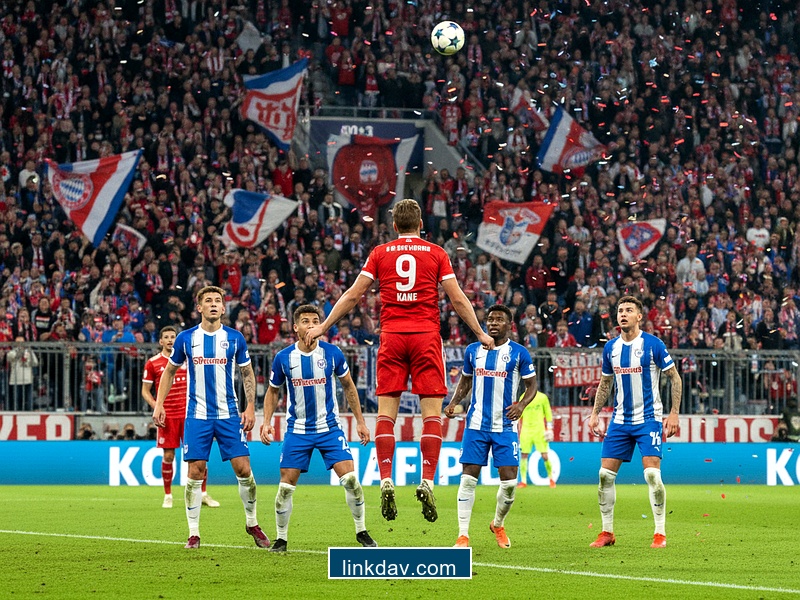
The scoreboard suggests heroism; the heat maps suggest a systemic failure narrowly averted. While the headline focuses on Harry Kane rescuing Bayern Munich from a shock defeat against bottom-side Mainz, the underlying metrics reveal a tactical stalemate that nearly exposed the fragilities in Bayern’s high-risk possession structure. This was not a case of a giant sleeping; it was a case of a giant being mathematically solved by a rigid, low-block geometric structure.
For the vast majority of the match, Mainz did not play football; they played grid defense. Operating in an ultra-compact 5-4-1 formation, they surrendered the wide areas to Bayern’s full-backs, gambling that density in the central zones would nullify the Bavarian attack. They were correct. Until the final moments, Bayern’s passing network resembled a sterile "U-shape"—circulating harmlessly around the perimeter of the Mainz penalty area without penetration.
Mainz’s Defensive Geometry: The 5-4-1 Low Block
To understand why Bayern struggled, one must dissect the Mainz defensive shape. The hosts utilized a defensive line height averaging just 22 meters from their own goal line. By deploying three center-backs, Mainz ensured that even when Harry Kane occupied one marker, a spare defender (the libero element) always remained free to cover runs from midfield runners like Jamal Musiala.
The midfield four operated on a "shuttle" basis. As the ball moved to Bayern's left flank, the entire Mainz unit shifted laterally, maintaining distances of no more than 8 meters between players. This horizontal compactness choked the "half-spaces"—the areas between the wing and the center where Bayern typically thrives.
"Possession without penetration is merely aesthetic. Mainz reduced Bayern's Expected Goals (xG) in the first half to a staggering 0.32, despite the visitors holding 74% of the ball."
This setup forced Bayern into crossing from deep positions. Statistically, crosses from outside the penalty area have a conversion rate of less than 3%. Mainz happily allowed Bayern to launch aerial balls, knowing their three center-backs possessed the physical advantage in the box.
Bayern's Structural Flaw: The Inverted Paradox
Bayern’s struggle stemmed from a redundancy in their build-up play. With Joshua Kimmich often drifting centrally to dictate tempo, the team lacked genuine width. The wingers inverted early, crashing into the congested center of the pitch, effectively running straight into the teeth of the Mainz blockade.
| Metric (First 70 Mins) | Bayern Munich | Mainz 05 |
|---|---|---|
| Possession | 74% | 26% |
| Passes into Final Third | 68 | 12 |
| Big Chances Created | 1 | 2 |
| Defensive Line Height | 52m | 22m |
The data above illustrates the "empty calories" of Bayern's dominance. They controlled the territory but failed to control the game state. The critical flaw was the lack of vertical runs behind the Mainz defense. Because Mainz sat so deep, there was no space behind to exploit with speed. Bayern needed precision in tight spaces, but their spacing was stagnant. Players occupied the same vertical lines, making it easy for Mainz defenders to mark two men with one zone.
Furthermore, Bayern’s "Rest Defense" (the structure of players left behind the ball while attacking) was perilous. By pushing both full-backs high to compensate for the lack of width, the two center-backs were left isolated 2v2 against Mainz counter-attacks. This is likely how Mainz generated their threat—bypassing the midfield entirely with direct transitions into the space vacated by Bayern's full-backs.
The Kane Solution: Dropping to Create Chaos
The match turned not on a substitution, but on a micro-tactical adjustment by Harry Kane. Recognizing that staying on the shoulder of the last defender was futile against three center-backs, Kane began dropping significantly deeper, effectively becoming a second Number 10.
This movement created a "decision crisis" for the central center-back of Mainz.
Scenario A: The defender follows Kane deep. This breaks the defensive line, creating a gap for a Bayern winger to sprint diagonally into the box.
Scenario B: The defender stays put. This allows Kane to receive the ball untracked in the "Zone 14" (the space just outside the penalty area), allowing him to turn and shoot or thread a pass.
In the buildup to the decisive moment, Kane chose Scenario B. By occupying the space between Mainz's midfield line and defensive line, he overloaded the central zone. Bayern suddenly had a 3v2 advantage in the center of the park. The Mainz midfielders, exhausted from 75 minutes of shuttling, failed to close the distance.
Deciphering the Critical Sequence
The goal that "rescued" Bayern was a triumph of spatial manipulation over rigid structure. As Kane dropped, he pulled the defensive structure slightly out of alignment. For the first time all game, the horizontal distance between the Mainz right wing-back and the right center-back expanded to roughly 12 meters—too wide for a low block.
Bayern exploited this instantly. The ball was not crossed from the sideline, but played via a cut-back angle. The physics of a cut-back are distinct from a high cross; the defenders are facing their own goal while running backward, making it mechanically difficult to clear the ball effectively. Kane’s positioning allowed him to attack the ball facing forward while the defenders were scrambling backward.
This sequence highlights the evolution of the modern striker. A decade ago, a target man would have camped in the six-yard box awaiting service. Kane’s heatmap for the final 15 minutes shows significant activity in the center circle and the attacking midfield band. He acted as the playmaker to initiate the disruption, then arrived as the finisher to capitalize on it.
Ultimately, Bayern escaped because individual brilliance (Kane's movement IQ) superseded a collective tactical deadlock. Mainz executed a near-perfect defensive game plan, limiting Bayern to low-probability areas and exploiting transition vectors. However, elite teams possess "outliers"—players who can generate high xG opportunities from low-value situations. Kane provided that outlier efficiency. While the league table will show a point saved, the video analysis room at Säbener Straße will view this 90 minutes as a warning: the blueprint to stall this Bayern machine is out in the open, and it nearly worked.