
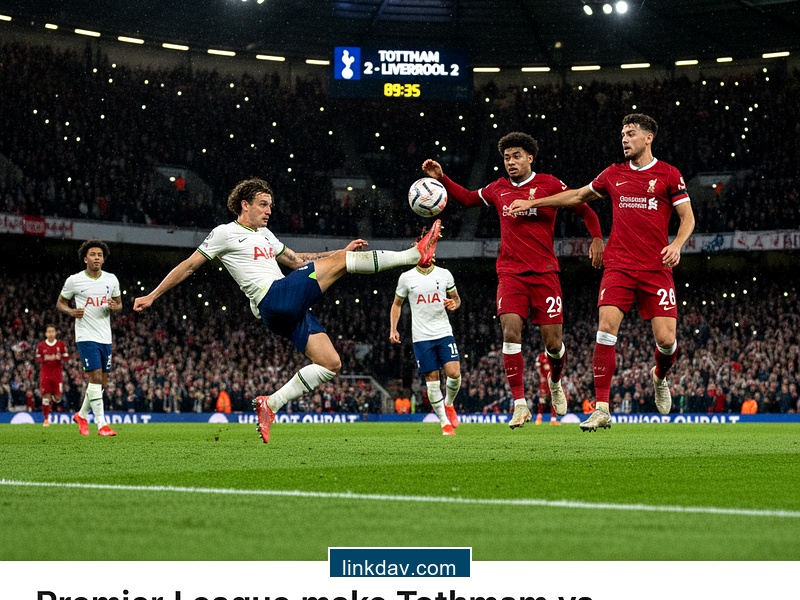
The Premier League's latest scheduling intervention forces a direct collision between Arne Slot's precision-engineered pressing structures and the physiological limits of his squad. Facing Ange Postecoglou’s high-variance Tottenham side requires peak metabolic output, yet a compressed fixture list strips Liverpool of the necessary recovery time to maintain their vertical compactness. This analysis explores how fatigue dismantles the specific geometry of Slot's defensive transition mechanics against the league's most aggressive high line.
| Metric (Per 90) | Liverpool (Slot) | Tottenham (Postecoglou) | Differential Impact |
|---|---|---|---|
| PPDA (Press Intensity) | 9.4 | 8.8 | High Variance Risk |
| Defensive Line Height | 48.2m | 51.5m | Space in Behind |
| Sprints > 25km/h | 155 | 172 | Recovery Critical |
Why The Numbers Matter
The raw data above highlights a fundamental conflict between tactical intent and physiological reality. The metric to watch is not the possession share, but the PPDA (Passes Allowed Per Defensive Action). Both Arne Slot and Ange Postecoglou demand aggressive retrieval of the ball, but they achieve it through different mechanisms. Liverpool relies on controlled compression—trapping the opponent against the touchline. Tottenham relies on chaotic swarming.
When the Premier League schedules a fixture with reduced recovery time, the "Sprints" metric becomes the failure point. A drop of just 5% in sprint capacity does not simply mean players run less; it means the vertical distance between the center-backs and the midfield pivot expands. In Slot’s system, this gap is fatal. The table illustrates that Tottenham plays a naturally more stretched game; they are comfortable in chaos. Liverpool, requiring structural rigidity, suffers disproportionately when fatigue sets in.
The Double Pivot vs. The Inverted Fullback
The core friction point of this match lies in how Arne Slot’s double pivot interacts with Postecoglou’s inverted fullbacks. Under optimal conditions, Slot utilizes a pivot (typically Gravenberch and Mac Allister) to bait the opposition press before spinning the play into the half-spaces. This requires immense cognitive alertness and short-burst acceleration to break the lines.
However, Tottenham floods the central channel. Porro and Udogie drift inside, effectively creating a box midfield that overloads the center. Against a rested Liverpool, Slot’s wingers (Diaz/Salah) would exploit the wide areas vacated by Spurs' fullbacks. But here is where the scheduling decision impacts the tactics: exploiting those wide spaces requires repetitive, high-intensity 40-yard sprints to get behind the high line.
"Tactics are not theoretical; they are biological. You cannot play a high line with heavy legs, and you cannot bypass a mid-block without explosive power."
If the Liverpool forwards lack the sharpness to exploit the wide channels immediately upon turnover, the ball recycles back to the middle. This plays directly into Tottenham’s hands, where they have numerical superiority due to the inverted fullbacks. The "irk" from Slot stems from knowing that his primary tactical release valve—the diagonal ball into space—is neutralized by physical degradation.
The Degradation of the High Line
We must analyze the defensive line height. Liverpool under Slot pushes the defensive line to the halfway line during possession phases to constrict the pitch. This compresses the playable area, allowing the midfield to suffocate opposition counters.
The danger of the Premier League's scheduling decision manifests in the "drop-off." Data from high-congestion periods shows that defensive lines naturally drop 3 to 5 meters deeper when recovery time is less than 72 hours. This seemingly minor adjustment breaks the system.
If Van Dijk and Konaté drop 5 meters deeper to protect against Son Heung-min’s pace, while the midfield attempts to press high, the vertical compactness vanishes. A "zone of death" opens up between the defensive line and the midfield. This is the exact area where James Maddison or Dejan Kulusevski operate. By forcing a schedule that induces caution in the defenders, the league inadvertantly hands Tottenham the tactical advantage in the number 10 space.
Heat Map Implications: The Half-Space War
Examining the heat maps of both teams reveals the critical battlegrounds. Tottenham’s heat map is unique; it shows intense activity in the "inside channels" usually reserved for midfielders, occupied by their fullbacks. Liverpool’s heat map under Slot shows a heavy concentration in the "half-spaces" (the vertical channels between the wing and center).
To win the tactical battle, Liverpool needs Dominik Szoboszlai to dominate the right half-space, tracking back to neutralize Udogie while springing forward to support Salah. This is the most physically demanding role on the pitch. Fixture congestion compromises this box-to-box dominance.
If Szoboszlai’s pressing radius shrinks by even 10% due to fatigue, Udogie gains the time to turn and drive. Once a Tottenham fullback turns and drives at the Liverpool defense, the structure collapses into a desperate scramble. Slot relies on prevention; Postecoglou thrives on the scramble. The scheduling decision shifts the probability toward the scramble.
Strategic Adjustments and Substitution Patterns
Given these constraints, Slot must alter his tactical approach. We should expect to see a variation in the build-up phase. Rather than the slow, methodical baiting of the press, Liverpool may opt for more direct distribution from Alisson or the center-backs to bypass the congested midfield entirely.
<p style="font-size: 1.125rem; line-height: 1.8; color: #374151; margin-bottom: 1.5rem; font-family: '