
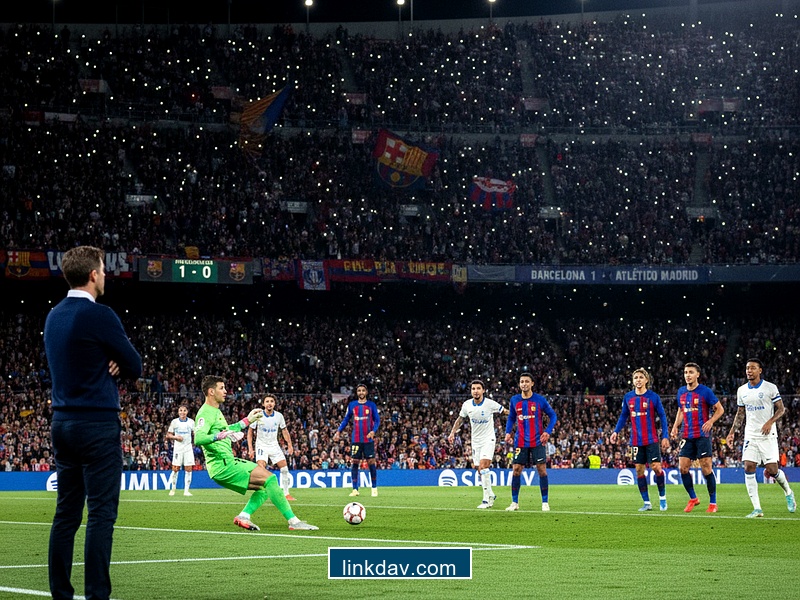
Modern football often confuses possession with control. For years, Barcelona fell into this semantic trap, believing that holding the ball in harmless zones constituted dominance. Under Hansi Flick, the paradigm has shifted. The metrics suggest a radical transformation not in how Barcelona attacks, but in how they manipulate space when they do not have the ball. The narrative focuses on the revitalization of Robert Lewandowski or the brilliance of Lamine Yamal, but the engine of this resurgence is a defensive structure that operates on the razor’s edge of high-risk geometry.
Flick has installed a system that defies conventional safety logic. Where Xavi Hernández sought security through passing volume, Flick seeks security through spatial compression. The defensive line does not retreat; it stalks. By analyzing the average player positions and defensive action maps, we observe a team that has effectively deleted the middle third of the pitch, forcing opponents to play exclusively in the final thirds or not at all. This is not merely a change in formation; it is a fundamental reprogramming of the defensive trigger mechanisms.
The Mechanics of the Suicide Line
The most visually arresting aspect of this tactical evolution is the defensive line's height. Statistical tracking places Barcelona’s average defensive line nearly 50 meters from their own goal line during possession phases. This leaves a vast expanse of green grass behind the centre-backs, a zone usually considered fatal against pacey wingers. However, pure distance analysis fails to capture the synchronization involved.
Flick utilizes a "bungee" concept. The back four—typically Koundé, Cubarsí, Martínez, and Balde—are tethered to the midfield line. When the midfield presses, the defense steps up in unison. This compresses the effective playing area to a strip often narrower than 25 meters. The opponent faces a dilemma: play short into a congested midfield meat-grinder or attempt a long ball over the top.
"The trap is not passive. It is an aggressive action designed to force the pass before the runner is ready."
This strategy relies heavily on the "offside trap" not as a lucky break, but as a primary defensive statistic. Barcelona leads Europe’s top five leagues in offsides provoked by a significant margin. This suggests the backline is drilling specific visual cues: watching the ball carrier’s head drop to make the pass, which serves as the trigger to step forward rather than drop back.
The Double Pivot: Filtering the Pass
A high line collapses instantly if the opposing passer has time to look up and measure a clip over the top. The structural integrity of Flick’s system depends entirely on the pressure applied by the double pivot and the attacking midfielder (often Pedri or Raphinha dropping deep). The emergence of Marc Casadó has provided the tactical discipline required to execute this filter.
Heat maps from recent fixtures show Casadó and his partner (Pedri or De Jong) operating in narrower channels than previous Barcelona midfields. They prioritize blocking central vertical passing lanes. By forcing the opponent to circulate the ball wide, they buy precious seconds for the defensive line to adjust its height. If the ball goes wide, the line drops slightly; if the ball is central and pressured, the line holds or steps up.
| Metric | Barcelona (23/24) | Barcelona (Flick Era) | Tactical Implication |
|---|---|---|---|
| Offsides Provoked (Avg) | 2.4 | 6.8 | Aggressive line manipulation |
| PPDA (Pressing Intensity) | 9.8 | 7.5 | Higher intensity, less time for opponents |
| Avg Line Depth (Meters) | 38m | 48m | Vertical compression of space |
The data highlights a clear correlation: as pressing intensity increases (lower PPDA), the offside numbers skyrocket. This confirms that the front-line pressure and back-line positioning are inextricably linked. The defense works because the midfield ensures the opposition is playing under duress, resulting in rushed, inaccurate long balls that are easily swept up by the goalkeeper or flagged by the assistant referee.
Cubarsí and Martínez: The Brains Behind the Line
Personnel selection dictates tactical feasibility. The partnership of Pau Cubarsí and Iñigo Martínez offers a specific blend of attributes necessary for this high-wire act. Cubarsí, despite his youth, possesses elite anticipation metrics. His ability to read the body shape of the passer allows him to initiate the "step up" trap fractions of a second before the ball is struck.
Conversely, Martínez provides the vocal organization required to keep the line straight. In a zonal system operating this high, a single defender dropping deep "just to be safe" breaks the entire mechanism, playing every attacker onside. Flick has instilled a discipline where dropping back without a specific cue is viewed as a tactical error, regardless of whether a goal is conceded.
Furthermore, their distribution allows Barcelona to escape the counter-press. When the ball is recovered deep, the transition is vertical and immediate. Heat maps indicate Cubarsí rarely plays lateral passes to his full-back; he looks for the line-breaking vertical pass into the half-spaces occupied by Pedri or Yamal. This immediate verticality prevents the opposition from resetting their defensive block, keeping the game in a state of controlled chaos that favors Barcelona’s athletic profile.
The Asymmetry of Transition Defense
Flick addresses the vulnerability of the channels through asymmetry. Alejandro Balde operates almost as a left-winger in possession, stretching the field and pinning the opposition right-back deep. This leaves the left defensive channel seemingly exposed. However, Jules Koundé on the right side rarely overlaps with the same ferocity.
Tactically, Koundé tucks inside to form a temporary back three with the centre-backs during offensive phases. This "Rest Defense" (Restverteidigung) structure ensures that Barcelona creates a 3-2 shape at the back (three defenders, two pivots) to guard against counter-attacks. By keeping Koundé deeper and narrower, Flick mitigates the risk of a 2v2 situation against the centre-backs. It forces opponents to counter down Barcelona’s left, where Balde’s recovery pace is the fail-safe.
This is a calculated trade-off. Flick invites pressure into specific zones where he knows he has superior recovery speed or numerical advantages. It is not flawless defending in the traditional sense of clean sheets through low blocks; it is defending through territorial arrogance. The system asserts that Barcelona can recover faster than the opponent can exploit the space.
Ultimately, Hansi Flick has not just "fixed" the defense; he has weaponized it. By condensing the pitch, maximizing the offside trap, and utilizing a highly disciplined rest defense structure, Barcelona controls games without needing 70% possession. The high line is a high-stakes gamble, but the data suggests the house is winning.