
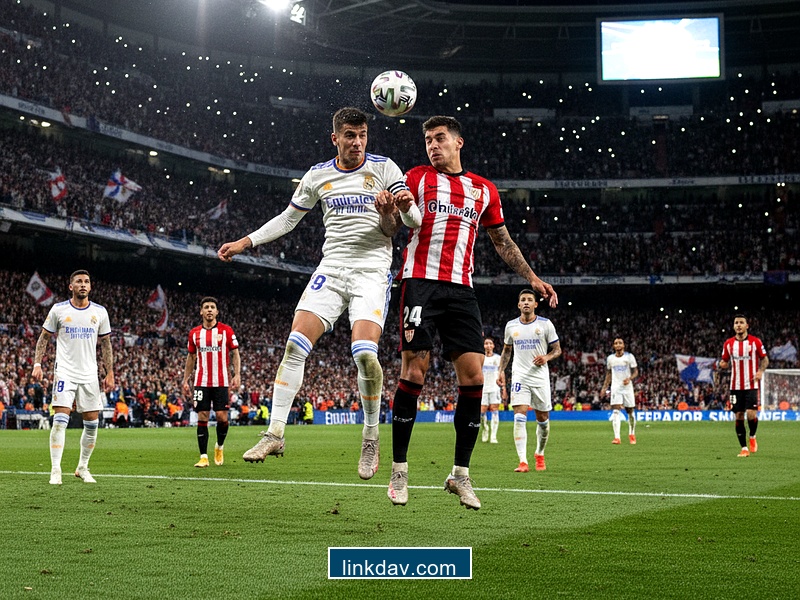
The Santiago Bernabéu has a peculiar way of breathing. When the football is fluid, it hums; when the play is stagnant, it growls. For seventy-five minutes against a stubborn, trench-entrenched Sevilla side, the great concrete bowl growled. The Galácticos of the new era—Vinicius Jr., frantically sprinting into cul-de-sacs, and Jude Bellingham, crowded out by a swarm of red shirts—looked mortal. The narrative was writing itself: a frustrating draw, points dropped, questions raised about the balance of a team overloaded with athleticism but starved of guile.
Then, the fourth official raised the board. The number 10 flashed in neon green. Luka Modric stood on the touchline, adjusting his socks, his face a mask of weary determination. The growl of the stadium softened into a ripple of hopeful applause. This was not just a substitution; it was a summoning of the old magic. In a sport obsessed with youth, speed, and verticality, what followed was a majestic, slow-burning reminder that the mind remains the sharpest muscle of all.
The Weight of the White Shirt
To understand the significance of Modric’s intervention against Sevilla, one must strip away the accolades and look at the man’s current reality. At his age, most midfielders are playing in retirement leagues or waving from the punditry gantry. Modric stays. He stays knowing that his minutes are rationed. He stays knowing that every bad pass will be scrutinized not just as a mistake, but as a symptom of decline. The cruelty of elite sport is that it does not allow heroes to fade gracefully; it demands they be pushed out.
Throughout the first half, Madrid lacked a conductor. They had runners. They had dribblers. But they lacked the pause—the pausa—that forces a defense to blink. Sevilla, organized by Quique Sánchez Flores, sat deep, absorbing the kinetic energy of Madrid’s youngsters and repelling it with ease. The game needed surgery, not a sledgehammer.
"There are players who play with their feet, and players who play with their eyes. Luka sees the game two seconds before the rest of the world."
When Modric entered the fray, the geometry of the pitch altered. He didn't sprint. He drifted. He occupied the pockets of space between Sevilla’s defensive lines that had previously seemed non-existent. His first touch, a velvet cushion to kill a high ball, drew an audible gasp. This is the tragedy of his genius: we are watching the final chapters, and every touch feels like a precious heirloom we are terrified to lose.
A Boy From Zadar Against the World
The path to this night in Madrid began in the war-torn streets of Zadar, Croatia. It is a story told often, but relevant always. The sheer fragility of Modric’s frame has always been his greatest deception. Early coaches dismissed him as too slight, too weak for the physical demands of modern football. They looked at his legs and missed his heart. They looked at his size and missed his brain.
Tonight, facing a Sevilla midfield anchored by physical powerhouses, that same narrative played out in microcosm. Sevilla’s Soumaré tried to bully him; Modric simply wasn't there to be hit. He spun away, using his low center of gravity to pirouette out of trouble. It was a vindication of a career spent proving that intellect conquers brute force.
| Statistic (vs Sevilla) | Luka Modric | Madrid Avg (First 75 Mins) |
|---|---|---|
| Pass Accuracy | 96% | 84% |
| Chances Created | 3 | 1.2 |
| Ball Recoveries | 4 | 2 |
The data tells part of the story, but it misses the emotion. It misses the way he pointed, shouted, and reorganized a disheveled Madrid attack. He took the armband not just as a formality, but as a burden he was willing to carry.
The Moment of Redemption
The clock ticked past 80 minutes. The growl of the Bernabéu began to sharpen into whistles of discontent. The ball fell loose just outside the D, bouncing awkwardly. A younger player might have lashed at it, sending it into the stands. A panicked player might have recycled possession safely to the wings.
Modric did neither. He waited. He let the ball drop, shaping his body in that familiar, leaning arc. His right boot connected with the leather—not with violence, but with supreme technical precision. The ball curled, bending around the outstretched leg of Sergio Ramos—his old brother-in-arms, now the enemy captain—and kissed the inside of the post before nestling into the net.
The celebration was not one of wild ecstasy, but of intense relief and defiance. He ran to the corner, arms spread wide, soaking in the adulation. For a moment, he wasn't the veteran fighting for a contract extension; he was the Ballon d'Or winner, the king of Madrid, the undisputed master of his craft.
This goal was a redemption arc compressed into a single strike. In recent weeks, whispers had grown louder that the game had passed him by. Pundits argued that the dynamism of Valverde and Camavinga rendered Modric obsolete. But against a low block, dynamism hits a wall. Wisdom finds the door. Modric found the door, unlocked it, and walked right through.
A Twilight Masterpiece
The final whistle blew, sealing a crucial victory for Real Madrid. The cameras did not flock to Vinicius or Bellingham. They found the small figure with the headband, now embracing Sergio Ramos in a poignant reunion of legends. It was a scene straight out of a tragedy: two titans of the game, one celebrated in white, the other defeated in red, both raging against the dying of the light.
This match serves as a stark reminder to the Real Madrid hierarchy. While the future is bright and fast, the present still requires the nuance that only experience can provide. You cannot buy what Luka Modric possesses in the transfer market. You cannot train it in the gym. It is forged over two decades of high-stakes competition.
We do not know how many more of these nights remain. Every masterclass feels like a farewell. But tonight, the Bernabéu slept soundly, safe in the knowledge that their old guard stands watch. Luka Modric may be nearing the end, but on nights like this, he looks infinite.