
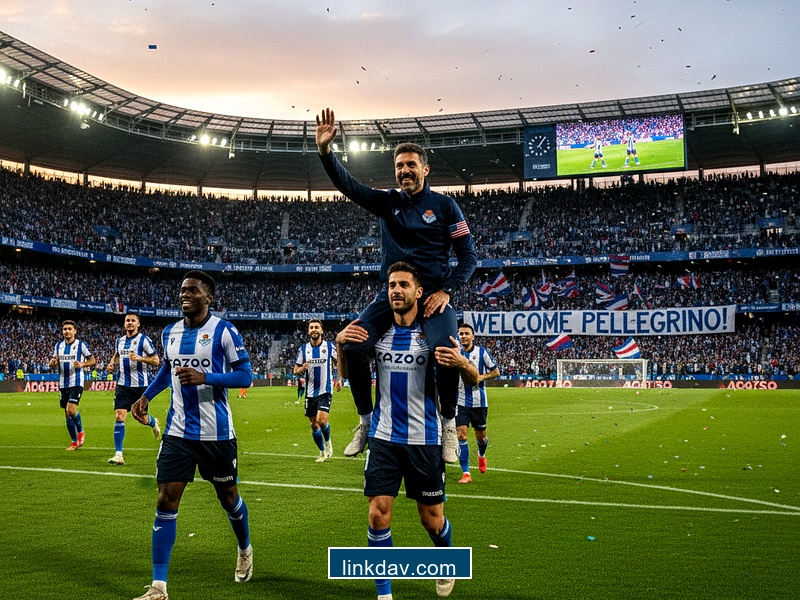
Can you feel the ground shaking? That isn’t the Metro Donostialdea rumbling beneath the city. That is the collective gasp of forty thousand souls in San Sebastián. The news dropped like a thunderclap over La Concha bay. The whispers are dead. The rumors have turned into ink on paper. Real Sociedad has a new commander, and he isn’t from the valleys of Gipuzkoa. He isn't from the plains of Castile. He comes from the other side of the Atlantic, by way of the German tactical furnaces.
Pellegrino Matarazzo. The name bounces off the concrete walls of the Reale Arena today. It feels foreign on the tongue here, where surnames usually carry the weight of centuries of Basque heritage. But look at the faces in the crowd outside the club offices. Look at the eyes. There is shock, yes. But beneath the shock, a fire is lighting up. This is bold. This is dangerous. This is exactly the kind of madness that makes us fall in love with football every single morning.
We are standing here in the drizzle—because it always rains in Donostia—watching a new chapter rip itself open. The club has looked at the safe option and thrown it into the Cantabrian Sea. They have gone for the scientist. The mathematician from New Jersey. The man who tamed the chaos of the Bundesliga. It sends a shiver down your spine. Is it fear? Is it excitement? Right now, in the shadow of the stadium, it feels like pure adrenaline.
The Scientist in the Cathedral
Let’s cut through the noise. Why him? Why bring a Columbia University graduate to the passionate heart of Basque football? Because the game is changing. It moves faster now. It demands a brain that processes geometry at a hundred miles an hour. Matarazzo isn't just a shouter on the touchline. He is an architect of space.
"This isn't just a hiring; it's a statement. La Real isn't looking back at tradition. They are staring down the barrel of the future."
Think about the squad. Think about the technical wizards like Takefusa Kubo or the midfield engine of Zubimendi. They crave structure to unleash their chaos. Matarazzo brings that verticality. In Germany, his teams didn't just pass the ball; they assaulted the goal. They played with a high line that made supporters cover their eyes in terror and scream in delight simultaneously.
That is what Reale Arena craves. We don't want sleepy possession. We want the heavy metal. We want the noise. The fans in the Aitor Zabaleta stand don't sing to be polite. They sing to intimidate. They sing to drive the team forward. Matarazzo’s style—aggressive, pressing, relentless—might just be the perfect match for the lungs of this stadium. It’s a collision of cultures, but sometimes, the hardest crashes make the most beautiful sparks.
From New Jersey to the Basque Country
The narrative is irresistible. An American passport in La Liga. It sounds like fiction. But strip away the flag. Look at the path. This man didn’t take the easy road. He didn’t get handed a job because of a famous playing career at Real Madrid or Barcelona. He ground it out in the reserves. He studied in the coaching school that produced Nagelsmann. He earned his stripes in the unforgiving trenches of Hoffenheim and Stuttgart.
| Attribute | Typical La Liga Style | The Matarazzo Way |
|---|---|---|
| Possession | Patient, horizontal circulation | Vertical, risk-taking, fast |
| Defense | Structured mid-block | Suffocating high press |
| Mentality | Control the game | Create chaos in the opponent |
The skeptics are already sharpening their knives. "He doesn't know the league," they say. "He doesn't know what it means to wear the Txuri-Urdin." Rubbish. Football is a universal language, and hunger translates perfectly. Matarazzo has walked into rooms where nobody knew his name and forced them to respect him. He has faced relegation battles and European pushes.
But let’s be real. The pressure here is different. San Sebastián is a goldfish bowl. Everyone is an expert. The old men in the pintxo bars in the Old Town will dissect his substitutions over a glass of txakoli before the final whistle even blows. He needs to win them over fast. Not with words. Not with interviews. With blood, sweat, and three points.
The Verdict from the Stands
I walked around the stadium perimeter just an hour ago. The chatter is incessant. There is a sense of mourning for the stability of the past, but it is quickly being replaced by the intoxicating drug of the unknown. Fans are looking up his stats on their phones. They are watching clips of his Stuttgart teams tearing apart defenses. You can see the eyebrows raising. You can see the nods of approval.
"If he attacks, we will love him," one supporter told me, adjusting his blue and white scarf against the wind. That is the bottom line. This city appreciates art, but it worships bravery. If Matarazzo sends the team out to hide, he will be eaten alive. If he sends them out to fight, to run until their lungs burn, to chase every lost cause? He will be a king.
The appointment is a gamble. Of course it is. Every managerial change is a spin of the roulette wheel. But this feels like a calculated gamble. It feels like Real Sociedad is tired of being the nice team that plays pretty football. They want an edge. They want the modern, athletic, scientific edge that Matarazzo represents.
So, welcome to Donostia, Pellegrino. The rain is cold, the food is the best in the world, and the expectations are heavy enough to crush a tank. The stadium is waiting. The lights are humming. The silence is over. Now, the rollercoaster begins. Strap in, everyone. It’s going to be a wild ride.