
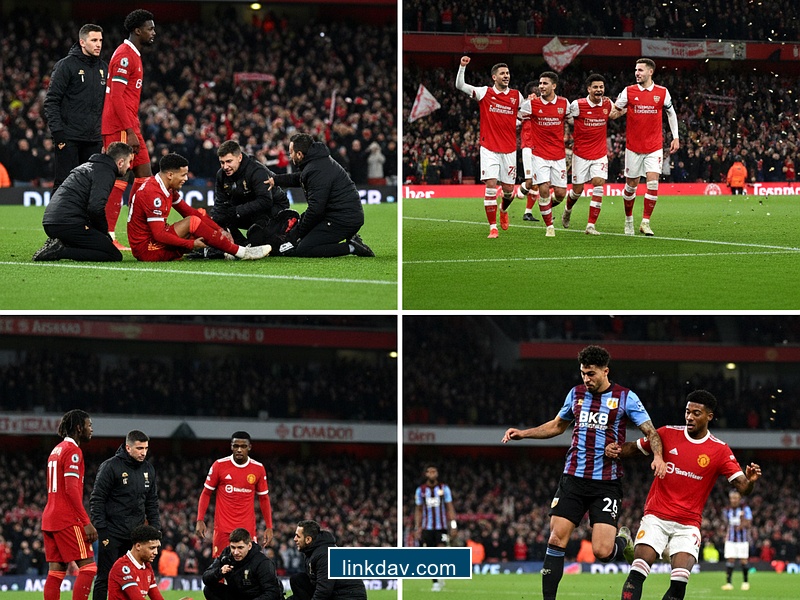
Modern Premier League supremacy is defined less by moments of individual brilliance and more by the rigorous application of spatial control. While Arsenal maintains their summit position through a suffocating rest-defense structure, the chaotic transition data from Villa Park exposes fundamental flaws in Manchester United's engine room. We analyze the underlying metrics to explain why structure is currently trumping spontaneity.
| Metric | Arsenal (Controlled) | Man Utd (Chaos) | Aston Villa (Vertical) |
|---|---|---|---|
| Field Tilt % | 72.4% | 44.1% | 51.3% |
| PPDA (Press Intensity) | 8.9 | 14.2 | 11.5 |
| xG Against (Transition) | 0.12 | 1.05 | 0.88 |
| Avg Defensive Line Height | 54m | 38m | 49m |
Why The Numbers Matter
The data above highlights the schism at the top of the table. Field Tilt—measuring the share of possession in the final third—shows Arsenal dominating territory, pinning opponents back to limit counter-attacking variance. In contrast, the United and Villa statistics display a willingness to surrender control for verticality, resulting in higher Expected Goals (xG) conceded during transitions. This distinction forms the basis of our tactical inquiry.
Arsenal’s 3-2 Rest Defense: Suffocating the Out-Ball
Arsenal staying top is a direct consequence of their off-the-ball structure while in possession. Mikel Arteta utilizes a strict 2-3 or 3-2 rest defense structure. When the wingers isolate the opposing full-backs, the inverted full-back (often operating centrally alongside the pivot) creates a numerical overload in the center circle.
This positioning is defensive, not offensive. By occupying the central zones 8, 11, and 14, Arsenal effectively blocks the opposition's "out-ball." Opponents cannot play vertically through the middle because the passing lanes are congested by three Arsenal bodies. They are forced wide, where the touchline acts as an extra defender for the pressing unit.
"Control is not just about keeping the ball; it is about dictating where the opponent recovers it. Arsenal forces recoveries in zones where the counter-attack is mathematically improbable."
The heat maps from their recent performances show a "U" shape in the opposition half. This implies patience. They recycle possession until the opposition defensive block shifts laterally one too many times, creating a half-space opening. It is a war of attrition won by geometric discipline.
The Isak Variable: Impact on Liverpool's High Line
The news regarding Alexander Isak’s potential injury significantly alters the tactical calculus for Liverpool. Isak represents a specific profile of striker: the channel runner. His movement maps typically show drifting runs between the center-back and full-back (the channel), stretching defenses horizontally and vertically.
Liverpool’s primary defensive vulnerability this season stems from their aggressive high line. When facing a striker with elite pace and channel-running tendencies, their center-backs are forced to drop five to ten meters deeper to mitigate the ball in behind. This creates a larger gap between Liverpool's defense and midfield, a zone opponents can exploit.
Villa vs. United: The Empty Midfield Phenomenon
The tactical battle between Aston Villa and Manchester United provides a textbook example of "artificial transitions." Unai Emery’s Villa invites pressure. They hold the ball in their own penalty area, baiting the United press forward. Once United commits bodies, Villa executes rapid vertical combinations to break the first line of pressure.
This exposes the fatal flaw in Erik ten Hag’s current setup: the midfield disconnect. United’s forwards press high, but their defensive line often remains deep due to a lack of recovery pace. This creates a massive void in the central midfield—often spanning 40 meters. In tactical analysis, we refer to this as the "donut" shape.
Villa’s double pivot exploits this space ruthlessly. By positioning players like Youri Tielemans or Morgan Rogers in these pockets behind United’s pressing line, they can turn and drive at an unprotected back four. The statistics reflect this: United conceded a high volume of shots from Zone 14 (the area directly outside the penalty box) because their defensive midfielders are overworked, covering lateral distances that are physically unsustainable.
Structural Rigidity vs. Individual Reliance
Comparing these three situations reveals the current meta of the Premier League. Arsenal relies on a system that functions regardless of the opponent; their shape minimizes variance. Liverpool adjusts the aggression of their line based on the threat of the opposing number 9. United, conversely, relies on individual transitions, resulting in matches that resemble basketball games rather than controlled football.
For Villa, the high line is a high-risk, high-reward offside trap strategy. When it works, they compress the space United wants to attack. When it fails, as seen in moments where runners time their movements perfectly, it leads to 1v1 situations with the goalkeeper. The tactical divergence is clear: Arsenal seeks to eliminate chaos, while Villa and United attempt to harness it.
Ultimately, the team that controls the "half-spaces" and manages the transition phases efficiently dictates the result. The metrics suggest that until United fixes their vertical compactness, they will remain vulnerable to structured teams like Villa, while Arsenal’s robotic consistency in defensive transitions keeps them at the summit.