
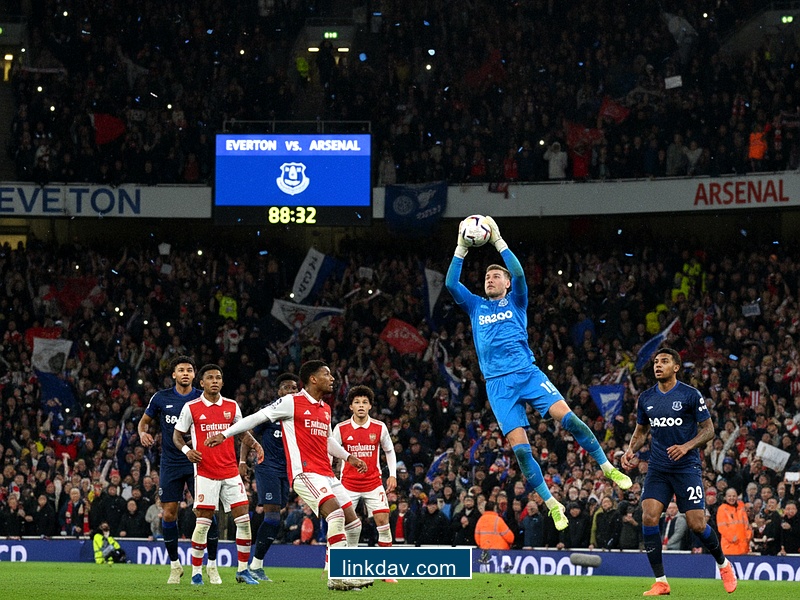
Jordan Pickford is not a goalkeeper known for hyperbole. When the Everton shot-stopper claimed recently that Arsenal presents a singular, recurring problem for every team in the Premier League, he wasn't offering a generic compliment. He was diagnosing a tactical illness that is sweeping through the division. I’ve spent two decades watching defensive lines fragment and low blocks crumble, but what Mikel Arteta has constructed at the Emirates is distinct. It isn't just dominance; it is structural bullying.
To understand Pickford’s frustration, you have to strip away the goals and the clean sheets and look at the biometrics of the game. Watch the game through the eyes of a scout sitting in the upper tier, ignoring the ball to focus on the shape. What you see is a terrifying exercise in pitch compression. Arsenal does not just beat you; they remove the oxygen from the room until you suffocate.
The Psychology of the High Press: Weaponizing Body Language
Most pundits talk about "pressing" as a measure of effort. That is a layman's fallacy. At the elite level, pressing is about geometry and psychology. When I analyze Arsenal’s front line—specifically the coordinated movements of Kai Havertz, Martin Ødegaard, and Bukayo Saka—I don't see players merely running at defenders. I see "arced pressure."
Watch Havertz when the opposition center-back receives the ball. He doesn’t run in a straight line. He curves his run to place the deepest pivot player in his "cover shadow." This is a crucial coaching term. By blocking the passing lane to the midfielder with his body shape while simultaneously closing down the ball carrier, Havertz effectively removes two players from the game with one movement. This forces the defender to look wide or long. It triggers anxiety. You can see it in the opposition’s body language: shoulders drop, heads swivel frantically, panic sets in.
This is what Pickford feels. It’s the sensation of having your options deleted one by one before you even make a decision. It forces goalkeepers into kicking long, low-percentage balls, which feeds directly into Arsenal’s next strength.
Rest Defense and the Art of the 40-Yard Pitch
The "problem" Pickford alludes to is compounded by Arsenal’s "Rest Defense" structure. This is the formation the team adopts while they are attacking, preparing for the moment they lose the ball. Under Arteta, William Saliba and Gabriel Magalhães operate with an arrogance that is almost offensive. They push the defensive line to the halfway line, compressing the effective playing area to a 40-yard strip.
Historically, playing this high is suicide. It leaves vast acres of space for runners in behind. But Saliba and Gabriel are physical anomalies. They possess the recovery pace of wingers and the physical mass of heavyweight boxers. When an opposition goalkeeper or defender is forced to clear the ball long (because of the arced pressure mentioned earlier), they aren't kicking into space; they are kicking into a duel that Gabriel is statistically guaranteed to win.
This creates a kinetic loop. Arsenal attacks, loses the ball, immediately wins the duel on the halfway line, and attacks again. For the opposition, there is no respite. There is no time to breathe, reorganize, or step out. The psychological fatigue this induces is heavier than the physical exertion. By the 60th minute, opposition legs aren't just tired; their minds are broken.
Set-Piece Choreography: The Jover Effect
We cannot ignore the dead-ball situations. Pickford’s comments likely stem from the trauma of facing Nicolas Jover’s set-piece routines. In my years scouting, I have rarely seen a top-tier side treat corners with the intricacy of an NFL offensive coordinator. Arsenal has weaponized the "pick play"—a concept borrowed from basketball.
"It’s not just a cross and a header. It’s a series of screens, blocks, and isolations designed to create a 1v0 situation in the six-yard box."
Watch Ben White. He is rarely the target. His role is often that of the agitator or the blocker. He engages the goalkeeper, messing with his gloves, stepping on toes, disrupting the center of gravity. It is dark arts, refined. Meanwhile, Gabriel or Saliba start their runs from deep, utilizing "blind side" movement. They run off the back shoulder of the defender, entering the vision of the marker only when it is too late to react. This isn't luck; it creates a statistical probability of success that defies the low-scoring nature of football.
The Half-Space Overload and Isolation
When Arsenal does settle into possession, the problem shifts from suffocation to stretching. The tactical theory here relies on "Gravity." Bukayo Saka and Martin Ødegaard on the right flank generate immense gravity. Opposing teams are terrified of Saka’s 1v1 ability, so they double-team him. Ødegaard floats into the right half-space, demanding attention from a defensive midfielder.
This cluster of activity draws the entire opposition defensive block toward Arsenal’s right side. Then comes the switch. A rapid circulation of the ball finds Gabriel Martinelli or Leandro Trossard on the left, often in a true 1v1 against an isolated full-back who has no cover because his support system has been sucked into the Saka gravity well.
For a goalkeeper like Pickford, this is a nightmare to organize against. If he screams for his defense to shift left to cover Martinelli, the gap opens for Ødegaard to slip a through ball to Saka. If they stay compact, the switch of play kills them. It is 'Pick Your Poison' football.
The Rice Factor: The Midfield Anchor
Declan Rice’s role in this system is the final nail in the coffin. In scouting terms, Rice is an elite "floor raiser." His specific movement patterns in transition are elite. He doesn't just tackle; he anticipates the passing lane the opponent wants to use to escape the pressure.
Rice’s ability to cover lateral ground allows the full-backs (White or Timber/Calafiori) to invert into midfield or overlap without fear. Rice acts as the safety net, patrolling the width of the pitch. His body orientation is always open, ready to receive or intercept. This allows Arsenal to commit five, sometimes six players into the final third, knowing the back door is bolted shut. This numerical superiority in the attack is what breaks down the low blocks that frustrate other top teams.
The Verdict
When Jordan Pickford says Arsenal causes everyone the same problem, he is describing the feeling of inevitability. In the Invincibles era, Arsenal beat you with technical brilliance and speed. The current iteration beats you with a methodical, suffocating constriction of space and time. They make the pitch small when you have the ball and impossibly wide when they have it.
This is not just a run of good form. It is a tactical blueprint that requires perfect physical profiles and supreme coaching discipline. Arteta has built a machine that removes the variables of chance from the game, replacing them with the cold, hard logic of spatial domination. For the rest of the league, the problem isn't going away.