
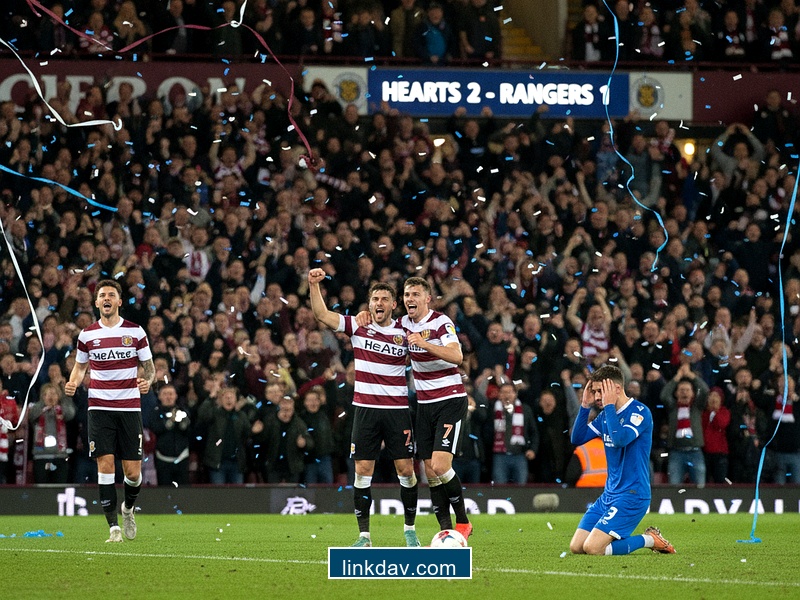
The scoreboard at Tynecastle read 2-1, but the tectonic plates shifting underneath Scottish football suggested a magnitude far greater. Hearts have not just beaten Rangers; they have dismantled the aura of inevitability that usually surrounds the Ibrox side in Edinburgh. For the first time since the heady, chaotic days of the Vladimir Romanov era, the Jambos look less like plucky underdogs and more like legitimate predators.
This result is a forensic examination of two trajectories. For Hearts, it is the crystallization of a philosophy under Steven Naismith that relies on aggression and the lethal finishing of Lawrence Shankland. For Rangers, it is a damning indictment of a spine that has turned to jelly. When we compare this Rangers vintage to the iron-clad units of the past, the regression is startling.
The Shankland Supremacy vs. The Ghost of Skacel
Lawrence Shankland’s winner was not merely a goal; it was a statement of intent that echoes the heroics of 2005-06. To understand the magnitude of what Shankland is doing, one must look back to Rudi Skacel. During that breathless 2005 season under George Burley, Skacel scored 16 goals from midfield, driving a Hearts team that split the Old Firm for the first time in a decade.
Shankland, however, is operating in a more difficult tactical ecosystem. Skacel was surrounded by Champions League-level quality like Takis Fyssas, Edgaras Jankauskas, and Paul Hartley. Shankland is carrying a heavier burden with less elite support, yet his output is arguably more impressive. His hold-up play against Rangers was reminiscent not of a Hearts forward, but of Mark de Vries during his legendary four-goal debut in 2002—bulying defenders not just with physicality, but with a streetwise intelligence that Rangers’ backline could not decipher.
"Shankland doesn't just score; he occupies the mind of the opposition. He is the first Hearts striker since the early 2000s who walks onto the pitch believing he is the best player in the stadium, regardless of the badge on the other shirt."
The statistics reinforce this historical shift. In the mid-2000s, Hearts relied on a collective midfield engine. Today, they rely on a spearhead. Shankland’s conversion rate inside the box is currently tracking higher than Kris Boyd’s was during his 2009 peak with Rangers, a terrifying metric for the rest of the league. He has become the equalizer—the variable that bridges the budget gap between Gorgie and Govan.
Rangers: A Defense Devoid of Steel
If Hearts were inspired, Rangers were insipid. The "significant blow" to their title hopes mentioned in the match reports is an understatement; it is a fatal wound to their credibility. To watch this Rangers defense is to witness a profound loss of identity.
Cast your mind back to the 2007-08 season. Walter Smith’s Rangers reached the UEFA Cup Final built on a defensive partnership of David Weir and Carlos Cuéllar. That duo possessed a combined mental fortitude that the current crop cannot comprehend. Weir and Cuéllar thrived on the hostile atmosphere of Tynecastle; they absorbed pressure like a sponge. In contrast, the current defensive pairing looked terrified every time the ball entered the final third.
The opening goal for Hearts exposed a fragility that would have been unthinkable in the era of Barry Ferguson. Ferguson, for all his controversies, patrolled the midfield with a snarl that demanded standards. Rangers currently lack a "General." They have technicians and athletes, but they lack the psychological armor required to win ugly in Edinburgh. When the crowd turned up the volume, Rangers wilted. There was no Richard Gough pointing fingers, no Lorenzo Amoruso driving out from the back. There was only panic.
Tactical Naivety and the High Press
Tactically, Hearts suffocated Rangers in a way that exposed the limitations of the visitors' build-up play. Naismith’s setup mirrored the high-intensity pressing game employed by Craig Levein’s teams of the early 2000s, but with modern refinement. By cutting off the passing lanes to the Rangers double pivot, Hearts forced the center-backs to go long—a strategy that played directly into the hands of the Hearts defense.
This is where the historical context becomes damning for the Ibrox side. In the 1990s, during the Nine-in-a-Row era, Rangers could bypass a high press through the sheer individual brilliance of Brian Laudrup or Paul Gascoigne. They had bailout mechanisms. This current squad relies heavily on system cohesion, and when the system is disrupted by a physical Hearts press, there is no individual genius capable of grabbing the game by the scruff of the neck.
| Era | Hearts Key Attribute | Rangers Defensive Spine | Outcome at Tynecastle |
|---|---|---|---|
| 2005-06 (Burley Era) | Pace & Skacel's Power | Kyrgiakos / Andrews | Hearts Dominance (Split the Old Firm) |
| 2008-09 (Smith Era) | Grit & Determination | Weir / Bougherra | Rangers "Steel" (Title Winners) |
| 2024-25 (Current) | Shankland's Precision | Fragile & Passive | Hearts 2-1 Rangers |
The Title Race Reality Check
The headlines claiming Hearts are "tightening their grip on the top spot" signals a potential paradigm shift in the Scottish Premiership not seen since the "New Firm" challenges of the 1980s. While the Old Firm duopoly usually corrects itself over a 38-game season, the psychological damage inflicted here is permanent.
Rangers are now chasing shadows. The concern for the Ibrox faithful shouldn't just be the points dropped; it should be the lack of reaction. In the 2002-03 treble-winning season under Alex McLeish, Rangers responded to setbacks with ferocity. This team responds with resignation. They allowed Hearts to dictate the tempo, win the second balls, and ultimately, want it more.
Tynecastle as a Fortress Reborn
We must acknowledge the venue. Tynecastle Park, when the blood is up, remains the most hostile environment in British football outside of the Old Firm derbies. For too long, however, Rangers treated it as a training ground, sweeping aside soft Hearts teams with ease. That fear factor is back. The roar that greeted the final whistle wasn't relief; it was belief.
Hearts have found a template to dismantle the Glasgow giants: aggression, tempo, and a striker who doesn't miss. For Rangers, the road back to the summit looks steeper than Ben Nevis. They aren't just fighting Hearts and Celtic; they are fighting the ghosts of their own legends, whose shirts they currently wear but whose boots they cannot fill.
Lawrence Shankland may not have the exotic flair of Jankauskas or the longevity of John Robertson yet, but after this 2-1 victory, he has something just as valuable: the keys to the city and the fear of every defender in Govan.