
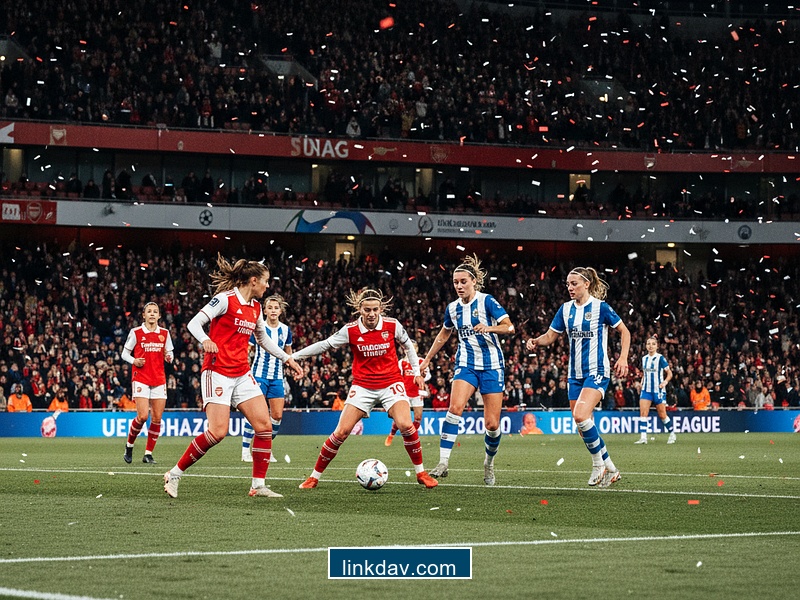
The Champions League draw in Nyon has been kind to Arsenal. Drawing Oud-Heverlee Leuven (OHL) in the quarterfinals is, on paper, the most favorable outcome Renee Slegers could have hoped for. It avoids the titanic clashes against the likes of Lyon, Barcelona, or Wolfsburg—teams that have turned the latter stages of this competition into their own private fiefdoms over the last decade. But let us not pop the champagne in North London just yet. While the draw is favorable, the context is heavy.
For the modern Arsenal supporter, there is a tendency to view this tie through the lens of relief. We dodged a bullet. But twenty years ago, the sentiment would have been radically different. In the mid-2000s, under the stewardship of Vic Akers, Arsenal did not hope for easy draws. They were the easy draw that other teams prayed to avoid. This tie against the Belgian champions offers more than a path to the semi-finals; it offers a stark mirror to a club trying to reconnect with a heritage of dominance that has slowly eroded into "competitiveness."
The Shadow of Vic Akers
To understand the stakes against Leuven, you must understand the standard set in 2007. That season, Arsenal didn’t just participate in Europe; they annexed it. The 2006-07 campaign remains the Holy Grail of English women’s football—a Quadruple season that culminated in the UEFA Women’s Cup (the precursor to the UWCL) victory over Umeå IK.
That Umeå side was terrifying. It boasted Marta, arguably the greatest female player to ever lace boots, at the peak of her powers. Yet, Arsenal strangled them. Over two legs, Alex Scott’s swerving strike and a defensive masterclass at Borehamwood secured the trophy. It wasn’t just about talent; it was about a suffocating mental fortitude.
Compare that to the current iteration of Arsenal. The talent is undeniable. In players like Alessia Russo, Mariona Caldentey, and Emily Fox, the technical ceiling is arguably higher than it was two decades ago due to the evolution of athletic training. However, the psychological floor is lower. This modern squad has made a habit of oscillating between brilliance and fragility—collapsing against Bayern Munich one week, then dismantling Juventus the next. The Akers team never oscillated. They were a flatline of ruthless efficiency.
2007 vs. 2025: A Crisis of Identity
The draw against OHL brings this identity crisis into sharp relief. Leuven will likely play a low block, a tactical setup that has been kryptonite for Arsenal over the last three seasons. Under Jonas Eidevall, and now Slegers, Arsenal has frequently looked toothless against disciplined defenses, engaging in what I call "horseshoe football"—passing endlessly around the perimeter of the box without penetration.
"In 2007, we didn't just pass the ball. We passed it to kill you. Every touch had malice. Today, I see a lot of possession without purpose. Against Leuven, pretty patterns won't be enough; they need the killer instinct of Kelly Smith."
Kelly Smith is the crucial point of comparison here. In her prime, she was a chaotic force of nature, a player who could bypass structure with a moment of individual brilliance. Today, Arsenal relies heavily on system play. When the system fails, who grabs the game by the scruff of the neck? Kim Little has been that figure for a decade, but she is in the twilight of her career. The burden now falls on players like Frida Maanum. Maanum has the engine, but does she have the arrogance? To beat a block like OHL’s, you need the arrogance to try the impossible pass, a trait Smith had in abundance.
The Tactical Evolution: Scott vs. Fox
Tactically, the contrast between the eras explains why this tie is fascinating. In 2007, the width was provided by Alex Scott overlapping relentlessly on the right. It was simple, physical, and direct. The service into the box for Julie Fleeting was constant. Fleeting, a part-time PE teacher who scored goals with the frequency of a machine, thrived on that service.
Today, Emily Fox plays the right-back role very differently. She inverts. She drifts into midfield to create numerical superiority. This is sophisticated, "Pep Guardiola-style" football, but it often clogs the central channels. Against Leuven, who will pack the center of the pitch, inverting the full-backs might actually play into the Belgians' hands. Slegers faces a tactical dilemma: stick to the modern philosophy of control, or revert to the 2007 blueprint of width and crosses to stretch the Belgian defense?
Analyzing the Opponent: OHL is a Trap
It would be negligent to treat Oud-Heverlee Leuven as mere cannon fodder. While the Belgian Super League does not possess the depth of the WSL, OHL has been building a project focused on technical proficiency. They are not a physical long-ball team; they attempt to play. However, in the Champions League, lesser sides inevitably become pragmatic.
The danger for Arsenal is the "Wolfsburg Hangover." Having avoided the German giants, the subconscious drop in intensity is a real physiological phenomenon. If Arsenal approaches the first leg in Leuven with anything less than 100% intensity, they risk a draw or a narrow loss that puts immense pressure on the return leg at the Emirates. We saw this earlier in the season in the qualifiers—a lack of urgency that nearly cost them the group stage entirely.
The Metrics of Dominance
Let’s look at the raw shift in philosophy between the two eras to understand what is required to progress.
| Attribute | 2006-07 "The Quadruple" | 2024-25 Current Squad |
|---|---|---|
| Primary Playstyle | Direct, Counter-Attacking, Physical | Possession-based, Inverted, Patient |
| Defensive Anchor | Faye White (Aerial Dominance) | Leah Williamson (Ball Progression) |
| Key Creator | Kelly Smith (Individual Brilliance) | Mariona Caldentey (System Link-up) |
| European Mindset | Expectation to Win | Hope to Compete |
The shift from Faye White to Leah Williamson epitomizes the change in the sport. White was a warrior—a head-on-a-stick defender who secured clean sheets through grit. Williamson is a quarterback in defense, capable of splitting defenses with a 40-yard pass. Against OHL, Williamson’s distribution will be vital, but if the game turns into a scrap, Arsenal misses the nastiness of a Faye White.
The Verdict: A Step Toward Redemption?
The draw against Leuven is a gift, but gifts can be squandered. Renee Slegers has stabilized the ship after the turbulent end of the Eidevall era, bringing a sense of calm and clarity back to the squad. The dismantling of Juventus showed what this team can do when the handbrake is off.
However, history is watching. Arsenal remains the only British women’s side to have lifted the European trophy. Chelsea has spent millions trying to replicate that feat and failed. Manchester City is knocking on the door. But that 2007 trophy in the cabinet at the Emirates is becoming dusty. It is no longer a symbol of dominance; it is becoming a relic of a bygone era.
Beating Leuven should be a formality. But for this columnist, the scoreline matters less than the manner of the victory. I want to see the ghost of 2007. I want to see the ruthless efficiency of Vic Akers' machine. I want to see Arsenal not just pass Leuven to death, but intimidate them. If they can rediscover that nasty streak, that arrogance that says "we are Arsenal," then maybe, just maybe, a trip to the final in Lisbon isn't a fantasy.
If they approach this with the timidness we saw in the early season, the ghost of 2007 will continue to haunt them, rather than inspire them.