
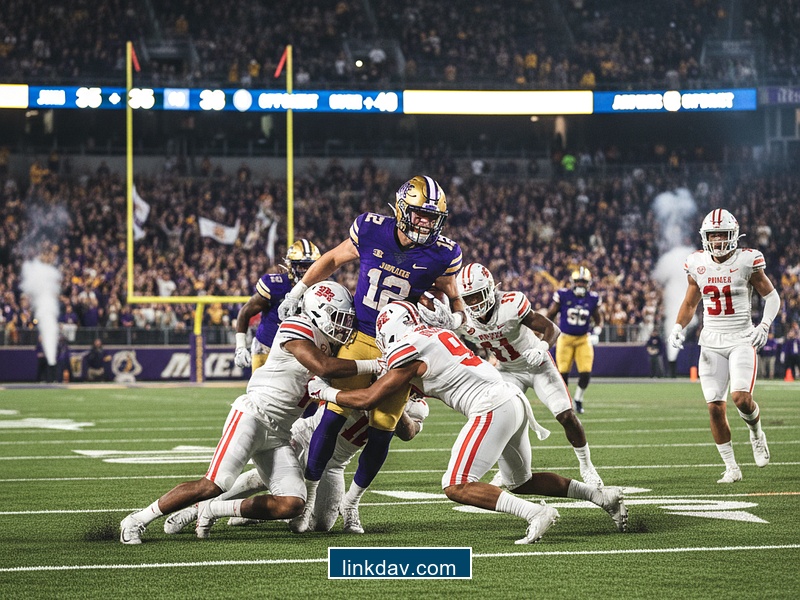
Dan Lanning walked into the post-game press conference looking like a man who had just discovered a scratch on his Ferrari, not a coach who had just secured Oregon’s first-ever 12-team College Football Playoff victory. The scoreboard read 51-34. The offense, led by Dillon Gabriel, had operated with the surgical efficiency of a localized airstrike. Yet, the 38-year-old head coach was visibly agitated.
This dissonance—the chasm between a comfortable three-score victory and the manager’s simmering frustration—is precisely where the "Oregon Project" becomes interesting. In the Chip Kelly era, a 51-point outing was a party. In the Dan Lanning era, conceding 34 points to a Group of Five opponent is a dereliction of duty. We are witnessing a fundamental rewriting of the program’s DNA, shifting from a culture of offensive aestheticism to one of defensive totalitarianism, even if the scoreboard against James Madison didn’t quite reflect it yet.
The Saban-Smart Genetic Imprint
To understand Lanning’s annoyance, you must look at his pedigree. He didn’t cut his teeth in the high-flying Big 12; he was forged in the pressure cookers of Tuscaloosa and Athens. As a graduate assistant under Nick Saban and the defensive coordinator under Kirby Smart, Lanning learned a singular, brutal truth: the process matters more than the result.
Saban famously ranted about "rat poison"—the media praise that makes players soft. Smart demands suffocation, not just victory. When James Madison, a program playing just its third season at the FBS level, managed to pull within 31-28 in the third quarter, it wasn't just a competitive flare-up; it was an indictment of Lanning's defensive philosophy. The "Mint" front and simulated pressures that Lanning specializes in are designed to create havoc without sacrificing coverage integrity. Against the Dukes, however, Oregon looked suspiciously like the Pac-12 teams of old—fast, flashy, and occasionally soft in the underbelly.
"We didn't play to our standard... There's a standard of how we want to operate, and I don't think we operated effectively enough to that standard tonight." — Dan Lanning
This quote is not coach-speak. It is the architectural blueprint of the new Oregon. Lanning knows that giving up 34 points to James Madison is a survivable error in the first round. However, that same defensive leakage against the interior physicality of Georgia or the vertical stretch of Texas is a death sentence. He isn't coaching against the opponent on the field; he is coaching against a theoretical standard required to hoist a trophy in January.
The Big Ten Experiment: A Rosters Transition
The sustainability of this project relies heavily on how quickly Lanning can complete the roster metamorphosis. For two decades, Oregon was built on speed. "Blur" offenses required lighter, faster linemen and conditioning over brute strength. The move to the Big Ten required a pivot to mass. You cannot survive a November in Columbus or State College with a 240-pound defensive end.
Lanning has aggressively used the transfer portal and high school recruiting to import "SEC bodies" to the Pacific Northwest. The struggle against James Madison exposed that this transition is not yet complete. The Dukes found success running the ball and extending plays, exploiting gaps that a fully realized Lanning defense would have shut down. The defensive line rotation, while deeper than in the Mario Cristobal era, still lacks the terrifying, wave-after-wave depth of the 2021 Georgia defense that Lanning orchestrated.
This is why the 34 points hurt. It suggests that while the offense is championship-caliber, the defense is still a construction site. The philosophy is sound—match physicality with complexity—but the personnel execution lagged. The fear isn't that they can't score; it's that they can't stop a nosebleed when the air gets thin.
The Group of Five Reality Distortion Field
We must also address the context of James Madison’s performance. The final score masks a terrifying reality for the power brokers of the sport: the gap is closing tactically, even if it remains wide physically. JMU head coach Bob Chesney engineered a game plan that neutralized Oregon’s athletic advantage for 40 minutes.
Historically, Group of Five teams in major bowl games rely on trickery and variance. JMU didn't do that. They lined up and executed standard spread concepts, finding soft spots in Oregon’s zone drops. This validates the expansion of the CFP. If a Sun Belt team can push the No. 5 seed into the fourth quarter without gimmicks, the integrity of the 12-team field is secure.
However, the final 15 minutes illustrated the "Blue Chip Ratio" theory. This metric, often cited by recruiting analysts, posits that teams cannot win national titles without recruiting more four-and-five-star players than two-and-three-stars. As the game wore on, JMU’s depth evaporated. Oregon’s backups are better than JMU’s starters. That is the luxury of Phil Knight’s investment and the Nike machine. Lanning’s frustration stems from having to rely on that talent gap rather than schematic dominance.
Phil Knight’s Checkbook and the Demand for Perfection
Let’s be cynical about the economics. Oregon is not a Cinderella; it is a corporate superpower. The "Division Street" NIL collective is among the most robust in the nation. Dillon Gabriel was acquired like a free agent specifically to bridge the gap during this conference realignment year. The investment into the program demands a return that looks like dominance, not a scrappy dogfight with a team from Harrisonburg, Virginia.
The "Project" is to turn Oregon into the Alabama of the West. That requires a psychological shift where winning is boring because it is expected. When Lanning chastises his team after a 51-point outburst, he is trying to kill the lingering "celebrity" culture of Oregon football—the flash, the uniforms, the hype—and replace it with the cold, industrial efficiency of a factory.
Is the Philosophy Sustainable?
Can a coach maintain a locker room when he tears them down after a blowout win? History says yes, but only if the hardware follows. Saban did it for 17 years. Belichick did it for two decades. The moment the players stop believing that the misery is the price of the ring, the culture collapses.
Oregon’s offense is sustainable. Will Stein, the offensive coordinator, has built a system that protects the quarterback and distributes the ball to playmakers like Tez Johnson with ruthless efficiency. They scored on seven straight possessions. That travels well.
The defense is the variable. Lanning’s dissatisfaction is the most positive sign for Oregon fans. If he had walked into that press conference smiling about a "great team win," the Ducks would be dead in the water next round. His anger is the fuel. He knows the tape from this game will be dissected by future opponents who possess the talent to punish the mistakes JMU couldn't capitalize on.
The Ducks advanced, but they didn't conquer. In the new world order of college football, where 12 teams enter and one survives, the ability to be self-critical in victory is the only trait that separates the contenders from the pretenders. Dan Lanning isn't chasing a win; he's chasing a ghost—the standard of perfection that his mentors established in the South. Until his defense plays with the suffocating arrogance of a Georgia or Alabama, he will remain the most miserable winner in America.