
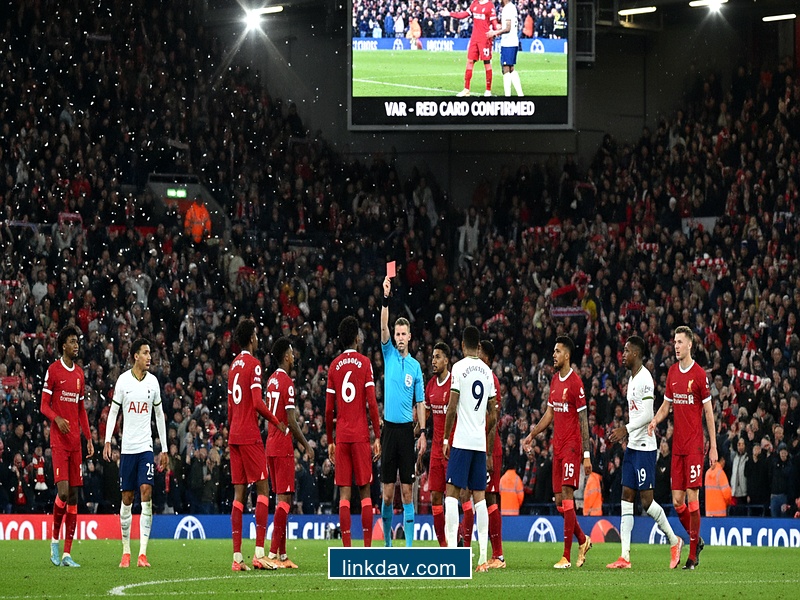
The relentless news cycle following Liverpool’s chaotic defeat to Tottenham Hotspur has been dominated by acronyms. PGMOL. VAR. IFAB. We have pored over audio transcripts, dissected lines on a screen, and debated the semantic integrity of the phrase "check complete." But while the world obsesses over the forensic incompetence of officiating, the real story—the one that actually matters for the next five years of the Premier League—is being ignored.
The profound takeaway from North London was not that referees make mistakes. It is that Jurgen Klopp’s "Liverpool 2.0" is not a rebuild in progress. It is a terrifyingly complete competitive entity that has arrived ahead of schedule.
To focus on the injustice is to miss the footballing miracle that occurred before Joel Matip’s heartbreaking 96th-minute intervention. For nearly 70 minutes, Liverpool played with ten men. For 25 minutes, they played with nine. And yet, until the dying seconds, Tottenham—the league’s newly crowned kings of attacking fluidity—looked utterly devoid of ideas. This defensive masterclass reveals more about the sustainability of Klopp’s philosophy than any 7-0 thrashing of Manchester United ever could.
The Tactical Evolution: From Heavy Metal to Titanium Alloy
For years, the Klopp doctrine was defined by "Heavy Metal Football"—a high-pressing, chaotic storm designed to induce errors. Critics long argued that this system lacked a plan B. When the legs went, or when the red cards came, the structure was supposed to crumble. We saw glimpses of that fragility last season when the midfield of Jordan Henderson and Fabinho lost their anaerobic capacity, leaving the back four exposed.
The Tottenham match provided a stress test of extreme variables, and the results were staggering. Down to nine men, Liverpool did not simply "park the bus" in the traditional sense. They adopted a highly sophisticated 5-3-0 low block that shifted horizontally with the precision of a foosball table.
This wasn't panic; it was drilled geometry. The focus shifted from pressing the ball (impossible with a two-man disadvantage) to controlling the space. Ibrahima Konaté and Virgil van Dijk compressed the verticality of the pitch, effectively suffocating Ange Postecoglou’s wing-focused attacks. The "Project" here has evolved. Klopp has moved away from a system purely reliant on physical dominance to one grounded in supreme tactical intelligence.
"Resilience is not just about grit; in the modern Premier League, resilience is about shape. To hold that structure while your lungs are burning is a technical skill, not just a moral one."
The Midfield Renaissance: Chaos with a Touch of Class
To understand the sustainability of this project, one must analyze the engine room. The summer transfer window was viewed by many as a scramble. Losing the captain and the primary holding midfielder to the Saudi Pro League felt like a capitulation. The narrative was that Liverpool had lost their leadership.
The performance at the Tottenham Hotspur Stadium dismantled that myth. Dominik Szoboszlai and Alexis Mac Allister have offered an immediate upgrade—not just in technical ability, but in athletic durability. Szoboszlai, specifically, represents the archetype of the new Klopp player. He possesses the silk of a number 10 but tracks back with the aggression of a Gennaro Gattuso.
In the "Liverpool 1.0" era, the midfield was industrial, designed to service the front three. In "Liverpool 2.0," the midfield is the protagonist. Even when reduced to a skeleton crew against Spurs, the midfield retained possession in tight areas rather than blindly clearing their lines. This suggests a philosophical pivot toward 'La Pausa'—the ability to slow the game down amidst chaos—which was noticeably absent in the frantic rock-and-roll years of 2017-2019.
Siege Mentality as a Strategic Asset
Historically, great dynasties feed on perceived injustice. Sir Alex Ferguson mastered this at Manchester United. Jose Mourinho weaponized it at Chelsea. Jurgen Klopp has now been handed the ultimate fuel for his "Us Against the World" narrative.
The PGMOL statement admitting "significant human error" regarding Luis Diaz’s disallowed goal does nothing for the points tally, but it does wonders for the dressing room psychology. A manager cannot manufacture the level of bonding that occurs when a team feels collectively robbed. Klopp knows this.
The "Project" thrives on emotion. By reacting with a strange calmness post-match—focusing on the pride in his players rather than the vitriol toward the officials—Klopp performed a masterstroke of man-management. He framed the defeat as a moral victory, instantaneously removing the pressure of the loss and replacing it with a sense of martyrdom. This is the psychological sustainability that keeps teams running through brick walls in February and March.
Sustainability of the High Line
If there is a flaw in the philosophy, it remains the high defensive line. Even with reduced numbers, Liverpool attempted to squeeze the pitch. It is high-risk, high-reward. Against Tottenham, it nearly worked perfectly, but it relies heavily on the recovery pace of the center-backs and the sweeping ability of Alisson Becker.
However, the data suggests this is a calculated gamble rather than tactical naivety. By compressing the space, Liverpool forces opponents to play perfect long balls under pressure. In a league where possession-based teams (City, Arsenal, Brighton, Spurs) dominate, surrendering the midfield space to sit deep is suicide. Klopp’s insistence on the high line, even in adversity, proves he is doubling down on his identity. He would rather lose playing his way than draw playing like an underdog.
The Verdict: A Dynasty Reloaded
We must look past the PGMOL apology. That is administrative noise. The signal is on the pitch.
Most pundits predicted a "transition season" for Liverpool—a euphemism for finishing fifth and rebuilding chemistry. Saturday’s performance in North London shattered that timeline. A team in transition collapses when the captain is sent off. A team in transition folds when a legitimate goal is chalked off. A team in transition does not force the home side, boasting a man advantage, to wait until the 96th minute for an own goal to secure the points.
The "Project" is not just sustainable; it is terrifyingly robust. Klopp has managed to inject fresh blood into the squad without diluting the culture. He has replaced legs without losing the heart. Liverpool left London with zero points, but they may have returned to Merseyside with something far more valuable: the undeniable proof that they are legitimate title contenders, capable of enduring the most extreme storms the Premier League—and its officials—can conjure.
This wasn't a defeat. It was a statement of intent written in the language of defiance.