
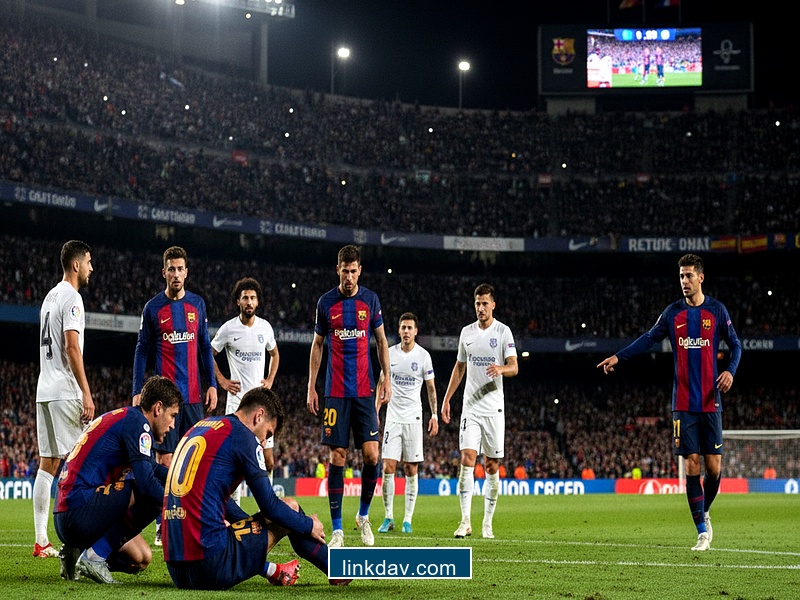
The news dropped with the grim inevitability of a third-act plot twist everyone saw coming. Another Barcelona star is out for the remainder of the season. Another press release filled with medical jargon, another flurry of frantic calls to agents, and another headline claiming the club has "already identified a replacement." It is a cycle that has become as much a part of the club’s identity as the blaugrana stripes.
But to view this latest injury—whether it be the catastrophic blow to Marc-André ter Stegen’s knee or the fragile hamstrings of the midfield elite—as mere bad luck is to misunderstand the project Hansi Flick is building in Catalonia. This isn't misfortune. It is the cost of doing business in a system designed to run at 110% capacity until the machinery snaps.
The Kinetic Cost of Verticality
Hansi Flick arrived at the Camp Nou not as a caretaker of the Cruyffian flame, but as an accelerant. While Xavi Hernández spent two years obsessing over pausa and control—often resulting in sterile domination—Flick introduced a brand of heavy-metal verticality that hasn't been seen in Barcelona since the chaotic transition years of the early 2000s.
The statistics from the first half of the 2024/25 campaign paint a vivid picture of this shift. Barcelona’s average defensive line height moved nearly four meters higher compared to the previous season. They have caught opponents offside more than any team in Europe’s top five leagues. This sounds tactically brilliant on a spreadsheet, but physically, it is brutal. It requires defenders to sprint back toward their own goal repeatedly and demands a goalkeeper who operates essentially as a libero.
When you demand that human beings perform repeated high-intensity sprints (HIRs) without the ball, the muscular load increases exponentially. Under Flick, Barcelona’s "distance covered at speed" metric has spiked. The injury to a key starter isn't an anomaly; it is a direct physiological receipt for the tactical risks taken. The system works beautifully when the pistons are firing, but it lacks the one thing Xavi desperately tried to install: self-preservation.
"Flick doesn't manage a football team; he manages a high-pressure algorithm. The moment a component fails, the protocol is to replace the part, not reduce the pressure."
The Replacement Fallacy
The second half of the headline—"Club Already Identify Replacement"—is where the true hubris of the modern Barcelona board reveals itself. It speaks to a commoditization of talent that ignores the intangible architecture of a winning team. You can go into the market and buy a pair of gloves or a pair of boots; you cannot buy the neural pathways developed over a decade of La Liga warfare.
Let’s look at the historical precedent. When Victor Valdés tore his ACL in 2014, the club scrambled. They brought in Claudio Bravo and Marc-André ter Stegen. It worked eventually, but the immediate psychological trauma on the defensive unit was palpable. When Sergio Busquets left, the "replacements" (Oriol Romeu, and the forced adaptation of others) failed to replicate the metronomic calm required to sustain attacks.
The reports suggest the club is looking at stop-gap solutions—veterans out of contract or emergency loans. This is the financial reality of a club still navigating the treacherous waters of La Liga’s salary cap. But tactically, plugging a new player into Flick’s high-line system mid-season is akin to asking a stranger to defuse a bomb with instructions written in a language they don't speak. The cohesion required to play an offside trap with mere inches of margin for error takes months to build. A new signing, no matter how pedigree-rich, introduces hesitation. In Flick’s system, hesitation is death.
The Industrialization of La Masia
Perhaps the most disturbing element of this "next man up" mentality is the burden it places on the nursery. The reliance on La Masia has shifted from a philosophy of development to a strategy of survival. We are witnessing the industrialization of teenagers.
Lamine Yamal, Pau Cubarsí, Gavi, and Pedri have all been subjected to workloads that would break seasoned veterans. The physical demands of the Champions League’s new format, combined with Flick’s refusal to compromise on intensity, are eroding the longevity of these players before they hit their prime. Historical data from the Premier League suggests that players who exceed 3,000 minutes before the age of 20 are 40% more likely to suffer chronic injuries later in their careers.
When a senior star goes down "for the rest of the season," the solution is rarely the external transfer target mentioned in the tabloids. The reality is that the load simply transfers to the remaining fit players, usually the kids. The "replacement" is often just increased mileage on Lamine Yamal’s legs.
Sustainability vs. Glory
Hansi Flick’s tenure at Bayern Munich was defined by a sextuple, but it was also brief. His teams burn bright and hot. The pressing intensity of that 2020 Bayern side was unsustainable over three or four years without massive squad churn. Barcelona, financially hamstrung, cannot afford squad churn. They need continuity.
| Metric | Barça (Xavi 23/24) | Barça (Flick 24/25) | Risk Factor |
|---|---|---|---|
| High-Press Regains | Moderate | Elite | Increased collisions/impact injuries |
| Defensive Line Height | 42m | 48m | Hamstring strain on recovery runs |
| Rotation Frequency | High | Low (Core XI) | Cumulative fatigue failure |
The loss of a key star for the season forces us to ask: Is this project viable? Winning a league title requires consistency, not just peak performance. Real Madrid, for all their faults, manage games. They walk when they can, sprint when they must. Flick’s Barcelona attempts to sprint a marathon.
The Verdict
The injury is tragic for the player, but for the club, it is a diagnostic indicator. The engine is running too hot. Identifying a replacement is a bandage on a bullet hole. Unless Hansi Flick learns to temper his vertical obsession with moments of genuine control—resting with the ball rather than chasing it—the medical room at the Ciutat Esportiva will remain the busiest room in the facility.
Barcelona fans are currently intoxicated by the thrill of the high line and the goals. But the hangover is coming. In modern football, the most valuable ability is availability. Right now, Barcelona’s tactical philosophy is actively working against it.