
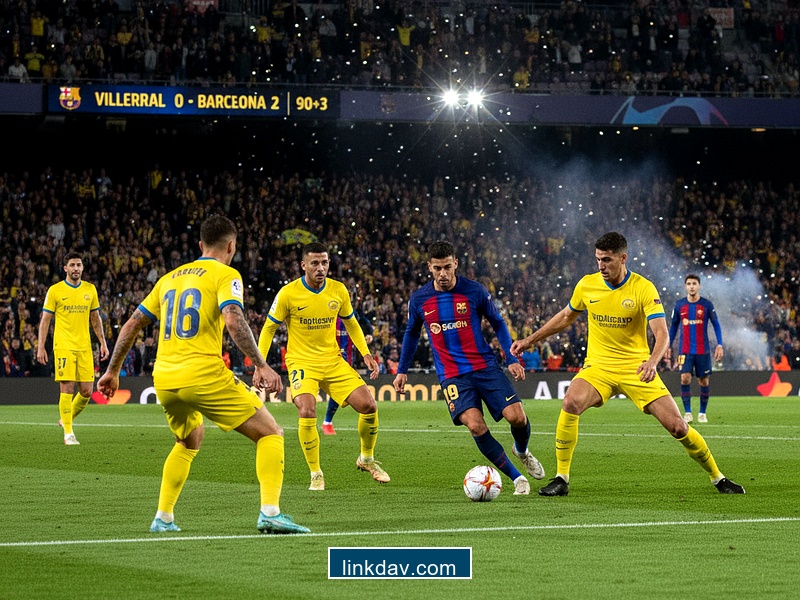
There are victories that produce poetry, and there are victories that produce scar tissue. Barcelona’s 2-0 dismantling of Villarreal at the Estadio de la Cerámica belongs firmly in the latter category. While the headlines will inevitably drape superlatives over Lamine Yamal, the true narrative of this match wasn't offensive brilliance; it was a masterclass in the dark arts of game management reminiscent of the 2005-06 vintage under Frank Rijkaard.
Moving four points clear at the summit of La Liga is the statistical outcome. The existential outcome is far weightier. For the first time in perhaps a decade, Barcelona went into a hostile, rain-slicked ground in Castellón, faced a physical onslaught, and didn't just survive—they engaged in the brawl and won.
The Echoes of the 2006 Transition
To understand the significance of this December evening, one must look back exactly twenty years. The 2005-06 Barcelona side is often remembered for Ronaldinho’s smile, but that revisionist history ignores the steel of Mark van Bommel, the lung-busting recovery runs of Sylvinho, and the cynicism of Deco. That team knew how to strangle a game.
Tonight, we saw the reincarnation of that pragmatism. When Villarreal was reduced to ten men—a decision that sent Marcelino into an apoplectic fit on the touchline—Barcelona did not fall into the trap of over-exertion. In the post-Guardiola years, specifically the late 2010s, a numerical advantage often made the Blaugrana paradoxically vulnerable to the counter-attack. They would push too high, desperate to paint a masterpiece, only to be caught by a long ball.
Not this team. They slowed the tempo to a walking pace. They baited fouls. It was cynical, it was frustrating for the neutrals, and it was absolutely championship-caliber behavior. It mirrored the way Xavi Hernandez (as a player) and Andres Iniesta used to simply hide the ball in the chaos of the 2009 Champions League semi-final at Stamford Bridge. Sometimes, you don't need to score; you just need to ensure the other team forgets how to play.
Lamine Yamal: The Burden of the Messi Parallel
It is lazy journalism to compare every La Masia graduate to Lionel Messi. However, Lamine Yamal’s goal tonight forces the comparison, not because of the style, but because of the situational gravity. Cast your mind back to the 2006-07 season, specifically Messi’s hat-trick against Real Madrid. It wasn't just about skill; it was the audacity of a teenager deciding he would be the one to drag the veterans across the line.
Yamal’s strike broke the deadlock when the tactical battle had become a stalemate. The cut inside was predictable—every defender in Europe knows it’s coming—but the execution was indefensible. This specific type of inevitability is rare. In 2011, when Messi received the ball 30 yards out, there was a collective intake of breath because the stadium knew what was coming. Yamal is beginning to generate that same gravitational pull.
"You cannot coach what Yamal did today. You can coach structure, you can coach pressing triggers, but you cannot coach the arrogance required to take that shot with the game in the balance."
However, unlike the isolated brilliance of the "Messidependencia" era of 2018-2020, Yamal is functioning within a system, not despite it. He is the tip of the spear, not the entire army.
The Marcelino Meltdown and Refereeing Lore
Villarreal manager Marcelino’s fury regarding the refereeing decisions provides the necessary villain arc for this drama. His post-match comments were less an analysis and more a primal scream against perceived injustice. Yet, this too is a hallmark of a title-winning campaign. Go back to the archives of the 2010-11 season. Real Madrid and Jose Mourinho spent months building a narrative of victimhood regarding officiating.
Great teams generate controversy. If the opposition manager isn't complaining about the referee, you probably didn't tackle hard enough. The red card changed the geometry of the match, certainly, but Villarreal had already lost the midfield battle. The refereeing decisions will dominate the talk radio waves in Madrid tomorrow, but the history books only record the three points.
The Defensive Spine: Puyol’s Spirit Returns
While the attackers get the glory, the clean sheet is the most telling stat. The Cerámica is historically a graveyard for Barcelona defenses. The 4-4 draw in 2019 stands out as a prime example of Barca’s previous inability to close out games here. Tonight, the defensive line played with a high risk, high reward trap that demanded perfection.
There was a moment in the 65th minute, just before the second goal, where the defensive transition looked eerily like the Piqué-Mascherano axis of 2015. Not the tallest pairing, nor the fastest, but positionally flawless. They stepped up when Villarreal looked to break, rendering the counter-attack offside by inches. That coordination takes months to drill. It suggests a locker room that has bought entirely into the manager's philosophy, prioritizing collective shape over individual heroism.
Four Points Clear: The Psychological Chasm
A four-point gap in December is mathematically negligible but psychologically massive. In La Liga, pressure is hydraulic. By winning first and winning ugly, Barcelona forces their rivals in the capital to play with a deficit of error. Every pass for Real Madrid next week carries the weight of "must-win."
We saw this dynamic in 2008-09. Once Guardiola’s machine established a buffer, they never looked back. The chasing pack exhausts themselves mentally trying to bridge the gap, leading to unforced errors. Barcelona has effectively transferred the pressure from their own shoulders to their rivals'.
The Verdict
We have spent years waiting for Barcelona to return to the aesthetic purity of 2011. That is a mistake. Football has evolved; it is faster, more physical, and more data-driven than the Tiki-Taka era. You cannot pass teams to death in the same way anymore.
What we witnessed at Villarreal was not the resurrection of the "Dream Team." It was something more sustainable. It was a team winning through grit, tactical fouling, individual brilliance from Yamal, and a defensive solidity that has been absent since the days of Carles Puyol. They didn't play like artists tonight; they played like champions.