
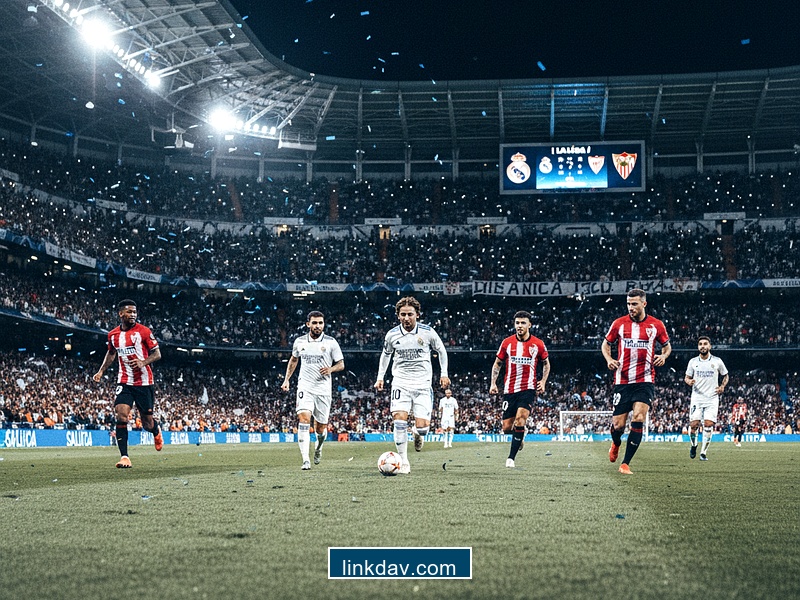
A squad list is never just a list. To the untrained eye, Real Madrid’s announcement for the trip to the Ramón Sánchez Pizjuán is a roll call of available millionaires. To a professional scout, it is a declaration of tactical intent, a risk assessment document, and a psychological profile wrapped into one. Carlo Ancelotti isn't simply picking the best eleven footballers; he is curating a specific set of biomechanical traits to survive one of Europe’s most hostile cauldrons.
Sevilla away is not a football match; it is an ambush. The "Nervión" atmosphere demands a specific kind of athletic arrogance. Looking at the traveling party, we see a distinct shift away from possession-obsessed aesthetics toward verticality and duel-dominance. This isn't about controlling the ball; it's about controlling the space and the man.
Biomechanics of the High Press: The Valverde Axiom
The inclusion of Federico Valverde is non-negotiable, but we need to analyze why beyond his stamina. Watch Valverde’s gait analysis during the warm-up. Most midfielders run with a consistent cadence. Valverde possesses what scouts term a "variable stride pattern." He can shorten his steps to engage in close-quarters combat or elongate them to bypass a low block in transition.
In a fixture like this, Sevilla will look to overload the central channels, creating a claustrophobic midfield battle. Valverde’s value here is his "recovery velocity." It’s the unseen work: the sprint back after a failed attack. When possession is lost, watch how quickly he transitions from an offensive posture (upright, scanning forward) to a defensive tuck (low center of gravity, tracking the runner). This is crucial against Sevilla’s tendency to utilize wing-backs for rapid overlaps. Ancelotti has selected a midfield engine capable of sustaining high-intensity eccentric contractions—the braking force required to stop and turn repeatedly for 90 minutes.
"The modern game isn't decided by who holds the ball, but by who governs the transition. Madrid’s selection suggests they are happy to let Sevilla have the ball, provided they can kill them in the three seconds after winning it back."
Defensive Posture: Rudiger and the Art of Dark Arts
The defensive selection signals a preparation for physical warfare. Antonio Rudiger’s presence is pivotal, not just for his aerial dominance, but for his "anticipatory contact." If you isolate the film on Rudiger, you notice he engages the forward before the ball arrives. He utilizes his forearm to disrupt the striker’s equilibrium, altering their center of mass just enough to ruin their first touch.
This is vital at the Pizjuan. The crowd bays for blood; the referee is under immense cognitive load. Rudiger’s game is built on the edge of legality—the "grey zone" of officiating. By selecting a backline with this level of aggression, Ancelotti is employing a high defensive line that relies on "rest defense." Even when Madrid attacks, Rudiger and Militao (or his partner) will maintain a staggered shape, locking onto Sevilla’s outlets to prevent the counter before it begins. This is "preventative marking," a concept Ancelotti mastered during his time in Serie A and has adapted for the faster pace of La Liga.
Vinicius Jr: The Isolation Mechanic
The narrative around Vinicius Jr often focuses on his dribbling or his temperament. A scout focuses on his deceleration. The squad list confirms he is the focal point, meaning Madrid’s entire offensive structure is built around "isolation mechanics."
Watch Vinicius when he doesn't have the ball. He hugs the touchline, stretching the pitch horizontally. This forces the Sevilla fullback to make a binary choice: step out and leave a gap in the half-space for a midfielder to exploit, or stay narrow and allow Vinicius to receive the ball with momentum. The genius of Vinicius is his ability to go from 30km/h to zero in two steps. This rapid deceleration forces defenders to commit their weight to a tackle that isn't there, allowing him to exit the space laterally.
However, the Pizjuan creates a unique variable: emotional volatility. Sevilla’s defenders will employ "rotational fouling"—taking turns to hit him to avoid accumulation of yellow cards. Ancelotti’s selection of a robust bench suggests he is prepared for the game to devolve into a stop-start brawl. The technical staff will be looking for "trigger movements"—when Vinicius drops deep, does the striker pin the center backs? If not, the spacing collapses.
The False Tempo: Modric and Kroos (The Ghost Paces)
If the veterans are involved, the analysis shifts to "scan frequency." Luka Modric, even in his twilight, scans the field at a rate of 0.8 scans per second, significantly higher than the league average. In a hostile away game, this cognitive processing speed allows Madrid to escape pressure traps.
Sevilla will likely press high early on. The antidote isn't running; it's "La Pausa." This is the South American concept of delaying the pass to draw the defender in, creating space behind them. Madrid’s squad composition balances the chaotic energy of the youngsters with this veteran ability to manipulate the tempo. It is a cynical, brilliant mix. You use the youth to win the physical duels and the veterans to win the mental ones.
The Unseen Work: Off-Ball Gravity
The most critical aspect of this squad announcement is the implication of the "unseen" player. Whether it is Rodrygo or Bellingham operating in the pockets, their role is defined by "gravity."
In scouting terms, gravity is the number of defenders a player attracts simply by existing in a zone. Bellingham, for instance, has immense gravity in the box. When he makes a late run (a "blind-side run" across the defender's shoulder), he collapses the defensive structure. This opens the cut-back zones for others. Against a Sevilla side that can be emotionally charged and positionally undisciplined, these late arrivals into the box are lethal.
Tactical Forecast
Ancelotti has not selected a squad to entertain; he has selected a squad to execute a hit-and-run job. The absence of certain profile types (pure flair players who lack defensive work rate) indicates a shift toward a 4-4-2 defensive shape without the ball.
We will likely see a "mid-block." Madrid will not press Sevilla’s goalkeeper; they will engage at the halfway line. This conserves energy and denies Sevilla the space in behind that they crave. It is a pragmatic, cynical approach that prioritizes structural integrity over possession stats.
In the end, the Pizjuan doesn't care about xG (Expected Goals). It cares about grit. This squad list is a testament to the fact that Ancelotti knows the league is won in the mud of these hostile grounds, not the pristine lawns of the Bernabeu. He has picked a team of disruptors, runners, and fighters. The football might be ugly, but the mechanics of victory often are.