
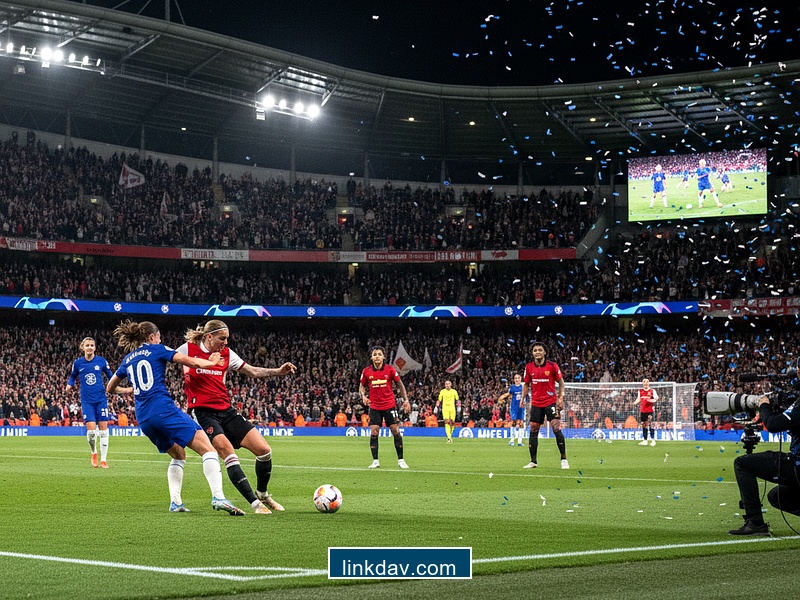
The Women’s Champions League draw has concluded, and with it comes the familiar, suffocating hype of the English media machine. We are told, incessantly, that the Women’s Super League (WSL) is the pinnacle of the sport. We are sold narratives of Chelsea’s inevitability, Arsenal’s redemption, and Manchester United’s insurgence. Yet, as the balls were plucked from the bowls in Nyon, settling the Round 2 fixtures that stand between English clubs and the group stages, I found myself thinking not of the current corporate juggernauts, but of a muddy pitch in Borehamwood nearly two decades ago.
The disparity between the marketing of English supremacy and the reality of European silverware is becoming a chasm. Since 2007, the trophy has resided in Germany, France, and Spain. The draw for Chelsea, Arsenal, and Manchester United is not just a logistical scheduling of fixtures; it is a stark reminder that while the WSL has won the commercial war, it has lost the soul required to win the continental war.
The Vic Akers Blueprint vs. Modern Fragility
To understand why modern English sides repeatedly crumble against Lyon or Barcelona, one must dissect the only English side to ever conquer Europe: the 2006-07 Arsenal Ladies. That team, managed by the legendary Vic Akers—who simultaneously served as the men's kit man—possessed a psychological fortitude that today's six-figure earners seemingly cannot purchase.
When Chelsea faces elite opposition in Europe, particularly in the latter stages or difficult qualifiers, there is a systemic rigidity to their play. They are tactically drilled to perfection by elite coaching staffs, yet they often lack the improvisational genius of the chaotic mid-2000s.
"We didn't have GPS trackers or cryotherapy chambers. We had a fear of losing that was greater than our desire to win. That was the fuel." – Reflections on the '07 era.
Compare the current Chelsea squad to that Arsenal '07 unit. Today, we fawn over the hold-up play of the modern striker, analyzing their xG (Expected Goals) and pressing triggers. But look back at Kelly Smith in her prime. Smith wasn't playing within a 'system'; she was the system. In the 2000s, the tactical setup was often a loose 4-4-2 or 4-5-1, reliant on individual brilliance to break low blocks. Smith played with a street-football arrogance that terrified defenders. She would receive the ball with her back to goal, not to lay it off for an overlapping fullback, but to turn and nutmeg a center-back.
Modern English teams, for all their athletic superiority, have coached the maverick out of the game. They play percentages. The Akers team played with personality. Until a WSL side rediscovers that raw, unquantifiable grit—the kind that saw Alex Scott scoring from distance to silence Umeå IK—the trophy remains a mirage.
The Tactical De-Evolution: From Box-to-Box to Possession Obsession
The draw presents specific tactical nightmares for the English sides, primarily because the European giants play a game the WSL has forgotten. In the mid-2000s, the dominant force was the German school, led by 1. FFC Frankfurt and Turbine Potsdam. Their game was built on physical verticality and the "Libero" influence.
Today, the game is obsessed with Spanish possession metrics. Arsenal, in their current iteration, often fall into the trap of sterile domination. They circulate the ball in a U-shape, racking up 65% possession but failing to penetrate. This is a stark departure from the tactical pragmatism of the past.
Consider the role of the midfield general. In 2007, it was Katie Chapman. Chapman was a destroyer and a creator, a true box-to-box engine who didn't worry about 'half-spaces.' She won the ball and drove it 40 yards. Contrast that with Manchester United’s current midfield engine room. It is technically exquisite, filled with players who can thread a needle, but can they survive a muddy war of attrition in Paris or Wolfsburg? History suggests not.
The European game, specifically the style played by Wolfsburg (heirs to the Frankfurt throne) and Lyon, still values that physical verticality. They bypass the press. While WSL teams are trying to walk the ball into the net to satisfy an aesthetic ideal, European heavyweights are happy to batter them on the counter-attack—a strategy that was commonplace in 2005 and remains lethal in 2024.
The Ghost of Umeå IK and the Marta Factor
Manchester United’s debut in this competition (referencing their initial entry context) is particularly illustrative of the new world order. They are a club formed, disbanded, and reformed, now thrust into the elite thanks to massive investment. They face institutions that have existed for decades.
When Arsenal beat Umeå IK in the 2007 two-legged final, they were facing Marta—the greatest female player in history—at her absolute peak. Umeå was the 'Galacticos' of the era. The Swedish league (Damallsvenskan) was then what the WSL claims to be now: the best in the world.
How did Arsenal stop Marta? They didn't use a zonal marking system or a high-line offside trap, which are the darlings of modern tactical blogs. They used man-to-man marking and cynical, intelligent fouling. It was ugly. It was effective. It was winning football.
Watching Manchester United or Arsenal in qualifiers today, there is a naïveté. They defend space, not players. When you play against the modern equivalents of Marta—be it Caroline Graham Hansen or Aitana Bonmatí—defending space is suicide. The English game has become too sanitised, too polite. We need less "respect the opponent" and more of the ruthless cynicism that defined the defensive partnerships of the mid-2000s, like Faye White and Casey Stoney, who treated every clearance like a personal vendetta.
Financial Doping vs. Organic Pedigree
The underlying narrative of this draw is money. The WSL has the biggest broadcast deal. Chelsea and United have budgets that dwarf the GDP of some small nations. But in the Women's Champions League, there is a currency more valuable than pounds sterling: Pedigree.
| Era | Dominant Philosophy | Key Attribute | English Status |
|---|---|---|---|
| 2000-2010 | German Physicality | Vertical Power | Underdogs (Winners '07) |
| 2011-2020 | French Hegemony (Lyon) | Resource Monopolization | Participants |
| 2021-Present | Spanish Technicality | Systemic Pressing | Pretenders |
Lyon did not become the queens of Europe solely because of Aulas’s money; they built a culture where losing a single game was a crisis. English clubs tolerate failure too easily. A semi-final exit is greeted with "we go again" Instagram posts and applause for "growth."
In the era of 1. FFC Frankfurt, led by the indomitable Birgit Prinz, losing was shameful. Prinz, a three-time World Player of the Year, played with a physicality that would likely see her red-carded in today’s non-contact obsessed WSL. She was a striker who bullied defenders. Our current crop of English forwards are undeniably skilled, but do they fear failure the way the legends did?
The Verdict
As Chelsea, Arsenal, and Manchester United prepare for their European fixtures, they should stop looking at the tapes of Barcelona or Lyon to emulate them. They should look at the tapes of Arsenal 2007. They need to strip away the over-coaching, the obsession with perfect possession, and the sanitized corporate veneer.
The draw has provided a path, but the obstacle isn't the opposing team; it's the English mindset. Until a WSL team is willing to win ugly, to abandon the "project" for the sake of the result, and to resurrect the spirit of Vic Akers' wash-your-own-kit discipline, the Champions League trophy will remain exactly where it has been for 17 years: on the continent, laughing at our expense.