
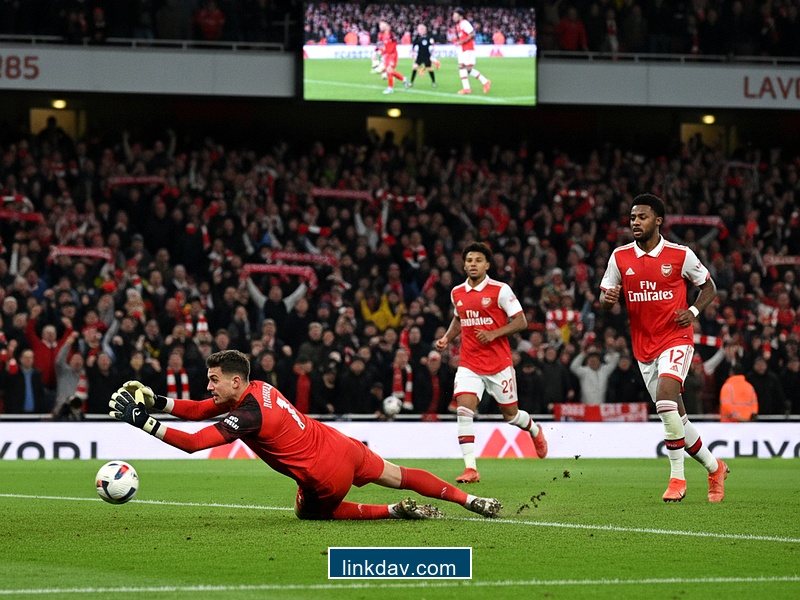
The latest whispers emerging from North London suggest Arsenal are casting their net toward the Bundesliga for yet another goalkeeper. To the casual observer, this reads like transfer market gluttony. To those of us who have tracked Mikel Arteta’s tenure with a forensic lens, it is simply the latest symptom of a relentless, bordering on pathological, pursuit of control.
If the reports linking the Gunners to a German shot-stopper are accurate, we must look past the name on the back of the shirt. This isn't about depth charts or Carabao Cup rotation. This is about the terrifying specificity of the "Project." It is a confirmation that at the Emirates, the goalkeeper is no longer a distinct species protected by the sanctity of the number one jersey. They are now, effectively, the eleventh midfielder.
The Death of the Traditional Number One
To understand why Arsenal are scouting the Bundesliga—a league that has historically functioned as the finishing school for the modern sweeper-keeper—we must first revisit the brutal defenestration of Aaron Ramsdale. Ramsdale was popular, passionate, and by most metrics, a very good goalkeeper. But "good" is the enemy of the specific elite standard Arteta demands.
The acquisition of David Raya was not a competition; it was a usurpation. The statistics from the 2023/24 season paint the picture clearly. Raya didn’t just stop shots; he suffocated attacks before they began. His cross-collection rate sat comfortably above 14%, dwarfing Ramsdale’s numbers. This specific metric is the heartbeat of Arteta’s high line. If you cannot claim crosses 15 yards from your line, the defensive unit cannot squeeze the pitch. The Bundesliga target, whoever it may be, is being recruited not to save penalties, but to act as a prophylactic against chaos.
"We have seen goalkeepers evolved into quarterbacks. But Arteta wants something more nuanced: a goalkeeper who acts as the bait."
Why the Bundesliga? The Tactical Pedigree
Why look to Germany? The answer lies in the tactical DNA of the Bundesliga. Since the days of Ralf Rangnick’s Ulm and the subsequent heavy metal football of Klopp’s Dortmund, the Bundesliga has been the highest-pressing league in Europe's top five. Goalkeepers there do not have the luxury of time.
In the Premier League, pressing structures have become sophisticated, but in Germany, they are feral. A goalkeeper developed in that ecosystem is inoculated against panic. When Arsenal play out from the back, they invite pressure to create artificial transitions. They need a player who sees a charging center-forward not as a threat, but as a mechanism to open a passing lane to Martin Ødegaard.
Historically, Arsenal have suffered when looking for "traditional" qualities. The eras of Bernd Leno (a brilliant shot-stopper but limited with his feet) or Petr Cech (past his prime distribution capabilities) feel like ancient history. By targeting the Bundesliga market now, Arsenal are looking for the Torwart-libero lineage—the Manuel Neuer disciples who are comfortable operating 30 yards from goal.
The Philosophy of "Pausa"
Arteta has frequently spoken about La Pausa—the ability to wait that extra split-second to draw an opponent in before releasing the pass. This concept was once reserved for Spanish midfielders like Xavi or Busquets. Arteta has radicalized this by demanding it from his goalkeeper.
This is where the skepticism arises. Is it sustainable to treat goalkeepers with the same ruthless churn as wingers? The psychological toll on the squad can be heavy. Goalkeepers rely on rhythm and confidence. By constantly looking to upgrade or challenge the position, Arteta risks creating a culture of anxiety rather than competition.
However, looking at the trajectory of Manchester City under Pep Guardiola provides the counter-argument. Claudio Bravo was discarded for Ederson instantly. Ruthlessness is the currency of champions. If Arteta believes a Bundesliga prospect offers a 5% improvement in distribution or sweeping actions over his current backup options, he will pull the trigger. Sentimentality died the day Aubameyang was stripped of the captaincy.
Sustainability and the Financial Fair Play Tightrope
There is also a cynical, economic angle to this potential move. The Premier League’s Profit and Sustainability Rules (PSR) have turned player trading into a necessary evil. Goalkeepers are currently a market inefficiency. You can acquire elite goalkeeping talent from Germany for a fraction of the cost of a mediocre English winger.
If Arsenal can sign a highly rated German keeper for €15-20 million, develop him under goalkeeping coach Iñaki Caña, and sell him on for double that price two years later, the move justifies itself on the balance sheet alone. We saw this model attempted with Matt Turner and Runarsson, albeit unsuccessfully. The club is now shopping in a higher tier of quality, suggesting they have learned that "project players" must still be Champions League quality.
The Verdict: A Feature, Not a Bug
Is this a good choice for Arteta? The question is almost irrelevant because the choice itself reveals the manager's intent. He is building a machine where no part is irreplaceable. The pursuit of a Bundesliga keeper signifies that Arsenal are no longer content with having a "solid backup." They want a clone of their starter.
The modern game is decided by margins. Last season, Arsenal lost the title by two points. A goalkeeper who is 10% better with his feet might result in one less turnover, one more sustained attack, and ultimately, one more goal over a 38-game season. That is the math Arteta is doing.
This relentless upgrading is exhausting for fans who want heroes to stay forever. But we are witnessing the final phase of Arsenal’s transformation from a football club into a high-performance winning entity. In that environment, looking at a Bundesliga keeper isn't just a transfer rumor; it's a declaration that perfection is the only acceptable standard.