
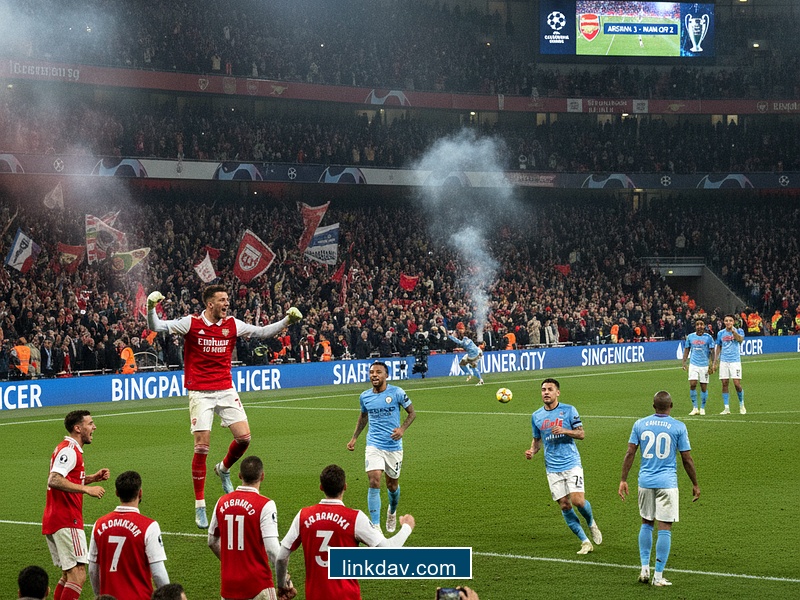
The latest Champions League power rankings following Matchday 6 tell a story far more compelling than a simple accumulation of coefficients. Arsenal sitting at number one, with Manchester City lurking in the shadows and Napoli crumbling, represents a fundamental shift in the tectonic plates of European football. We are witnessing the final death knell of the "Galactico" era and the absolute triumph of System Ideology.
To understand why Mikel Arteta’s Arsenal currently looks down on the rest of the continent, we must stop comparing them to Pep Guardiola’s Manchester City. That is a lazy parallel. The true historical mirror for this Arsenal side is not the Etihad machine of 2023, but the skeletal structure of Arsène Wenger’s "Invincibles" of 2003-04, albeit inverted by modern pragmatism.
The Ghost of Highbury vs. The Concrete of the Emirates
For nearly two decades, the post-Highbury narrative surrounding Arsenal was one of fragility. We remember the chaotic defending of the Almunia years, the naïve optimism of the Fabregas era, and the soft underbelly that made Didier Drogba look like a mythological monster every time he visited North London.
Arteta has not just fixed the defense; he has resurrected the spirit of the 1998-99 back four—Dixon, Adams, Keown, Winterburn—and modernized it. The partnership of William Saliba and Gabriel Magalhães is statistically performing at a level that rivals the legendary Manchester United duo of Rio Ferdinand and Nemanja Vidić from 2007-08.
In 2008, United conceded just 22 goals in the Premier League on their way to Champions League glory in Moscow. Saliba and Gabriel possess that same rare duality: one silk, one steel. Saliba operates with the nonchalance of a young Alessandro Nesta, while Gabriel attacks the ball with the raw aggression of a prime John Terry.
The tactical distinction here is crucial. Wenger’s 2006 finalists, who went 995 minutes without conceding in the Champions League, did so through a makeshift, reactive low block led by Kolo Touré and Philippe Senderos. It was a anomaly born of necessity. Arteta’s defensive solidity is proactive. It is a suffocating high press reminiscent of Arrigo Sacchi’s AC Milan in the late 80s, designed not to absorb pressure, but to prevent the opponent from playing entirely.
Manchester City: The Inevitability of the 1999 Treble Winners
The ESPN rankings suggest Manchester City is "rising." This is a polite way of saying they are pacing themselves. There is a terrifying calmness to City’s current campaign that echoes Sir Alex Ferguson’s 1998-99 Treble winners.
In the late 90s, United didn't always destroy teams territorially; they destroyed them psychologically. They knew, with absolute certainty, that if they stayed in the game, the goal would come. City has evolved into this. They no longer require the frantic, 75% possession dominance of Guardiola’s 2011 Barcelona to win. They have embraced the chaos of transition.
The critical variable is Kevin De Bruyne (and his imminent return/influence) compared to the role of Zinedine Zidane for Real Madrid in 2002. We are watching a master enter his twilight. Like Zidane managing his body for the '02 final volley in Glasgow, City is managing their squad for April and May. The reliance on Erling Haaland has altered their geometry, making them less beautiful but more lethal—a shift comparable to when Bayern Munich moved from the fluid "Robbery" (Robben and Ribery) era to the direct devastation of the Robert Lewandowski years.
Napoli and the Curse of the "Second Season"
Napoli’s fall from grace was written in the stars the moment Luciano Spalletti resigned. History teaches us that teams built on emotional momentum and over-performance rarely sustain it once the architect leaves.
We saw this with Inter Milan post-2010. Jose Mourinho squeezed every drop of blood from that treble-winning squad. When Rafa Benitez took over, the husk remained, but the soul was gone. Inter collapsed from European kings to mid-table obscurities within 12 months.
Napoli is currently undergoing the exact same decomposition. The magic of Khvicha Kvaratskhelia and Victor Osimhen last season relied on a synchronized pressing system that masked individual defensive deficiencies. Without that structure, they look like the Zdeněk Zeman sides of the 90s—all attack, no balance, and glass jaws. Their "trouble" isn't a slump; it's a regression to the mean.
Tactical Evolution: The Death of the Number 10
The rankings also highlight a broader tactical trend across the top 10. The classical "Number 10"—the luxury player like Juan Roman Riquelme or Mesut Özil—is extinct at this level.
| Tactical Element | 2004 Era (Arsenal/Milan) | 2024 Era (Arsenal/City) |
|---|---|---|
| Playmaker Position | Central, behind striker (Bergkamp/Kaka) | Inverted Fullback or Box-to-Box 8 (Odegaard/Trent) |
| Wingers | Wide providers (Pires/Giggs) | Inside forwards/scorers (Saka/Salah) |
| Defensive Shape | Two banks of four (4-4-2) | Rest defense (3-2 or 2-3 build-up) |
Arsenal sits at number one because Martin Ødegaard is not playing as a 10; he is the trigger for the press. He runs more than almost any midfielder in the league. Compare this to the 2006 Arsenal side, where Cesc Fàbregas was protected by Gilberto Silva. Today, the creative players are the defensive screen.
The Verdict: Why Arsenal’s Ranking is Justified
To rank Arsenal above the holders, Manchester City, and the royalty of Real Madrid requires bravery, but the logic holds water when viewed through the lens of control. In the Champions League, chaos usually favors Real Madrid. However, over the last 18 months, Arteta has built a team designed specifically to kill chaos.
This Arsenal team has conceded the fewest expected goals (xG) in the Premier League and remains miserly in Europe. If we look back at the 2005 Liverpool side under Rafa Benitez, they won the Champions League not because they were the best team, but because they were the hardest to beat. Arsenal has the technical quality of the 2004 Invincibles combined with the defensive stubbornness of Benitez’s Liverpool.
While City is rising and Madrid is resting on heritage, Arsenal is the only team in Europe playing with the hunger of a challenger and the discipline of a champion. They have exorcised the demons of the Round of 16. The ghost of Highbury is smiling, not because of the beautiful football, but because for the first time in twenty years, Arsenal looks like a team that enjoys keeping a clean sheet more than scoring a perfect goal.