
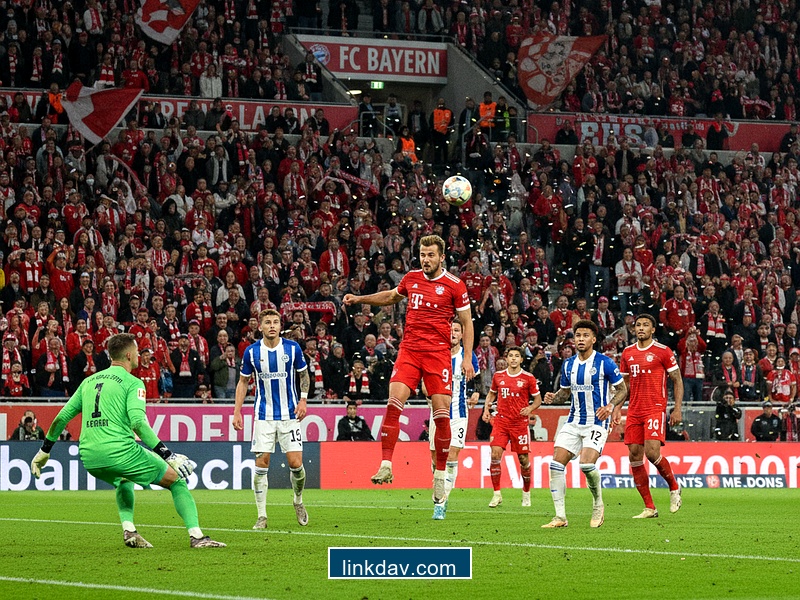
The scoreboard at the Voith-Arena read 0-4, but the true devastation wasn't numerical; it was psychological. Watching Bayern Munich dismantle Heidenheim to secure a nine-point lead going into the winter break wasn't about witnessing a contest. It was a lesson in spatial suffocation. For a scout, the intrigue in this December 21st fixture wasn't the ball hitting the net—it was the brutal efficiency of the movement that happened thirty seconds prior to every goal.
Frank Schmidt’s Heidenheim is built on disruption. They thrive on chaotic transitions and making the pitch feel like a phone booth. Yet, Bayern arrived in Baden-Württemberg not to match that physicality, but to render it obsolete. The Bavarian giants didn't just win; they bypassed the contest entirely through superior body orientation and cognitive speed.
The Mechanics of Harry Kane’s Gravity
Harry Kane smashing another Bundesliga record is the headline for the tabloids. For the purists, the story is his gravity. Throughout the first half, Kane rarely sprinted. Instead, he engaged in what we call "false engagement." He drops five yards into the number 10 space, dragging the Heidenheim center-back with him. This isn't just dropping deep; it’s a calculated manipulation of the opposition's defensive line height.
In the 24th minute, just before the opener, watch Kane’s head. He scans four times in six seconds. He isn't looking for the ball; he is checking the hips of the Heidenheim defensive midfielder. By occupying that specific pocket of space, he forces the opponent to make a binary choice: step up and leave space behind for the wingers, or stay back and let Kane turn.
"Great strikers score goals. Generational strikers dictate where the other 21 players stand on the pitch without touching the ball. Kane has mastered the art of being dangerous while standing still."
When he eventually finished for the record-breaking goal, his biomechanics were textbook. While most strikers plant their standing foot hard to generate power, Kane creates torque through hip rotation, allowing him to shoot instantly with minimal backlift. It’s this lack of "telegraphing" that freezes goalkeepers. They don't react because the visual cues of a shot are missing until the ball is already past them.
Rest Defense: The Arrogance of the High Line
The most impressive aspect of this 4-0 drubbing wasn't the attack—it was Bayern’s Restverteidigung (rest defense). This is the structure a team maintains while they are in possession, specifically to prevent counter-attacks. Heidenheim lives for the counter. They want to bypass midfield with vertical passes the moment they win the ball.
Bayern countered this by positioning their full-backs inverted, almost as auxiliary defensive midfielders. When the ball was lost in the final third, Bayern didn't retreat. They initiated an immediate counter-press, but look closer at the unit behind the press. The center-backs weren't watching the ball; they were physically blocking the passing lanes to Heidenheim's outlets before the pass could even be attempted.
This is high-risk, high-reward tactical gambling. It requires defenders with elite recovery pace and the anticipation to intercept passes before they are made. By suffocating the outlets, Bayern turned Heidenheim’s greatest strength—transition play—into a turnover machine. It creates a claustrophobic effect for the home side; every time they cleared their lines, the ball came back with interest within three seconds.
Breaking the Low Block: The Half-Space Invasion
Heidenheim defended in a compact 5-3-2 low block, a structure designed to force play wide and crowd the penalty box. Historically, Bayern has struggled against this by resorting to endless, sterile crosses. In this match, the approach was surgical. Instead of going around the block, they went through the half-spaces (the vertical channels between the center and the wing).
The interplay between Musiala and the overlapping runners was a masterclass in "third-man combinations." Player A passes to Player B, who immediately sets it for Player C, who is running into a space that didn't exist two seconds ago. This requires blind trust. Musiala, in particular, received the ball frequently on the "half-turn"—back to goal, but body opened up to spin past his marker.
| Metric | Heidenheim (Typical) | Bayern (This Match) | Tactical Insight |
|---|---|---|---|
| Line of Engagement | Low (Defensive Third) | Ultra-High | Bayern compressed the pitch to 30 meters. |
| Pass Completion (Final Third) | 65% | 88% | Indicates precision against a crowded box. |
| Sprints without Ball | High (Reactive) | Elite (Proactive) | Bayern moved to create space, not just chase. |
The Winter Champion Context
A nine-point lead at Christmas in the Bundesliga is historically a death sentence for the title race. We have seen this movie before. In the 2012/13 season under Jupp Heynckes, Bayern established a dominance that rendered the spring fixtures a formality. This current iteration feels frighteningly similar, not because of the points total, but because of the adaptability.
Earlier in the season, critics pointed to defensive fragility. This performance against Heidenheim silenced that narrative. To go to the Voith-Arena in freezing temperatures—a venue where top teams often drop points due to the sheer awkwardness of the fixture—and deliver a clean sheet speaks to a mental fortitude that was missing in previous years.
The coaching staff deserves immense credit for the rotation of the triangular shapes on the wings. By constantly swapping the winger and the attacking midfielder, they caused cognitive overload for the Heidenheim defenders. A defender can track a runner, but they struggle to track a runner who changes identity every three minutes. Is it Sané? Is it Musiala? By the time the defender processes the threat, the ball is in the net.
The Unseen Work of the Pivot
While the forwards take the glory, the double pivot in midfield operated with the cold detachment of assassins. Their role wasn't just distribution; it was spatial denial. By positioning themselves explicitly to cut off the passing lanes to Heidenheim’s strikers, they forced the home side to play lateral passes. Lateral passes against a pressing machine like Bayern are suicide.
Watch the replay of the third goal. It starts with a seemingly innocuous interception near the center circle. The midfielder didn't lunge. He simply stood in the shadow of the intended receiver, reading the eyes of the passer. That split-second anticipation is the difference between a Heidenheim break and a Bayern goal. It is the invisible work that defines elite football.
As the Bundesliga heads into the winter break, the rest of the league faces an existential crisis. Bayern isn't just winning; they are evolving. They have married the physical dominance required for the Bundesliga with the tactical sophistication of the modern positional game. If Heidenheim was a stress test for Bayern's ability to handle adversity, the Bavarians didn't just pass; they rewrote the grading scale.