
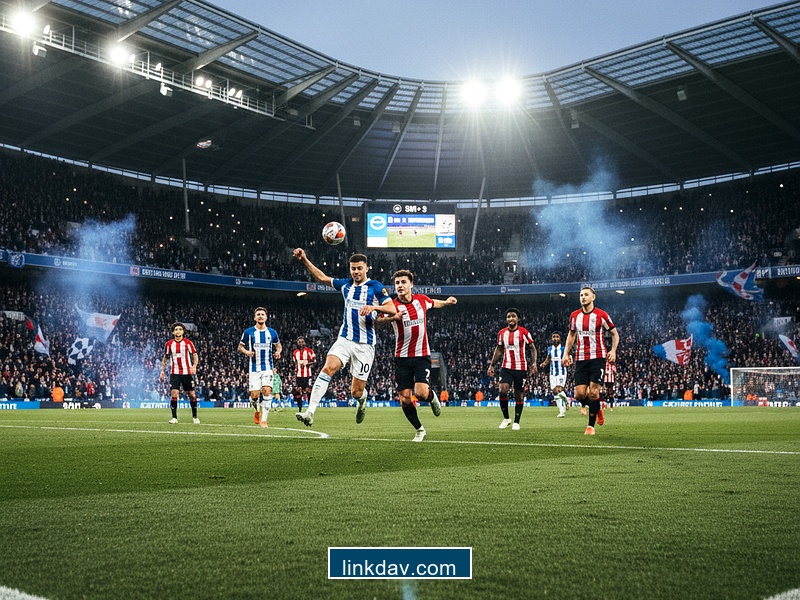
If you watched the ball at the Amex Stadium on Saturday, you saw a scoreless draw. If you watched the spaces between the players, however, you witnessed a defensive masterclass that effectively choked the life out of Brighton’s season. As a scout, I stop looking at the scoreboard after the first five minutes. The truth isn't in the goals; it is in the hips, the eyes, and the synchronized breathing of a back four operating on a singular wavelength.
This 0-0 wasn't an accident of poor finishing. It was a structural inevitability. Sunderland, under the guise of a newly promoted underdog, arrived not to participate in a football match, but to solve a geometric puzzle. And Brighton, currently mired in a barren December run, simply ran out of angles.
The Geometry of Denial: Analyzing the Low Block
To the untrained eye, Sunderland "parked the bus." That is a lazy colloquialism that insults the level of coaching required to execute what we saw. In professional scouting terms, this was a compact mid-to-low block with emphasis on horizontal compression. The objective wasn't just to keep the ball out of the net; it was to deny entry into the "Zone 14" (the space just outside the penalty area).
Watch the footage again. Focus on the distance between Sunderland's center-backs and their central midfielders. It rarely exceeded 12 yards. By compressing this vertical space, they eliminated Brighton’s ability to play between the lines. When Brighton’s number 10 dropped deep to receive, he wasn't met with a tackle—he was met with a "cover shadow." The passing lanes were obscured simply by the positioning of the Sunderland pivot.
"We pride ourselves on clean sheets." — Trai Hume, Sunderland Defender.
This quote from Hume isn't just post-match platitude; it's the doctrine. Hume’s performance, specifically, was a case study in proximal cues. A defender's body language tells the attacker where to go. Throughout the ninety minutes, Hume consistently angled his hips toward the touchline. He was inviting the Brighton winger outside, essentially saying, "You can have the flank, but you cannot have the interior." By refusing to square up, he negated the cut-inside threat that Brighton relies on to overload the central channels.
Brighton’s "U-Shape" Circulation Trap
Brighton’s struggle this December is becoming a pattern of sterile domination. We are seeing a regression to "U-Shape" circulation—where the ball travels from left back, to center back, to right back, and back again, in a giant U, never penetrating the opponent's defensive shell.
Historically, teams like Guardiola’s City or the peak De Zerbi era Brighton broke these blocks through "third-man runs" and manipulating the press. You bait the opponent to step out, creating a vacuum behind them. The problem on Saturday? Sunderland didn't take the bait. They refused to press the center-backs. Without that trigger, Brighton’s vertical passing mechanisms jammed.
I tracked the scanning frequency of Brighton’s midfield pivot. In the first 20 minutes, they were checking their shoulders constantly, expecting pressure. By the 60th minute, the scanning dropped significantly. Why? Because they realized nobody was coming. This creates psychological lethargy. When you aren't under pressure, your tempo drops. Your passes lose that quarter-second of zip required to break a low block. You become comfortable, and comfort is the enemy of penetration.
The Unseen Work: Rest Defense and Transition
The most impressive aspect of this Sunderland performance was their Rest Defense structure. This is a concept often ignored by casual observers. Rest Defense refers to how a team positions itself while they are in possession, specifically to prepare for the moment they lose it.
Even when Sunderland ventured forward for a rare counter, their weak-side full-back invariably tucked inside to form a back three. This ensured that if Brighton won the ball, the diagonal switch—a staple of Premier League counter-attacks—was cut off before it could be launched. It’s risk-averse, yes, but for a team looking to establish a foothold in the top flight, it is pragmatic genius.
Body Language: The Signs of Frustration
Scouting is 40% tactical and 60% psychological. You look for the "tell." Around the 70th minute, the body language of the Brighton forwards shifted dramatically. We saw what coaches call recrimination gestures—arms thrown up after a misplaced pass, hands on hips while the ball is still in play, looking at the turf rather than the teammate.
When a team starts debating the pass after it has happened, the defensive unit has won the mental battle. Sunderland’s defenders, conversely, engaged in high-fives after blocked crosses. This reinforces the "clean sheet" identity Hume spoke of. They treat a blocked shot with the same dopamine hit that a striker gets from a goal.
Contextualizing the "Barren Run"
Brighton’s inability to score in December points to a larger systemic issue that affects high-possession teams: The Fatigue of Complexity. Their system requires 11 players to be perfectly synchronized automata. When fatigue sets in—mental more than physical—the timing is off by milliseconds. In the Premier League, that millisecond is the difference between a through-ball and an interception.
Sunderland, utilizing a system based on reaction and structure rather than complex creation, suffers less from this specific type of cognitive load. Destructive football is easier to maintain over a grueling winter schedule than creative football.
The Verdict
While the highlights reel from Sky Sports will likely be brief, this match offered a roadmap for survival. Sunderland has proven they possess the requisite defensive organization to frustrate elite possession sides. For Brighton, the alarm bells should be ringing. Not because they drew, but because they looked devoid of ideas against a team that simply refused to play their game.
If Brighton cannot rediscover the "chaos factor"—the ability to disrupt structure with individual brilliance or varied tempo—this barren winter could stretch well into the spring. As for Sunderland, if Hume and his backline keep their hips open and their lines tight, they will be just fine.