
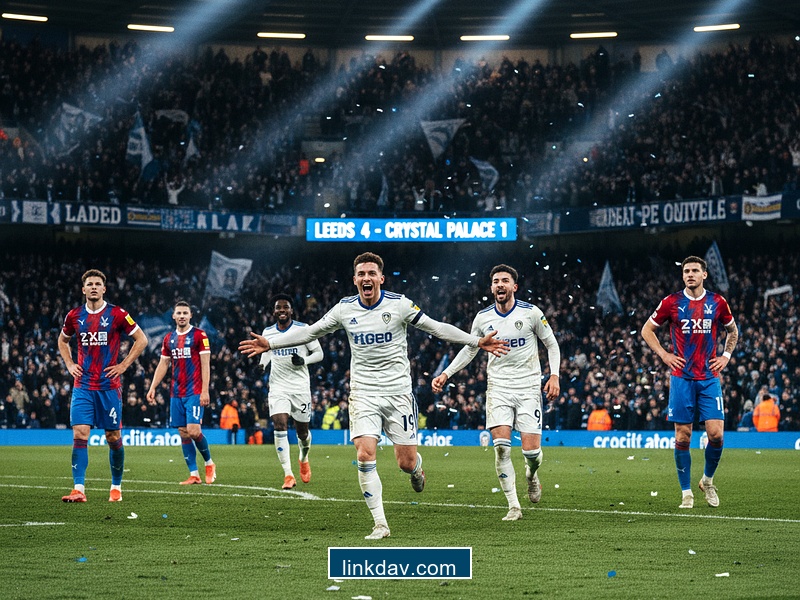
There are victories that earn three points, and then there are victories that exorcise ghosts. Leeds United’s 4-1 dismantling of Crystal Palace at Elland Road wasn’t just a tactical masterclass; it was a séance. For ninety minutes, the West Stand wasn’t watching a standard Premier League fixture. They were watching a resurrection of the fearless, cavalier spirit that defined the club’s dizzying highs and catastrophic lows of the early 2000s.
To view this result merely through the lens of Expected Goals (xG) or possession stats is to miss the cultural seismic shift occurring in West Yorkshire. We aren't seeing the rigid, frantic man-marking of the Marcelo Bielsa era, nor the pragmatic survivalism of the interim managers that followed. We are witnessing a return to the swagger of David O’Leary’s "Babies"—a team that doesn't just want to beat you, but wants to embarrass you with a smile on its face.
The Art of Controlled Chaos
Crystal Palace arrived with the reputation of a stubborn, well-drilled unit, the kind of team that usually turns Elland Road into a cauldron of frustration. Under typical circumstances, Palace sets a low block, invites pressure, and hurts you on the break. Historically, this is Leeds' kryptonite. Yet, the 4-1 scoreline flatters the visitors. It could have been six.
The tactical distinction here lies in the transition. In the 2000-01 season, when Leeds reached the Champions League semi-finals, their game was built on direct, explosive counter-attacks utilizing the pace of Harry Kewell and the hold-up play of Mark Viduka. Today’s Leeds mirrors that geometry but with modern pressing triggers. The third goal, a sweeping move from left-back to right-wing in three touches, was pure kinetic energy.
Daniel Farke has instilled a "rest defense" structure that allows the front four to play with an audacity we haven't seen since the days of Lee Bowyer arriving late in the box. When Palace tried to clear their lines, they weren't met by a retreating midfield; they were met by a white wall. This is a sophistication that separates pretenders from contenders.
"You look at the way they hunt the ball in packs, and it’s not desperation. It’s arrogance. The good kind. The kind that says, 'We are Leeds, and you are trapped in here with us.'"
Summerville and the Viduka Shadow
It is dangerous to compare modern players to legends, but the performance of the Leeds frontline demands it. For years, the No. 9 shirt at Leeds has been a heavy burden, weighed down by the memories of Mark Viduka’s velvet touch and Alan Smith’s bulldog aggression. In this 4-1 rout, we finally saw the synthesis of those two archetypes.
The second goal was a Viduka tribute act. Receiving the ball with back to goal, rolling the Palace center-back, and firing into the far corner requires a specific type of biomechanical genius. Viduka scored four against Liverpool in November 2000 using that exact center of gravity. The current iteration of Leeds’ attack possesses that same low center of gravity but pairs it with a chaotic fluidity that makes marking impossible.
Where the 2001 team relied on the rigid 4-4-2 structure of the era, this team operates in the half-spaces. The wingers aren't hugging the touchline; they are inverting, acting as dual No. 10s. It forces opposition defenders to make split-second decisions—step up and leave space behind, or drop deep and allow a shot. Palace did neither, and they perished.
The Midfield Engine: Batty Reborn?
You cannot discuss a 4-1 victory without addressing the engine room. In the glory days, David Batty provided the grit that allowed the artists to paint. He was the unsung hero who recycled possession and snapped into tackles. Against Palace, the Leeds midfield pivot was arguably superior in distribution, if not quite as menacing in the tackle.
The defining metric of this match was "progressive passes received." Leeds dominated the central channels. In 2001, Olivier Dacourt and Batty protected the back four. In 2024/25, the midfield is tasked with breaking lines. The assist for the opening goal—a laser-guided through ball splitting the Palace center-halves—was a pass purely of the modern era. It bypassed the entire Palace midfield line in one motion. That is the evolution: the grit is still there, but the technical floor is significantly higher.
Historical Warnings: The Icarus Complex
However, a word of caution is necessary for the Elland Road faithful getting ready to book European flights. The spectre of the early 2000s isn't just about glory; it's a cautionary tale of hubris. The O’Leary side was characterized by a youthful naivety that eventually saw them burn out. They chased the dream too hard, too fast, without the squad depth to sustain it.
This 4-1 result is intoxicating, but the Premier League is a marathon of attrition. The intensity required to dismantle Palace in this fashion takes a physical toll. We saw this with Bielsa’s burnout. The challenge now is squad management. Can this team rotate without a massive drop in quality?
| Metric | Leeds United (2000-01 Era) | Leeds United (Current vs Palace) |
|---|---|---|
| Primary Tactical Shape | Rigid 4-4-2 (Direct) | Fluid 4-2-3-1 (Rotational) |
| Defensive Philosophy | Individual Man-Marking/Hard Tackle | Zonal Pressing Traps |
| Key Attacking trait | Crosses & Target Man Hold-up | Inverted Wingers & Half-space overload |
| Psychological Profile | "Living the Dream" | Systematic Control |
The Verdict: A New Identity
What separates this 4-1 victory from other good days at the office is the sense of sustainability. When Leeds beat Chelsea 3-0 under Bielsa, it felt like a high-wire act—thrilling, but one slip away from disaster. This performance against Palace felt structural. It felt like a team that belongs in the upper echelons not by luck, but by design.
The "Fear Factor" is the most valuable currency in English football. For the better part of two decades, teams came to Elland Road expecting a fight but believing they could leave with points. That belief is evaporating. Just as teams dreaded the trip to face Radebe, Mills, and Ferdinand, they are now realizing that the current Leeds setup offers no respite.
If the O’Leary era was a rock and roll band trashing a hotel room, this current side is a symphony orchestra playing at a deafening volume. It is precise, it is loud, and on the evidence of this result against Palace, it is absolutely terrifying for the rest of the league.
History doesn't repeat itself, but it rhymes. And right now, the rhythm at Elland Road sounds suspiciously like the Champions League anthem is warming up in the distance.