
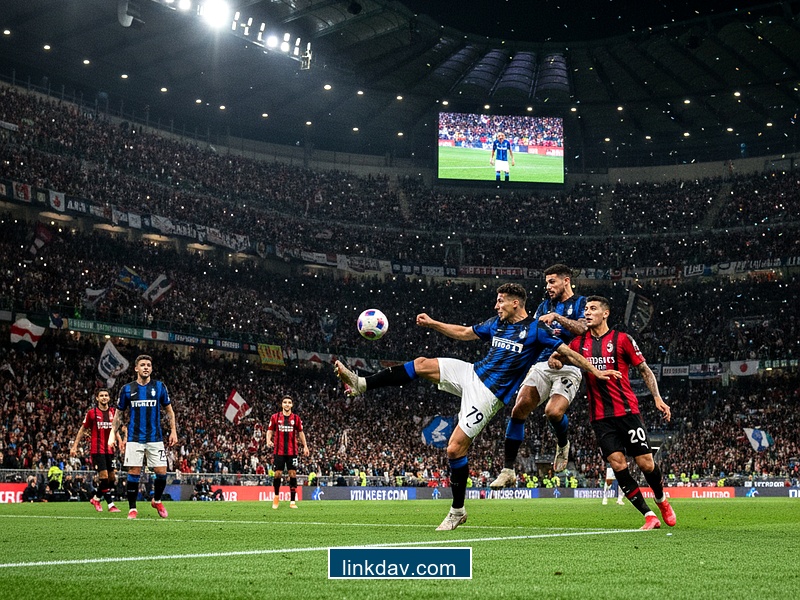
The recent confirmation that plans for a Serie A fixture in Australia have collapsed under the weight of Asian Football Confederation (AFC) conditions is more than a bureaucratic hiccup. It is a denial of education. While the Reuters dispatch frames this as a failure of logistics and scheduling—a clash of calendars and confederations—the true loss is far more granular. For the Australian football public, and specifically for the developing coaching eye within the A-League ecosystem, this is a missed opportunity to witness the highest level of off-the-ball cognition on the planet.
We need to strip away the commercial veneer. Forget the ticket sales or the tourism dollars. When you sit in the stands to watch a top-tier Italian side, you are not watching a match; you are witnessing a clinic in spatial manipulation. Television is a liar. It focuses on the ball. It zooms in on the dribble. But professional scouting—the lens through which we must view this cancellation—requires a wide angle. It requires seeing what happens 40 yards away from the action.
The Tyranny of the Camera Lens
The tragedy of modern football consumption is the broadcast crop. When you watch Inter Milan or Juventus on a screen, you see the execution of a pass. What you miss is the pre-orientation. You miss the three shoulder checks a regista makes in the ten seconds before the ball even arrives. This is the "unseen work" that defines the Italian game, and it is exactly what Australian audiences have been robbed of observing.
In Serie A, the game is played largely in the mind. The cancellation means local fans cannot see the specific body mechanics of a center-back fixing a striker. This is a subtle art. It involves standing perfectly still, stud-to-turf, inviting a press only to bypass it with a vertical line-breaking pass the moment the opponent shifts their weight. This creates a "pressing trigger"—a trap laid by the defender, not the attacker. You cannot appreciate the tension of that stillness through a 4K broadcast.
"The camera shows you the history of the play. The stadium shows you the future of the play."
Anatomy of the Cancellation: A Bureaucratic Low Block
The AFC’s intervention operates much like a classic Jose Mourinho low block: rigid, unyielding, and designed to nullify space. By enforcing strict conditions on foreign leagues playing competitive or high-profile games within their jurisdiction, the AFC is protecting its territory. Historically, this mirrors the resistance the English Premier League faced with its proposed "Game 39" concept years ago. The fear is cannibalization of domestic interest.
However, this protectionism ignores the value of proximity. The A-League suffers not from a lack of effort, but from a lack of tempo variance. Italian teams are masters of La Pausa—the ability to slow the game to a walking pace before exploding into a vertical transition. Watching this rhythm shift live is visceral. It changes how young players understand momentum. By blocking this fixture, the administrative bodies have prioritized territorial integrity over technical osmosis.
The Lost Lesson: Rest Defense and Cover Shadows
If the game had proceeded, the most valuable takeaway for the astute observer would have been the concept of Rest Defense (Restverteidigung). This is the structure a team maintains while they are attacking, designed to prevent counter-attacks before they begin.
Italian sides, particularly those influenced by the tactical school of Coverciano, are obsessive about this. While the ball is deep in the opponent's third, watch the back three and the holding midfielder. They are not spectating. They are adjusting their coordinates by inches to ensure they are occupying the opponent's "cover shadows"—the blind spots where an outlet pass might go. They are physically blocking passing lanes that haven't opened yet.
Live viewing allows you to see the communication required to maintain this shape. It’s a constant stream of non-verbal cues: a pointed finger, a subtle grab of the shirt, a shift in hip orientation to force an opponent wide. This is the dark art of Calcio. It is cynical, brilliant, and entirely invisible on TV.
The Half-Space and the Mezzala Role
The specific tactical loss here involves the role of the mezzala—the half-winger/half-midfielder hybrid that thrives in Italy’s preferred 3-5-2 systems (favored by the likes of Simone Inzaghi or Gian Piero Gasperini). The movement patterns of a mezzala are counter-intuitive. When the ball goes wide, they often underlap into the box, or conversely, drift incredibly wide to overload a fullback.
To scout a mezzala properly, you watch their eyes. They are constantly scanning for the "half-space"—the vertical channel between the opposition center-back and fullback. The timing of their run is predicated on the body language of the opponent. If the defender crosses their feet or turns their back, the mezzala accelerates. This "trigger movement" is the difference between a blocked cross and a goal. It is a biomechanical chess match that Australia’s developing midfielders desperately needed to study in person.
The Economics of Movement
There is a distinct economy of movement in Serie A veterans that contrasts sharply with the frantic energy often seen in developing leagues. We often mistake distance covered for effectiveness. A top-tier Italian defender like Francesco Acerbi or Alessandro Bastoni often runs less than their counterparts because their starting position is superior.
This is what we call "defensive efficiency." It is recognizing that if you step two yards forward as the ball travels through the air, you eliminate the need for a 40-yard recovery sprint later. Seeing a 35-year-old defender nullify a 20-year-old speedster without breaking into a full sprint is a lesson in cognitive positioning. It teaches young players that the brain is faster than the legs.
Administrative Friction vs. Footballing Reality
The Reuters report cites the promoter's inability to meet AFC constraints. This is the surface-level debris of a deeper structural clash. The AFC wants to build the Asian Champions League Elite; they want eyes on their product. But product quality is elevated by exposure to the best. The isolationist approach—treating the confederation borders like a closed shop—stifles the tactical evolution of the region.
When European giants tour, yes, it is a cash grab. Let’s not be naive. But for the 90 minutes the whistle blows, the players revert to their training. Their muscle memory takes over. And that muscle memory is programmed with the most sophisticated tactical coding in the sport. The cancellation saves the AFC some administrative face, but it costs the Australian football community a masterclass in the invisible mechanics of the game.
We are left, once again, to watch the pixels on a screen, guessing at the movement off-camera, while the real education happens thousands of miles away, behind closed doors.