
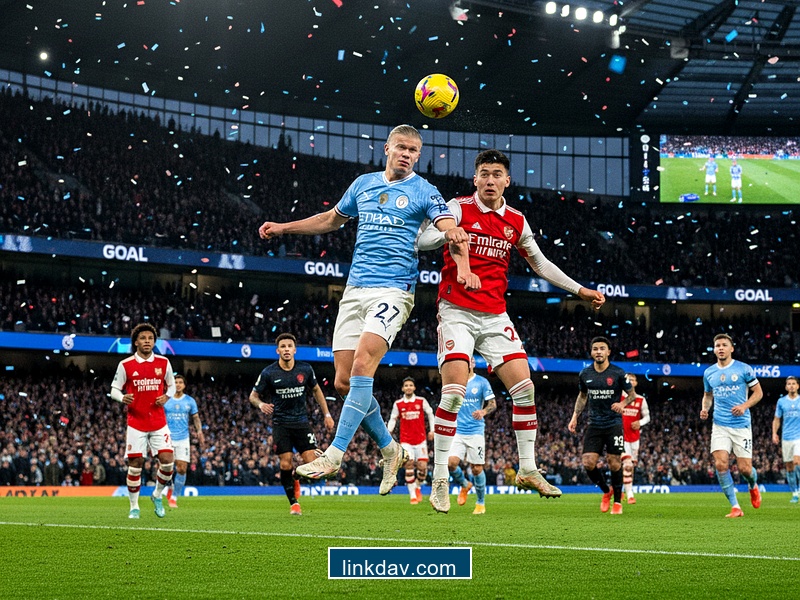
When GOAL released their Premier League Team of the Season so far for 2025-26, the inclusion of Erling Haaland and Declan Rice was about as surprising as rain in Manchester. It is a list that reads less like a celebration of individual brilliance and more like a confirmation of a tactical duopoly that has strangled the unpredictability out of English football. We are looking at a teamsheet that doesn’t just represent form; it represents the final, crystallized stage of two distinct, yet equally terrifying, managerial projects.
To the casual observer, Haaland is there because he scores goals, and Rice is there because he wins the ball. But to view them through such a rudimentary lens is to miss the broader geopolitical shift occurring in the technical areas of the Etihad and the Emirates. We are witnessing the industrialization of talent.
The City Project: The Era of 'Post-Control'
For years, the narrative surrounding Manchester City was one of obsessive control. The "death by a thousand passes" philosophy. However, the 2025-26 iteration of City has evolved into something far more cynical and significantly more efficient. The presence of Haaland in this list confirms the final abandonment of the false nine—a romantic ideal Pep Guardiola clung to for a decade—in favor of brute-force inevitability.
This season, City has not dominated possession statistics in the same way they did in 2021. They have traded possession for position. The managerial philosophy has shifted from "control the ball to deny the opponent" to "bait the opponent to destroy them in transition." Haaland is the linchpin of this shift. He is no longer just the finisher; he is the psychological anchor that forces opposition defensive lines 10 yards deeper, fracturing their ability to press City’s midfield.
"We are seeing a tactical reversion that mirrors the AC Milan of the early 90s under Capello more than the Barcelona of 2011. It is minimalism disguised as opulence."
Is this sustainable? That is the wrong question. The question is whether it is replicable. The City project has moved beyond tactics into muscle memory. When you analyze the "rest defense" (the structure adopted while attacking to prevent counters), City has perfected a 3-2 shape that effectively renders the opponent's counter-attack obsolete before a ball is even lost. This isn't coaching; it's programming. The concern for the rest of the league is that this machine no longer requires Guardiola to scream from the touchline; the code is embedded in the hardware.
The Arsenal Project: The Cult of Neurotic Intensity
If City is a machine, Arsenal is a cult of personality. Declan Rice’s ubiquity in the Team of the Season selections highlights a fundamental difference in Mikel Arteta’s philosophy compared to his mentor. While Guardiola rotates to preserve freshness, Arteta rotates only when forced by amputation. He relies on a core group of "generals" to police standards on the pitch.
Rice’s role has morphed this season. He is no longer playing the pivot; he is playing the role of a "destroyer-creator," a hybrid reminiscent of Patrick Vieira’s 2004 peak but with the passing volume of a modern regista. The tactical innovation here is Arsenal’s use of Rice to artificially create overloads. By dropping him into the left-back zone or driving him into the half-space, Arteta demands a physical output that defies modern sports science.
This reveals the flaw in the Arsenal project. It runs on high-octane emotion. The sustainability of Arteta’s model is suspect because it demands players live on the edge of a nervous breakdown every Saturday. You can see it in the way they celebrate defensive headers. It is manic. Where City’s dominance feels like a inevitable sigh, Arsenal’s feels like a scream.
The Tactical Homogenization of the League
The deeper issue with GOAL’s list is what it says about the league's ecosystem. The gap between the "Haaland/Rice class" and the rest has created a tactical homogenization among the chasing pack. To survive against the verticality of City and the suffocating press of Arsenal, teams like Aston Villa and Newcastle have been forced to adopt conservative, low-block architectures that stifle creativity.
We are seeing the death of the "maverick" manager. There is no room for the chaotic unpredictability of a Kevin Keegan or the laissez-faire brilliance of an early Wenger. Every team in the top six is now managed by a technocrat obsessed with "control." The inclusion of these specific players in the TOTS validates the idea that the Premier League has become a league of systems, not moments.
| Metric | Man City (The Machine) | Arsenal (The Cult) |
|---|---|---|
| Core Philosophy | Positional Rotations | Physical Duels & Second Balls |
| Defensive Structure | Proactive Rest Defense | Man-to-Man High Press |
| Squad Management | Clinical Rotation | Reliance on "Undroppables" |
| Risk Profile | Zero Risk (Calculated) | High Risk (Emotional) |
The Golden Handcuffs
There is a darker undercurrent to this success. Haaland and Rice represent "Golden Handcuffs" for their respective managers. For City, the team has forgotten how to win without a focal point. The intricate interplay of the Gundogan/Silva era is gone, replaced by a system designed solely to feed the Norwegian algorithm. If Haaland drops form, does City have a Plan B? The evidence suggests they have forgotten how to play any other way.
For Arsenal, the dependence on Rice is even more perilous. He is the structural integrity of the entire Emirates stadium. Arteta’s refusal to trust his squad depth means that if Rice’s hamstring twitches, the project collapses. This isn't team building; it's gambling with high stakes assets.
The Verdict
Goal.com’s Team of the Season so far is not a celebration. It is a warning. It showcases a league where financial might has met tactical perfectionism, creating a product that is awe-inspiring but sterile. The presence of Haaland and Rice tells us that the 2025-26 season is defined not by who plays the most beautiful football, but by who makes the fewest mistakes.
We are watching two managers who have solved the game. Guardiola has solved it through geometry; Arteta has solved it through intensity. But in solving the puzzle, they might have killed the fun. When perfection becomes the baseline, brilliance becomes boring. And right now, the Premier League is excruciatingly perfect.