
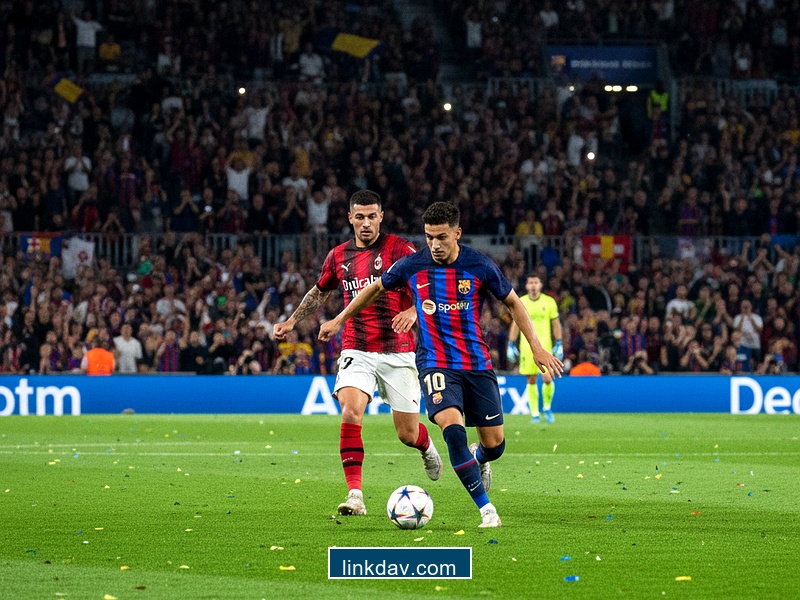
The murmurs from Warsaw to Catalonia are growing louder, and they carry a distinct tone of caution. When a figure of authority—former Polish FA chief and Juventus legend Zbigniew Boniek—publicly advises Robert Lewandowski against a romantic twilight move to AC Milan, suggesting instead the financial embrace of the Saudi Pro League or the lifestyle branding of MLS, we must listen. But not for the reasons the tabloids suggest.
This isn't merely about age or salary caps. It is a damning indictment of the current project at AC Milan, a club currently suspended in an identity crisis between its aristocratic heritage and its algorithmic present. For a striker of Lewandowski's pedigree, trading the calculated verticality of Hansi Flick’s Barcelona for the tactical volatility of Paulo Fonseca’s Rossoneri would be nothing short of professional malpractice.
The RedBird Algorithm: A Project, Not a Legacy
To understand why the advice to avoid Milan is sound, one must look past the crest on the shirt and stare directly into the boardroom. Since RedBird Capital, led by Gerry Cardinale, took the reins, the club has shifted from a patriarch-driven trophy hunter (the Berlusconi model) to a distressed-asset optimization machine.
The firing of Paolo Maldini was the first tremor; the subsequent transfer windows have been the aftershocks. The "Project" at Milan is no longer about assembling Galacticos or squeezing the last drops of genius from aging titans like Zlatan Ibrahimović or Olivier Giroud. It is about player trading, amortization, and resale value. It is Moneyball applied to the chaotic theatre of Serie A.
"Milan is no longer a retirement home for legends looking for one last European dance. It is a startup incubator. An aging superstar entering this ecosystem becomes an anomaly in the algorithm, not the centerpiece of the attack."
This structural reality makes the environment toxic for a player who requires a team built to service his specific movements. The current Milan squad is constructed on the premise of youth development and high-energy pressing from midfield runners like Tijjani Reijnders and Youssouf Fofana. It lacks the hierarchical stability required to support a 36-year-old pure number nine who demands service, not cardio.
The Fonseca Disconnect: Possession Without Purpose?
If the boardroom philosophy is hostile to the concept of an aging superstar, the dugout is tactically incompatible. Paulo Fonseca’s appointment was met with skepticism, and his tenure thus far has been a study in dogmatic adherence to a system that often defies the personnel available.
Fonseca preaches a dominant, possession-based style heavily reliant on positional rotation. In theory, it sounds modern. In practice, within the confines of Serie A’s low-block defensive culture, it often devolves into sterile domination—the dreaded "horseshoe" passing map around the penalty area. We have seen this Milan side struggle to break down organized defenses (witness the frustrations against Parma and Fiorentina earlier this season), relying on moments of individual brilliance from Rafael Leão or Christian Pulisic rather than systemic chance creation.
This is the antithesis of what a poacher needs. Lewandowski thrives on verticality and rapid transitions—the very tenets of the Flick-ball he is currently enjoying in Catalonia. Flick’s system is direct; it forces turnovers high up the pitch and feeds the striker immediately. Fonseca’s Milan, conversely, often allows the opposition to reset their defensive shape while the ball circulates harmlessly among the center-backs. Moving to San Siro would starve the striker, forcing him to drop deep into midfield to touch the ball—a misuse of resources that we saw plague Harry Kane during England's disjointed Euros campaign.
Analyzing the Sustainability of the 'Milan Miracle'
Observers might point to Milan’s stunning Champions League victory over Real Madrid at the Bernabéu as proof of the project’s viability. I argue that result was a mirage—a tactical outlier rather than a sustainable blueprint.
In that match, Milan played as the underdog, surrendering possession and hitting Madrid on the counter-attack. It suited Leão’s pace and the team's athleticism. However, Milan spends 80% of their domestic season facing teams that refuse to give them that space. The "Project" has not solved the issue of breaking down the catenaccio-adjacent blocks of Empoli or Verona.
A superstar striker arriving in January or the summer expects a machine that functions in all weather, not just under the bright lights of a European night. The unpredictability of Fonseca’s defensive structure—often leaving the team exposed with a fragile 2-3 rest defense—means Milan is constantly chasing games. This chaotic game state forces strikers to expend energy pressing and tracking back, eroding the sharpness needed in the six-yard box.
The MLS or Saudi Alternative: Accepting the End
The advice to choose the USA or an Arab country is rooted in a brutal honesty about the player's biological clock. The Serie A is a grinder. Defenders like Alessandro Buongiorno or Gleison Bremer treat duels with a physicality that borders on assault. It is a league where tactical fouls are an art form.
The MLS (Major League Soccer) offers a different proposition. It is a transition-heavy league, often described tactically as "basketball on grass." Defenses are loose, pressing structures are often disjointed, and the space afforded to attackers is immense. For a finisher of world-class caliber, even with diminishing pace, the MLS represents a statistical feast. It extends the career by reducing the physical toll of the defensive low-block grind.
Similarly, the Saudi Pro League, while physically demanding due to the climate, operates at a tempo significantly slower than the top tier of European football. The "Project" there is simple: star power. The tactical systems are designed explicitly to highlight the marquee names. In Milan, the star is the system (or the algorithm). In Riyadh or Miami, the star is the player.
The Verdict: Don't Mistake Nostalgia for Opportunity
There was a time when Milan was the sanctuary for the game’s elders. The Milan Lab extended the careers of Maldini, Costacurta, and Seedorf well into their late 30s. But that institution is gone, replaced by RedBird’s analytics department.
Hansi Flick has revitalized Barcelona by returning to German efficiency—high lines, aggressive pressing, and direct passing. It is a sustainable approach because it maximizes the technical quality of the squad while masking physical deficiencies through collective movement. Milan’s current approach under Fonseca is still in the beta-testing phase. It oscillates between brilliance and collapse.
For a superstar looking at the final chapter, stability is the most valuable currency. AC Milan, in its current iteration, offers excitement, history, and fashion, but it does not offer tactical stability. The advice is sound: if you leave the Camp Nou, do not stop in Italy. The San Siro is a magnificent cathedral, but for an aging striker in 2025, it is a graveyard where tactical experiments go to die.