
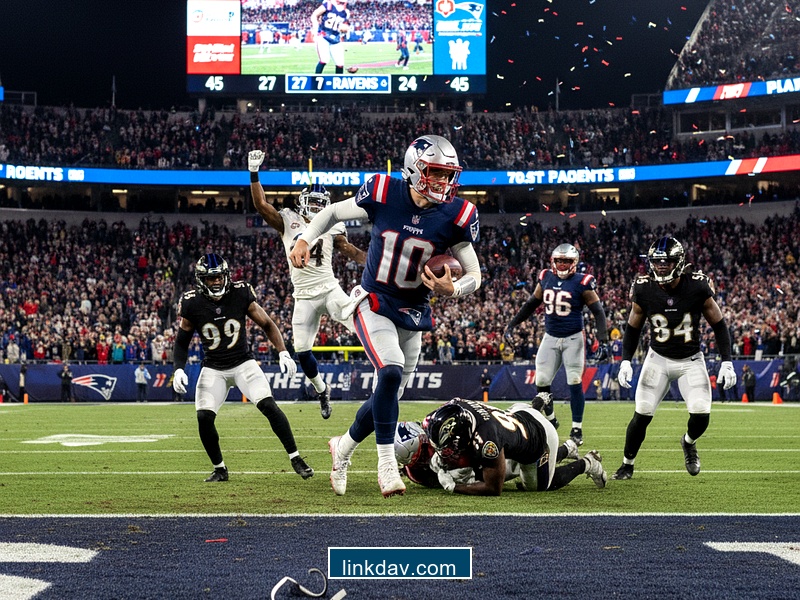
For the better part of five years, Gillette Stadium has felt less like a fortress and more like a museum—a venue dedicated to preserving the memory of dominance rather than perpetuating it. The air has been thick with the dust of six Lombardi Trophies, choking out the oxygen needed for a new era to breathe. But on Sunday, against a Baltimore Ravens team fighting for its postseason life, the Patriots didn’t just win a football game. They shattered the glass case.
By clinching a playoff spot via a comeback victory over Baltimore, this 2024 squad did something Mac Jones, Cam Newton, and the twilight version of Bill Belichick failed to do: they forged an identity independent of Tom Brady while simultaneously mimicking his most terrifying trait—inevitability.
The Anatomy of the Comeback: Maye vs. The Myth
To understand the significance of Drake Maye’s performance, we must first strip away the nostalgia that clouds New England. We tend to remember Tom Brady as the polished assassin of 2016, the man who dissected the Falcons in Super Bowl LI. We forget the Brady of 2001 or 2003. That version wasn't a statistical deity; he was a situational savant.
Maye’s stat line against Baltimore was solid, but the film reveals something far more potent: resilience. The "wake-up call" referenced in the post-game scrums echoes the sentiment of the 2003 season opener. That year, the Patriots were humiliated 31-0 by the Buffalo Bills. They released Lawyer Milloy days prior, and the dynasty looked dead on arrival. Brady and Belichick responded not with flash, but with a grinding, visceral toughness that reeled off 14 straight wins.
Maye is not Brady. His athleticism allows for off-platform throws that No. 12 would never attempt. On the critical fourth-quarter drive, Maye escaped a collapsing pocket—reminiscent of a young Steve Young rather than the stationary Brady—and delivered a strike down the seam. However, the mental processing speed is converging. Against a Ravens defense known for disguised coverages, Maye checked out of a bad run play into a quick slant, a pre-snap adjustment that was the hallmark of the Charlie Weis era offenses. He isn't just playing quarterback; he is managing the game’s heart rate.
The Ravens as the Ultimate Litmus Test
It is poetic that this validation came against Baltimore. In the lore of the Patriots' dynasty, the Ravens were never just another opponent; they were the boogeyman. They were the one team that refused to kiss the ring. The 2009 Wild Card round, where Ray Rice ran for 83 yards on the first play and the Ravens pummeled New England 33-14 within the confines of Gillette, marked the only time the Brady-Belichick era looked truly fragile at home.
Clifton Brown’s analysis from the Ravens’ perspective highlights a team on the brink, but for New England, this was about exorcising demons. The 2012 AFC Championship Game loss to Joe Flacco still haunts the corridors of Foxboro. By knocking Baltimore to the edge of elimination, this young Patriots core proved they can handle physical violence. The 2024 Ravens, much like the Lewis-Reed iterations, thrive on bullying opponents. Maye standing in the pocket and delivering strikes while taking hits is the exact brand of toughness that earned Brady the locker room’s eternal respect in the snow against the Raiders two decades ago.
Defensive Architecture: Shades of 2004
While Maye steals the headlines, the defensive performance warrants a deep dive comparison to the 2004 unit. That team, coordinated by Romeo Crennel, didn't feature the flashiest pass rushers, but they possessed heavyweight physicality in the secondary. Rodney Harrison and Ty Law physically assaulted receivers at the line of scrimmage (legally, mostly) to disrupt timing.
The current Patriots defense employed a similar philosophy against Baltimore's lethal ground game. The breakdown shows the linebackers filling gaps with the same reckless abandon as Tedy Bruschi and Mike Vrabel. They forced the Ravens into passing situations they didn't want. In the mid-2000s, the Patriots stopped Edgerrin James and Jerome Bettis to win championships. On Sunday, they neutralized the modern equivalent. This wasn't a scheme win; it was a personnel win. The tackling in open space—often a lost art in the modern, flag-happy NFL—was clinical. It suggests a culture shift back to the fundamentals that Belichick originally installed but which eroded in the post-2019 vacuum.
The Playoff Picture: The Danger of "Best Matchups"
Now, the MassLive experts and the fanbase turn their eyes to playoff seeding, debating the "best" and "worst" opponents. This chatter reveals a short memory. The arrogance of picking your poison is a luxury New England lost years ago, and frankly, it was never a winning strategy.
In 2006, the Patriots went into San Diego to face a 14-2 Chargers team that was arguably the most talented squad in NFL history (Tomlinson, Gates, Rivers, Merriman). Nobody wanted that matchup. The Patriots won because Marlon McCree fumbled an interception and Troy Brown—the ultimate warrior—stripped the ball. In 2010, the Patriots were the heavy favorites and "wanted" the Jets at home. They lost.
The current standings in the AFC are volatile. Looking for the path of least resistance is antithetical to what built this franchise. Whether they draw a high-flying offense like the Bills or a grinder like the Steelers, the formula remains unchanged from the 2001 blueprint: mistake-free football, special teams hidden yardage, and a quarterback who doesn't blink in the fourth quarter.
The Verdict: A New Standard
We need to stop asking if Drake Maye is the next Tom Brady. That question is unfair and intellectually lazy. The better question is: Is Drake Maye the first Drake Maye? Can he establish a legacy of winning that doesn't require a top-5 defense every year?
The tape from the Ravens game suggests the answer is yes. We saw a quarterback rally a team not through yelling on the sidelines, but through execution. The throw he made into tight coverage on 3rd-and-long late in the game was not a safe check-down; it was a throw intended to win, not to avoid losing. That aggressive mentality is the defining difference between this season and the purgatory of the last three years.
The dynasty is dead. It died the moment Brady signed with Tampa Bay. But Sunday proved that the Patriots are finally done mourning. They have stopped trying to recreate the past and have started building a future that looks, feels, and hits surprisingly like the glory days—just with a different name on the back of the jersey.
"We had a wake-up call... and we answered." — Drake Maye
It wasn't just a wake-up call for the team. It was a notice to the rest of the AFC. The free ride through Foxboro is over.