
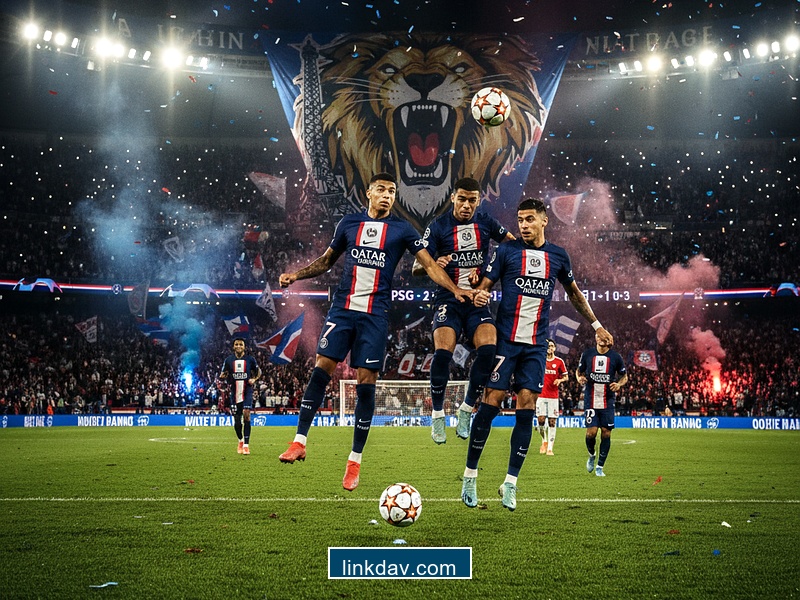
For over a decade, Paris Saint-Germain was not a football club; it was a luxury fashion brand that occasionally played 90 minutes of soccer on weekends. It was a marketing experiment funded by Qatar Sports Investments (QSI) designed to sell shirts in Tokyo and resentment in Marseille. But if the recent Champions League performances are the litmus test, the experiment is finally over. The circus has left town, and for the first time in the QSI era, a football team has remained.
The headline from Foot Africa suggests PSG has "revealed its ambitions." This is an understatement. By dismantling the most expensive forward line in history—Neymar, Lionel Messi, and Kylian Mbappé—Luis Enrique has not just adjusted the tactics; he has performed an exorcism. To understand the magnitude of this shift, we cannot simply look at expected goals (xG) or possession maps. We must look back twenty years to the greatest squad-building error in modern football history: the collapse of the Galacticos.
The Anti-Galactico Pivot
In the summer of 2003, Real Madrid President Florentino Pérez sold Claude Makelele—the tactical engine of the team—to Chelsea, famously remarking that he would not miss a player who rarely passed the ball more than three meters. He replaced him with David Beckham to play alongside Zidane, Figo, Ronaldo, and Raul. It was a commercial triumph and a sporting catastrophe. Madrid’s midfield collapsed, and they went three years without a trophy.
Until this season, PSG was essentially re-enacting the 2003 Real Madrid season on a loop. They bought Ferraris and removed the engine. The trio of Messi, Neymar, and Mbappé offered moments of individual brilliance that masked a systemic rot. They walked while opponents ran. In the Champions League, where pressing intensity is the currency of success, PSG was bankrupt.
Luis Enrique’s current project is the antithesis of the Galactico model. It draws a closer parallel to José Mourinho’s 2004 FC Porto or, perhaps more accurately, the 1995 Ajax side under Louis van Gaal. It is a system where the collective architecture supersedes the individual tenant. By removing the "Big Three," Enrique has redistributed the tactical load. The result is a team that presses with the ferocity of a pack of wolves rather than the indifference of three peacocks.
The Engine Room: Verratti’s Ghost vs. Neves’ Lungs
The most striking evolution is in the midfield. For years, PSG relied on the fragile genius of Marco Verratti. While brilliant, Verratti was often isolated, tasked with transitioning the ball to a front three that refused to track back. This created massive gaps in the half-spaces that elite teams like Bayern Munich and Manchester City exploited with surgical precision in consecutive UCL exits.
Enter the new Portuguese connection: Vitinha and João Neves. Their partnership is reminiscent of the Deco-Maniche axis from that 2004 Porto side. They are not merely distributors; they are ball-winners. Neves, in particular, covers ground with a Kanté-esque ubiquity that PSG has lacked since the days of Blaise Matuidi.
"Football punishes vanity. For ten years, Paris Saint-Germain tried to buy the Champions League trophy. Now, they are trying to win it."
This structural integrity allows the full-backs, particularly Achraf Hakimi, to operate as auxiliary wingers without fear of the counter-attack. In the previous era, a Hakimi overlap was a gamble because no forward would cover his defensive zone. Now, with the tireless work rate of players like Warren Zaïre-Emery—arguably the most mature teenager in European football since Steven Gerrard broke through at Liverpool—the defensive transition is secure.
Barcola and the 1990s Winger Revival
The rise of Bradley Barcola is the perfect metaphor for this new era. While Mbappé demanded the ball to feet and operated in bursts of static explosiveness, Barcola plays with the direct, terrifying verticality of a 1990s winger—think Ryan Giggs circa 1999 or, to keep it French, a young Robert Pires. He stretches the pitch.
Tactically, this is crucial. When a team plays narrow to accommodate superstars who want to occupy the "number 10" space (as Messi and Neymar often did), the opposition defense can compress. Barcola stays wide, hugging the touchline, forcing defenders to open up passing lanes in the center. This is "Positional Play" 101, a concept Guardiola perfected at Barcelona, but one that was impossible to implement at PSG when the forwards refused to adhere to positional discipline.
The Psychological Cleansing
We must also address the trauma. This club is haunted by the 2017 Remontada—the 6-1 loss to Barcelona. That collapse was born of fragility. The Thiago Silva-led teams were mentally brittle; as soon as adversity struck, they looked for a savior. When you have Messi or Mbappé, the tactical instruction becomes "Give it to him and pray." It breeds passivity.
The current squad is too young to care about the ghosts of the Camp Nou. Willian Pacho and Lucas Beraldo do not carry the scars of the Pochettino or Tuchel failures. There is a liberation in their ignorance. They play with the arrogance of youth rather than the anxiety of veterans protecting a legacy.
The Risk of the Collective
However, let us not be naive. The transition from a "Great Player" model to a "Great Team" model has risks. The 2003-2004 Arsenal "Invincibles" were a perfect collective, but they failed in Europe because, in tight knockout games, sometimes you simply need a chaotic variable—a player who can create a goal out of nothing when the system fails.
PSG’s current weakness is the lack of a ruthless killer in the box. Gonçalo Ramos and Randal Kolo Muani are industrious, but do they possess the cold-blooded finishing of a Ruud van Nistelrooy or a Filippo Inzaghi? The history of the Champions League suggests that while defenses win titles, strikers win matches. The 2012 Chelsea team that won the UCL was statistically poor but had Didier Drogba. PSG has built a beautiful machine, but does it have a sharp enough spearhead?
A Return to 1995?
The last time PSG was truly universally respected as a football project, rather than a marketing one, was the 1994-1995 season. With George Weah, David Ginola, and Valdo, they reached the Champions League semi-finals. That team had flair, yes, but it was built on a rugged, physical spine (Paul Le Guen, Alain Roche) and a collective spirit.
Luis Enrique is attempting to bridge a 30-year gap. He is trying to convince Paris that suffering without the ball is as noble as nutmegging a defender. The recent results suggest the message is landing. The "bling-bling" is dead. The diamonds have been sold to pay for the concrete needed to build a foundation.
Europe should be worried. A dysfunctional PSG with Mbappé was a dangerous opponent. A functional PSG without him is a title contender.