
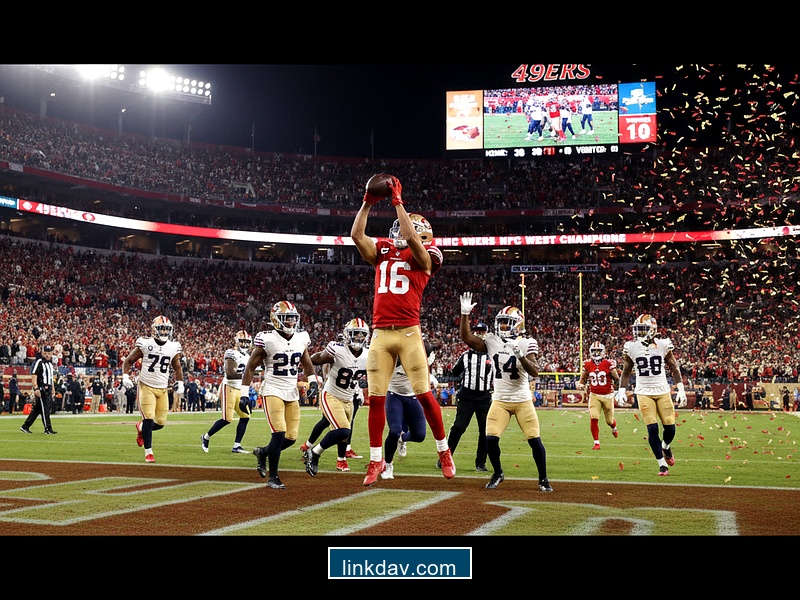
The Detroit Lions lost to the Pittsburgh Steelers, and somewhere in Santa Clara, a box was checked. That is the extent of the emotion that should—and likely does—accompany the news that the San Francisco 49ers have officially clinched a berth in the 2025 NFL playoffs. In previous eras, perhaps during the dark austerity of the Chip Kelly or Jim Tomsula years, a Week 16 clinch would warrant champagne. Today, under the regime of Kyle Shanahan and John Lynch, it feels less like an achievement and more like meeting the bare minimum requirements of a high-stakes contract.
We are watching the maturation of a specific, ruthless project. The news cycle will focus on the standings, the race for the NFC’s number one seed, and the implications of Monday Night Football. But to focus on the arithmetic of the playoff picture is to miss the architectural marvel—and the looming structural crisis—that is the current 49ers organization. This isn't about beating the Indianapolis Colts or watching the scoreboard. This is about a philosophical gamble eight years in the making that has finally removed all excuses.
The Death of the Underdog Narrative
Let’s strip away the romance of Brock Purdy’s draft status. The "Mr. Irrelevant" story was charming in 2022. In the context of the 2024-2025 season, it is merely a cap space efficiency. The 49ers are not an underdog story; they are a bullies' narrative. The project Shanahan installed upon his arrival in 2017 was never designed to be a Cinderella story. It was designed to be an algorithm that solves defensive coverages before the ball is snapped.
The philosophical underpinning of this team is distinct from the Walsh-era West Coast Offense, though it shares DNA. Walsh wanted to control the ball through short passing as an extension of the run. Shanahan wants to distort defensive geometry. By utilizing heavy personnel—specifically the relentless usage of Kyle Juszczyk and George Kittle—Shanahan forces defenses into "base" packages (4-3 or 3-4 personnel), effectively keeping lighter, faster nickel corners off the field.
Once the defense is heavy, the 49ers strike with speed. It is a cynical, brilliant manipulation of NFL roster construction rules. Most teams build defenses to stop 11-personnel (3 WRs). The 49ers build an offense to destroy the linebackers that 11-personnel defenses leave on the bench. Clinching a playoff spot is simply proof that the math still works.
The Sustainability of the "Avengers" Model
The most fascinating aspect of this clinch isn't the "who" but the "how much." We need to talk about the concept of the "Super Window." Historically, NFL dynasties—the 70s Steelers, the 90s Cowboys, the Brady-Belichick Patriots—relied on a steady influx of draft capital to replace aging stars. The 49ers have taken a different, far riskier path: The Accumulation Model.
"The check has come due, and the tip is included. This roster is the most expensive collection of skill-position talent in the salary cap era."
Consider the allocation of resources. Christian McCaffrey, Deebo Samuel, George Kittle, Brandon Aiyuk, Trent Williams, and Nick Bosa are all positioned at the top of the market. This is not sustainable team building; it is a "push-all-chips" strategy usually reserved for the NBA. The fact that they have clinched a playoff spot despite navigating the inevitable injuries that come with an older, expensive roster is a testament not to depth, but to the scheme's ability to elevate replacement-level players in the short term.
However, the cracks in the foundation are visible to the trained eye. The defensive line rotation, once a endless wave of pass rushers, has thinned. The secondary remains a patchwork quilt held together by scheme and a relentless pass rush. This playoff berth was secured not because the 49ers are deeper than the competition, but because their top-end talent is simply overwhelming when healthy. That is a fragile existence for January football.
Tactical Rigidity vs. The Purdy Evolution
For years, the knock on Kyle Shanahan was his rigidity. He was the brilliant composer who couldn't handle a jazz improvisation. If the play broke down, the system failed. This was the ceiling with Jimmy Garoppolo. The "Project" has shifted phase in 2024 because Shanahan has finally ceded some control to the quarterback.
The tactical theory behind the 49ers' current dominance is "condensed formations." By squeezing the receivers close to the offensive line, Shanahan creates vast acres of space on the perimeter for outside zone runs. But the evolution this season has been the intermediate passing game over the middle of the field—the "dagger" concepts and deep crossers. This requires a quarterback willing to throw with anticipation into windows that don't exist yet.
This is where the editorial stance must pivot to caution. The system works beautifully in the regular season when game-planning against a generic Week 14 opponent. In the playoffs, defensive coordinators like Steve Spagnuolo (Chiefs) or Jim Schwartz (Browns) don't play by the rules. They disrupt the timing. They jam the motion man. When the algorithm is disrupted, does Shanahan have a Plan B? The playoff clinch confirms Plan A is elite. It tells us nothing about the adaptability required to hoist the Lombardi Trophy.
The Historical Burden of "Almost"
There is a spectre haunting Santa Clara, and it looks a lot like the Buffalo Bills of the early 90s or the Philadelphia Eagles of the Andy Reid era. Consistent excellence is the hardest currency to acquire in the NFL, and the 49ers are wealthy in it. Yet, without the ring, this era risks being remembered as a failure of closing capability.
Comparing this squad to the 1994 49ers is instructive. That team brought in Deion Sanders and frantic mercenaries to maximize the window of Steve Young and Jerry Rice. They won. This current iteration has made similar "all-in" moves (the McCaffrey trade, the Chase Young rental last year, the big extensions). They have clinched the chance to validate those expenses, but the pressure is entirely asymmetric. A loss in the Divisional Round would be catastrophic for the franchise's long-term cap health and psyche.
The Verdict: A Machine Built for One Purpose
So, the 49ers are in. The Lions opened the door, and San Francisco walked through. But let’s be clear: this clinch is not a sign of momentum. It is a sign of obligation. When you possess a roster that features arguably the best player in the league at three different positions (Left Tackle, Linebacker, Running Back), making the playoffs is akin to a Michelin-star chef successfully boiling water.
The "Project" under Shanahan has solved the floor. They will never be bad as long as he is calling plays and breathing oxygen. But the ceiling? That remains guarded by the ghosts of blown fourth-quarter leads in the Super Bowl. The regular season is a laboratory for Shanahan's experiments. The postseason is the peer review. The data from Week 16 says the machine works. The history books are waiting to see if it actually matters.