
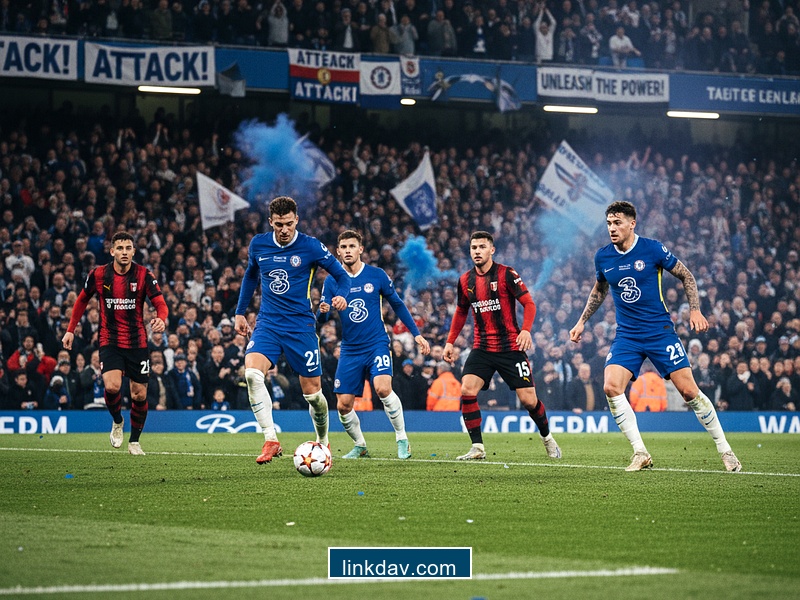
The metrics sheet will tell you one story. It will show possession approaching 65%, pass completion rates hovering in the nineties, and a field tilt heavily skewed toward the opposition's goal. But if you sit in the stands—specifically low in the West Stand, where you can hear the turf tear under studs—you see a different narrative. You see the frustration in the body language of Nicolas Jackson. You see the subtle drop of Cole Palmer’s shoulders when a center-back chooses safety over the incision.
The New York Times suggests Chelsea’s attack is key to their Champions League ambitions, questioning if the "handbrake" will be released. That metaphor, while apt, is too kind. A handbrake implies a temporary measure. What we are witnessing feels more like a systemic straitjacket. Enzo Maresca has installed a high-fidelity operating system at Stamford Bridge, but in the chaotic, high-stakes theater of the Champions League, operating systems crash. Instinct survives.
The Scout’s Eye: Analyzing the "Safe" Possession
To understand why Chelsea feels blunt despite their dominance, you have to look away from the ball. Professional scouting isn't about watching the goalscorer; it's about watching the reaction to the transition.
Under the current tactical setup, Chelsea suffers from an obsession with Positional Play (Juego de Posición) that borders on the neurotic. Watch the wingers—Noni Madueke or Pedro Neto. When the ball is with the center-backs, their instructions are rigid: hug the touchline to stretch the opponent's defensive block horizontally. This is standard Guardiola-school theory. The objective is to create "qualitative superiority" in 1v1 situations.
However, the movement patterns are sterile. In the Champions League, defenders are too smart to be stretched by static positioning. They need to be moved by chaos. When I watch Chelsea build up, I see players waiting in their zones rather than rotating through them. The "handbrake" is actually a lack of blind-side runs.
"Elite attacks are defined not by where players stand, but when they leave their stance. Chelsea’s front line is currently playing chess while European giants play speed chess."
Look at the body orientation of the midfielders receiving the ball in the "pockets" or half-spaces. Too often, they receive with closed hips, facing their own goal, pre-determined to bounce the pass back to a defender. This is "recycling possession." It pads the stats, but it allows the opposition's low block to reset. To kill a team in Europe, you need players receiving on the half-turn, willing to risk a turnover to break a line.
The Palmer Paradox and the False Winger
Cole Palmer is the anomaly, the glitch in the system that makes it work. But even he is suffering from the structural rigidity. A key scouting metric we use is "scanning frequency"—how many times a player checks his shoulder before receiving. Palmer’s numbers are elite. He builds a 3D map of the pitch instantly.
The issue arises when he drifts inside to find space. In a fluid system, a full-back or a number 8 would instantly overlap or underlap to occupy the space he vacated. Currently, that rotation is sluggish. The hesitation—that split-second pause to check if the movement aligns with the manager's diagram—kills the momentum. In Europe, passing windows open for 0.5 seconds. If you have to think about the system, the window is closed.
Rest Defense: The Hidden source of Caution
Why is the handbrake on? It is rarely because attackers are afraid to attack. It is usually because the manager is terrified of the counter-attack. This brings us to the concept of Restverteidigung, or Rest Defense.
In the modern game, your attack is only as good as your defensive structure while you have the ball. Chelsea’s current setup involves a rigid 3-2 or 2-3 structure at the back when attacking. This creates security, but it also removes numbers from the overload in the final third.
Historically, the Chelsea teams that conquered Europe—think of the 2012 miracle or Tuchel’s 2021 precision machine—embraced verticality. Tuchel’s structure was rigid, yes, but the trigger was immediate. As soon as possession was won, the vertical pass was mandatory. Maresca’s approach favors La Pausa—waiting for the opponent to press to open space behind them. The problem is, elite European teams don't take the bait. They sit back, stay compact, and let Chelsea pass themselves into a coma.
The Jackson Decoy: Unseen Work Going to Waste
We need to talk about Nicolas Jackson. Critics obsess over his finishing variance, but a scout looks at his gravity. Jackson is an elite channel runner. His movement patterns are designed to drag center-backs out of position, creating the "half-spaces" for the trailing midfielders.
Watch the tape from the last three European fixtures. Count how often Jackson makes a diagonal run across the face of the defense, signaling for a through ball. Now count how often the ball is actually played. Rarely. The midfield, conditioned to value retention over risk, ignores the run.
This has a psychological compounding effect. After five ignored runs, the striker stops sprinting. He starts checking short. He clogs the midfield. The depth of the attack evaporates. By refusing to play the risky ball, Chelsea creates a self-fulfilling prophecy of sterility.
The Necessity of Relational Play
The tactical meta of football is shifting. We are moving away from rigid Positional Play toward "Relational Play"—a style popularized by Fluminense and slowly bleeding into Europe, where players cluster near the ball and play off spontaneous chemistry rather than pre-set zones.
Chelsea has the personnel for this. Nkunku, Palmer, Lavia, and Neto are street footballers at heart. They thrive in tight spaces. They want to play one-twos, nutmegs, and rapid combinations. The current system treats them like chess pieces restricted to specific squares. To release the handbrake, the manager must trust the players' socio-affective connections.
The Verdict: Calculated Risk is the Only Safety
Safety in the Champions League is a myth. Trying to control every variable usually leads to elimination by a team willing to embrace chaos. Real Madrid has dominated this competition for a decade not because they have better tactical spacing, but because they understand moments. They know when to abandon the structure and go for the throat.
The "unseen" work off the ball requires validation from the man on the ball. If a winger makes a 40-yard blind-side sprint, he needs to be fed, even if there is a 40% chance of an interception. That 40% risk carries a 60% reward of a goal-scoring opportunity.
Chelsea stands at a precipice. They can continue to be the team that dominates the passing charts and loses on xG (Expected Goals), or they can release the handbrake. That requires the manager to loosen his grip on the joystick. It requires allowing the midfielders to turn blindly. It requires playing the ball into space for Jackson before he even looks for it.
The handbrake isn't a tactic; it's a mindset. And in the Champions League, hesitation is the only fatal error.