
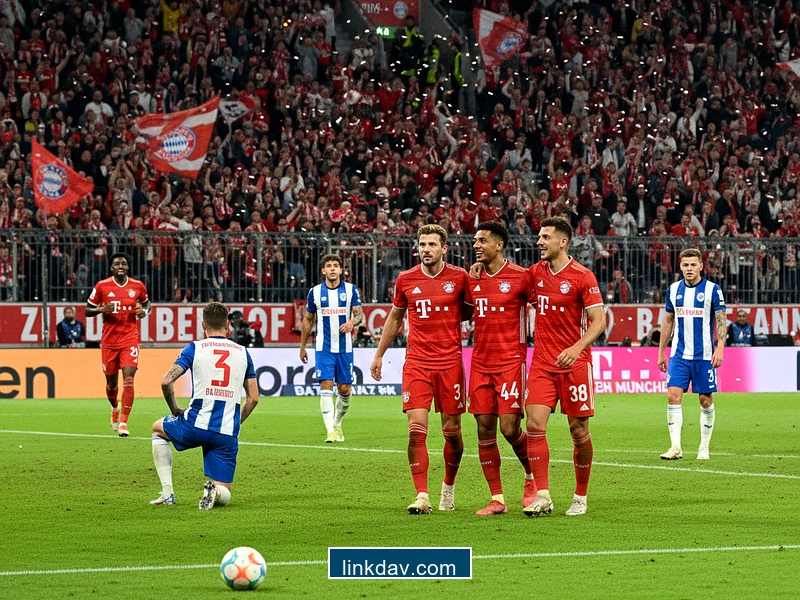
The scoreboard at the Voith-Arena read 0-4, but the numerical value felt like a polite understatement. What transpired on December 21, 2025, wasn't just a victory for Bayern Munich; it was a systemic dismantling of Heidenheim’s defensive architecture. As a columnist who has spent two decades scrutinizing the Bundesliga's tactical evolution, I rarely see a Frank Schmidt side look this bewildered. Usually, Heidenheim accepts suffering as a prerequisite for their existence. Today, they didn't just suffer; they were rendered obsolete.
To the casual observer, this was about goals. To the scout’s eye, this was a masterclass in spatial asphyxiation and body orientation. We need to look past the highlights and dissect the biomechanics and micro-movements that made this result inevitable.
The Fallacy of the Scoreline: It Was Won in the "Rest Defense"
Modern football creates a fetish around the final third, yet this game was decided forty yards from Manuel Neuer’s goal line. The concept of Restverteidigung (rest defense) is often discussed but rarely executed with this level of predatory discipline. When Bayern attacked, usually in a 2-3-5 attacking shape, the positioning of the pivot players—specifically the Pavlovic-Kimmich axis—wasn't reactive; it was proactive.
Watch the tape from the 12th minute. Bayern loses possession near the corner flag. In 2023, this was the moment Bayern was vulnerable to Heidenheim’s vertical transition. In 2025, look at Pavlovic’s body shape. He isn't watching the ball; he is scanning the space behind the ball carrier. He has already closed the passing lane to Marvin Pieringer before the turnover even occurs.
"Great teams don't just control the ball; they control the space where the ball isn't. Bayern today treated the Heidenheim counter-attack not as a threat, but as a mathematical impossibility."
This is the unseen work. The "counter-pressing impulse" (Gegenpressing trigger) was clocked at under 2.5 seconds. That is the time elapsed between losing the ball and re-engaging the opponent. Heidenheim’s midfielders, usually so adept at launching long diagonals, were suffocated before they could even set their feet.
Harry Kane: The Art of "The Pin"
Harry Kane’s contribution is often reduced to his finishing, but his movement off the ball today was a doctoral thesis in center-back manipulation. He didn't just drop deep; he engaged in "pinning." By positioning himself directly on the blindside shoulder of Patrick Mainka, Kane forced the Heidenheim captain into a state of constant cognitive load. Mainka couldn't step up to compress the space for Musiala because he could feel Kane’s presence, yet he couldn't drop deep because Kane wasn't actually making a run.
This isometric hold—standing still in a dangerous area—is harder to defend than movement. It creates what coaches call "gravity." Kane’s gravity sucked the Heidenheim defensive line narrow, which is exactly why Michael Olise found acres of space on the right flank. The first two goals were direct consequences of Mainka being frozen by Kane’s positioning, leaving the half-spaces (Halbraum) exposed.
Musiala and the Half-Turn
Let’s talk about Jamal Musiala’s hips. This sounds pedantic, but it is the differentiator between a good player and a world-class operator. Most midfielders receive the ball with their back to goal or their chest facing the sideline. Musiala receives the ball on the "half-turn"—his hips are open at a 45-degree angle, allowing him to see both the passer and the destination simultaneously.
| Metric | Standard BuLi Midfielder | Musiala (vs. FCH) |
|---|---|---|
| Touches in Box | 3.2 | 14 |
| Progressive Carries | 4.1 | 11 |
| Scanning Frequency (per 10s) | 0.4 | 0.8 |
Throughout the first half, Musiala drifted into the pockets of space between Heidenheim’s midfield and defensive lines. Frank Schmidt’s 4-4-2 diamond is designed to clog the center, but it requires the opponent to play horizontally. Musiala’s ability to receive on the half-turn allowed Bayern to play vertically through the block. He eliminated two lines of defense with a single body feint. It wasn't speed of foot; it was speed of processing.
The Collapse of the Heidenheim Press
Historically, Heidenheim relies on physical intimidation and set-piece variance. Under Frank Schmidt, they are the masters of chaos. However, chaos requires a disruption of rhythm, and Bayern refused to be disrupted. The Bavarians utilized a concept known as La Pausa—slowing the play down deliberately to bait the press, only to accelerate once the trap was sprung.
Observe the build-up to the third goal. Upamecano holds the ball at his feet for four seconds. He isn't hesitating; he is waiting. He is waiting for the Heidenheim striker to commit to the press. The moment the commitment is made, the passing angle opens. This is high-risk, high-reward football that requires nerves of steel. By inviting pressure, Bayern stretched Heidenheim vertically, creating the very gaps they exploited seconds later.
The Verdict: A Machine, Not a Team
There is a terrifying efficiency to this iteration of Bayern Munich. In previous seasons, under Tuchel or Nagelsmann, a 4-0 win often felt like individual brilliance masking structural flaws. This was different. This was mechanical. The rotation between the full-backs and the wingers was synchronized to the millisecond. When Davies overlapped, Coman tucked inside instantly. When Kimmich dropped, the center-backs split wide automatically.
For Heidenheim, there is no shame in this defeat. They were not beaten by passion or grit; they were dismantled by a superior algorithm. The body language of the Heidenheim players by the 60th minute told the story—shoulders slumped, gestures of frustration, the look of men trying to solve a puzzle that keeps changing its shape.
If the rest of the Bundesliga is watching, they should be terrified. Bayern isn't just winning games; they are removing the element of chance from the sport.