
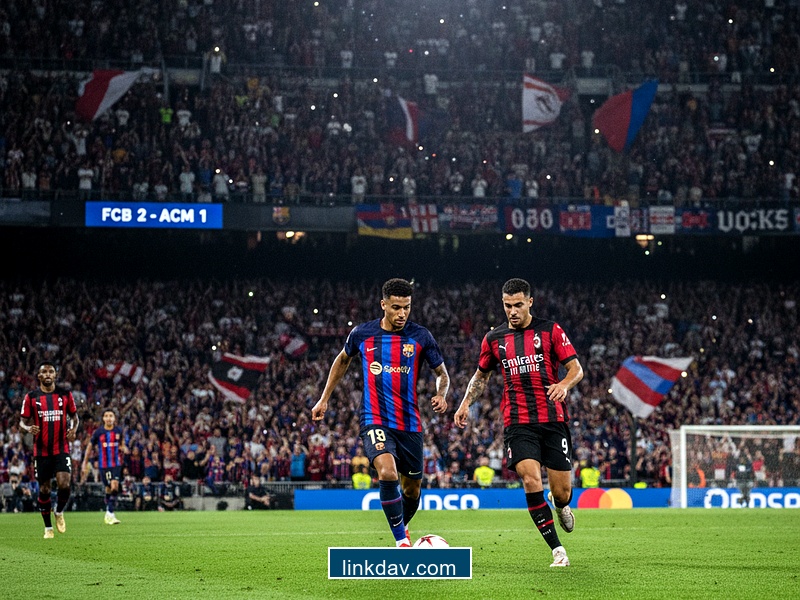
The advice was blunt, almost jarring in its honesty. Recent reports surfacing via Yahoo Sports indicate that Barcelona’s Robert Lewandowski has been firmly advised against a romantic twilight move to AC Milan. The suggestion? Go West to Major League Soccer or East to the Saudi Pro League. To the casual observer, this looks like a slight against Italian football or a cash-grab recommendation. It is neither.
As someone who has spent two decades breaking down game tape, watching the micro-movements of elite strikers from the rafters, this is simply sound biomechanical and tactical counsel. The romantic notion of the veteran predator conquering Serie A is a narrative relic. The reality, viewed through a scout’s lens, is that the modern iteration of Lewandowski—and indeed, any striker of his current physical profile—would find the San Siro not a sanctuary, but a suffocating tactical cage.
The Myth of the 'Slow' Italian League
There is a pervasive, lazy stereotype in football discourse that Serie A is a retirement home where the game is played at a walking pace. This is a fundamental misunderstanding of cognitive load versus physical speed. While the Premier League is a chaotic transition fest, Serie A is a claustrophobic grid.
For a striker entering the final phase of his career, the "unseen" work becomes harder in Italy than anywhere else. Defenders like Inter's Alessandro Bastoni or Juventus’s Gleison Bremer do not simply mark space; they engage in constant physical disruption. They are masters of the "dark arts"—the subtle shirt tugs, the hip checks during the jump, the disrupting of the center of gravity before the ball even arrives.
Lewandowski’s current game relies heavily on what we call "pinning." He backs into a center-back to create a pivot point. In Spain, defenders often try to intercept. In Italy, three-man backlines (a staple of the league) mean that if you pin one defender, a designated "sweeper" is reading the passing lane. A move to Milan would require him to operate in tighter phone booths than he currently finds in Catalonia, with less protection from officials regarding off-ball contact.
Biomechanical Analysis: The Decline of Eccentric Braking
Let’s look at the tape. Specifically, let’s analyze the player’s deceleration patterns over the last 18 months. The most critical athletic trait for a penalty-box poacher isn't top speed; it is eccentric braking—the ability to go from full sprint to a dead stop to create separation from a marker.
In his prime at Bayern Munich, Lewandowski was elite at the "double movement"—feinting near post, stopping, and peeling back post. Watch his recent outings for Barcelona. That stop-start explosiveness has dampened. He now relies on "drifting" into space rather than "snapping" into it.
"The ankles are the first to tell the truth. When a striker stops planting his foot hard to change direction and starts rounding his turns, he is conserving energy. He is managing pain. In Milan, against low blocks that compress the 18-yard box, rounding your runs means you are already marked."
If he were to move to AC Milan, he would be tasked with leading the line in a league that defends the width of the penalty area better than any on earth. Without that violent separation ability, he becomes a static target—easy to nullify for a disciplined tactical setup.
The Pressing Triggers and 'Shadow Cover'
Modern scouting isn't just about what a player does with the ball; it's about defensive geometry. AC Milan, under their recent tactical evolutions, demands a striker who can initiate the high press or, at the very least, cut off the "pivot" (the opponent's defensive midfielder).
This is where the advice to move to the US or Saudi Arabia becomes tactically astute. In MLS, the "rest defense" structures are notoriously loose. The gap between the defensive line and the midfield double-pivot often stretches to 15 or 20 yards. For a player like Lewandowski, this is paradise. He doesn't need to sprint to find space; the space exists by default due to structural indiscipline.
Conversely, in Serie A, teams build out from the back with intricate patterns. The striker is required to perform "curved runs" to shadow cover the passing lane while closing down the goalkeeper. This is high-anaerobic work. Asking a 36-year-old to perform 20 high-intensity pressing triggers per half in the Italian heat is a recipe for soft-tissue injury, not Golden Boots.
Why the 'Retirement Leagues' fit the Movement Profile
The recommendation to look toward the MLS or the Arab world acknowledges a shift in the player's functional utility. We need to talk about "Gravity."
Even with diminished mobility, a superstar name carries gravitational pull. Defenders panic. They double team. In a league with lower tactical organization (specifically regarding defensive transitions) like the MLS, this gravity opens massive lanes for wingers. The striker can stand still at the penalty spot, occupy two defenders, and allow inverted wingers to score. He becomes a facilitator through presence alone.
However, Milan requires a soloist. The expectation at the San Siro, specifically the number 9 shirt which carries a heavy historical burden (the post-Inzaghi curse), is that the striker creates something from nothing. The Rossoneri faithful demand a player who can turn a defender on the halfway line and drive. That is no longer the player in the scouting report.
The Verdict: Preservation of Legacy
We saw Olivier Giroud succeed at Milan, and pundits will lazily point to that as proof it can work. This is a false equivalence. Giroud made a career out of being a stationary wall—a target man who thrived on aerial duels and one-touch lay-offs. Lewandowski is, and always has been, a volume shooter who needs service on the ground or in the half-spaces.
If he goes to Italy, he risks being exposed by the tactical rigour of coaches like Simone Inzaghi or Antonio Conte. He risks looking slow, not because he is slow, but because his processing speed can no longer outpace the organized destruction of Italian defenses.
The advisor who suggested the US or Saudi Arabia is not telling him to quit; they are telling him to find a stage where his remaining elite skill—finishing—can shine without the interference of a tactical grind his body can no longer sustain. It is the advice of a pragmatist. And in this sport, pragmatism usually wins.