
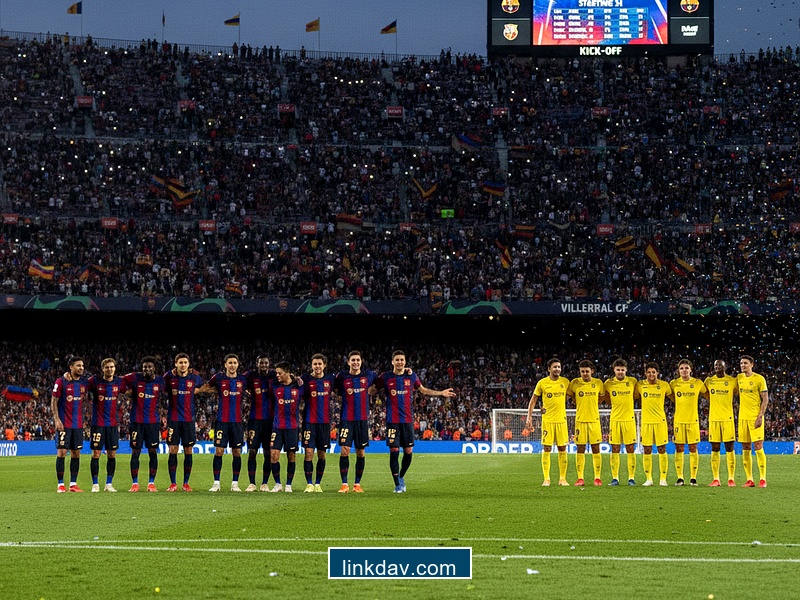
The teamsheet for Barcelona’s trip to La Cerámica has dropped, and if you look past the names and focus on the tactical implications, Hansi Flick isn't just looking for three points against Villarreal. He is conducting a stress test on the very fabric of his high-line philosophy. The selection confirms a suspicion I’ve held since preseason: Barcelona has abandoned the safety of horizontal control for the adrenaline of vertical chaos.
Analyzing this starting XI through a scout's lens reveals a distinct shift in biomechanical priorities. We aren't just seeing technically gifted players; we are seeing athletes selected for their capacity to execute "repeated sprint ability" (RSA) and rapid deceleration—traits essential for a system that compresses the pitch into a suffocating 30-meter strip.
The Suicide Line: Cubarsí’s Scanning Mechanics
The defensive selection is the most telling aspect of this lineup. By partnering Pau Cubarsí with Iñigo Martínez, Flick is relying on cognitive speed over raw recovery pace. When you watch Cubarsí in the warm-up, ignore his passing. Watch his neck.
Top-tier scouting analysis focuses on "scanning frequency"—the number of times a player checks their shoulder per ten seconds. Cubarsí operates in the 0.6 to 0.8 range, elite numbers comparable to a prime Sergio Busquets. Against a Marcelino-led Villarreal, known for rapid transitions via Álex Baena, this visual data collection is vital. Cubarsí doesn’t defend the man; he defends the passing lane before the ball is even struck.
"In a high line, the defender's body orientation is the difference between an offside trap and a goal. Watch Cubarsí’s hips. He rarely squares them up. He defends at a 45-degree angle, ready to drop or step up instantly."
This XI suggests Barcelona will bait the Villarreal press. The distance between Ter Stegen and the center-back pairing will likely be tantalizingly short, inviting the 'Yellow Submarine' to surface, only to bypass their first line of pressure with a single vertical ball.
The Engine Room: Casadó’s Unseen Labor
The inclusion of Marc Casadó in the double pivot is not a rotation; it is a tactical necessity. While Pedri provides the 'pausa'—that ghostly ability to freeze time and manipulate defenders' momentum—Casadó provides the grit. But it’s not just tackling stats.
A professional scout looks for "shadow cover." This is the work a defensive midfielder does to block passing lanes into the striker without actually touching the ball. Casadó has developed a knack for identifying the opponent’s trigger movements. When Villarreal’s Parejo looks to break lines, Casadó proactively drops into the half-space, cutting off the supply line before the request is even made.
This pairing fundamentally changes Barcelona’s build-up geometry. Unlike the Xavi era, where the pivot dropped between center-backs to create a back three, Flick demands the pivot stay ahead of the defense. This creates a "box midfield" overload, forcing Villarreal’s compact 4-4-2 to narrow, which consequently opens the wide channels.
Tactical Breakdown: Flick vs. Marcelino
To understand the volatility of this match-up, we must look at the contrasting metrics these managers historically produce.
| Tactical Metric | Hansi Flick (Verticality) | Marcelino (Compact Block) |
|---|---|---|
| Defensive Line Depth | 48-52 meters (High Risk) | 35-38 meters (Low Block) |
| Pressing Trigger | Heavy touch / Backwards pass | Ball entering wide zones |
| Transition Speed | Immediate vertical thrust | Rapid expansion via wingers |
| Space Utilization | Half-spaces & Between lines | Behind opponent fullbacks |
Yamal and the Art of Isolation
The selection of Lamine Yamal on the right is automatic, yet analyzing his specific movement patterns reveals why he is a nightmare for a structure-heavy coach like Marcelino. Most wingers rely on pace. Yamal relies on "deception mechanics."
Watch his first touch today. He often stops the ball dead under his sole. This creates a "micro-pause." The defender, terrified of his acceleration, halts their feet. Biomechanically, it takes significantly longer to restart momentum from a standstill than it does to change direction while moving. Yamal exploits this inertia deficit. He freezes the fullback, then explodes.
Furthermore, his partnership with Koundé (or the overlapping fullback) is evolving. Yamal has started drifting into the "interior channel," dragging the opposition left-back with him. This leaves the entire flank exposed for the fullback to attack, a classic overload strategy that forces the opposition winger to track back, dulling their counter-attacking threat.
The Raphinha Factor: The Pressing Dog
On the opposite flank or operating centrally, Raphinha’s inclusion is less about creativity and more about defensive intensity from the front. Klopp famously said that a good counter-press is better than any playmaker. Flick subscribes to this religion.
Raphinha’s "curved runs" are the key here. When pressing the Villarreal goalkeeper or center-backs, he rarely runs in a straight line. He arcs his run to cut off the passing angle to the sideline, forcing the play back into the congested center where Casadó and Pedri are waiting to snap the trap. This is 'Gegenpressing' 101, and it requires aerobic capacity that few players possess.
Lewandowski’s Physical Resurgence
Robert Lewandowski leading the line is standard, but his usage has changed. Under Xavi, he was often asked to drop deep to link play. Under Flick, he is being used as a "pin."
By staying on the shoulder of the last defender, Lewandowski forces the Villarreal defensive line to drop five yards deeper than they want to. This stretches the vertical distance between Villarreal’s defense and midfield—a zone often called "the seam." It is in this seam that Pedri and Raphinha will operate today. Lewandowski’s job isn't just to score; it is to manipulate the defensive line’s height through sheer physical presence.
The Verdict: A Statement of Intent
This starting XI is not designed to control the game in the traditional Barcelona sense. It is designed to break the game open. It accepts the risk of Villarreal’s counter-attacks as the cost of doing business. Flick is betting that his team’s chaotic energy and superior technical execution in the final third will outweigh the structural stability of Marcelino’s block.
We are witnessing a fascinating evolution. The 'tiki-taka' ghost has finally been exorcised, replaced by a Germanic efficiency that values vertical yards over possession percentages. If the high line holds, this will be a massacre. If the coordination fails, even for a split second, Ter Stegen will be the busiest man in Vila-real.