
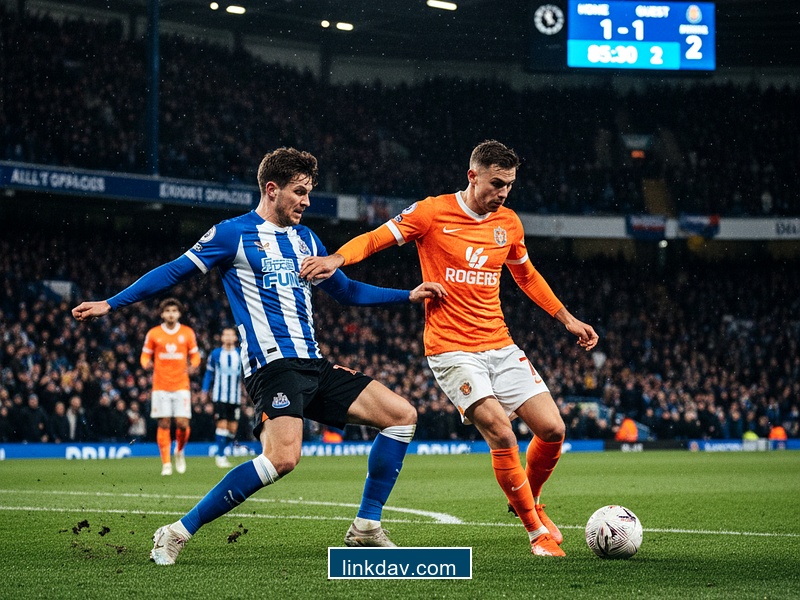
Modern football suffers from a peculiar illness: the fetishization of control. We look at the Premier League table, at the gargantuan point totals amassed by Manchester City and Arsenal in recent years, and we mistake their suffocating possession for the only viable path to nirvana. We are told that to win, one must strangle the game into submission.
Then there is Unai Emery. Watching Aston Villa this season—and specifically the bulldozing elegance of Morgan Rogers—it becomes clear that something distinct is happening at Villa Park. This is not a project built on the vanity of infinite passing triangles. It is a philosophy of artificial transition, a high-wire act of tactical anarchy that is proving to be the most disruptive force in English football since Jurgen Klopp’s heavy metal pressing first arrived on Merseyside.
The recent headlines focus on the flaws of the title chasers and Alexander Isak’s isolation at Newcastle, but the real story, the seismic shift under the surface, is the sustainability of the Emery Doctrine. We aren't watching a plucky underdog overachieve for 90 minutes. We are watching a systematic dismantling of the Premier League’s established hierarchy through a tactical blueprint that exploits the very desire for control that defines Villa’s rivals.
The Art of the "Artificial Transition"
To understand why Morgan Rogers is currently playing like a £100 million asset, we must look beyond his individual physicality. Rogers is the primary beneficiary of Emery’s defining tactical innovation: the artificial transition.
Most elite teams want to camp in the opposition half. Emery does not. He explicitly invites pressure. Villa’s center-backs, Pau Torres and Diego Carlos, will stand with their foot on the ball inside their own six-yard box, practically begging the opposition to press. It is a trap. The moment the opponent commits, Villa bypasses the first line of pressure vertically, creating a "transition" scenario where they are running at a retreating defense with acres of space.
"Emery has weaponized the offside trap and the goal kick. He has turned defensive phases into attacking launchpads. It is risky, it looks terrifying, but it is mathematically calculated aggression."
This is where Rogers thrives. He is not a playmaker in the traditional number 10 sense, loitering between lines waiting for a pass. He is a ball-carrying battering ram. When Villa breaks that first line of pressure, Rogers receives the ball on the turn and drives into the vacuum left by the opponent's high press. His form isn't a hot streak; it is a structural inevitability. In a Guardiola system, Rogers might be stifled by the need to retain possession. In Emery’s "chaos," he is the tip of the spear.
Sustainable Radicalism vs. The Burnout of Howe
The contrast provided in the briefing—Isak’s misery at Newcastle United—offers the perfect foil to the Villa narrative. Eddie Howe and Unai Emery took over their respective clubs around similar timelines, both backed by ambition (though Newcastle’s wealth is state-sponsored). Yet, their trajectories are diverging sharply.
Newcastle’s project was built on intensity. High pressing, physical dominance, and running stats. The problem with intensity-based philosophies is the ceiling. Eventually, legs go. Eventually, teams figure out how to bypass the press. Isak is isolated because Newcastle’s midfield can no longer sustain the ferocious compression of the pitch that defined their Champions League qualification season. When the physical edge dulls, there must be a tactical evolution. Howe has struggled to find his "Plan B."
Emery, conversely, is a chameleon. His project at Villa is sustainable because it is cerebral, not just physical. He rotates tactical setups based on the opponent, shifting from a 4-4-2 out of possession to a 3-2-5 in possession. This isn't the rigid dogma of "Sarriball" or the physical burnout of Bielsa. It is pragmatic adaptation.
Historically, we saw this with Emery at Sevilla. He won three consecutive Europa Leagues not by having the best players, but by having the most adaptable system. He navigates knockout football better than almost any manager in history because he treats every match as a distinct puzzle. He has now brought that cup-tie mentality to a 38-game league season.
The High Line: Madness or Genius?
Critics point to Villa’s high defensive line as the flaw in the diamond. It is true that when it fails, it fails spectacularly. But to focus on the failures is to miss the macro strategy. By condensing the pitch, Emery forces the "Title Chasers" into uncomfortable decisions.
Look at the historical context of Arrigo Sacchi’s AC Milan. Sacchi revolutionized football by demanding his team stay within a 25-meter block. Emery has modernized this for the VAR era. Villa catches opponents offside more than any team in Europe’s top five leagues. This isn't luck; it's drilling.
This compression suffocates the creative midfielders of the elite teams. There is no space between the lines for an Odegaard or a Foden to operate when the distance between Villa’s center-backs and strikers is non-existent. The "flaws" of the title chasers mentioned in the news are often exacerbated when they play Villa because Emery refuses to let the game stretch.
The Recruitment of Specificity
The "Project" is also defined by how Villa spends money. While Chelsea plays fantasy football hoarding talent, and Manchester United chases commercial stars, Villa recruits for specific tactical roles. Youri Tielemans was written off by many as too slow for the elite level after Leicester’s relegation. Emery saw a player capable of executing the "Pause"—La Pausa—in deep areas to bait the press.
Amadou Onana was brought in not just for tackles, but for aerial dominance to protect that high line on set pieces. And Rogers? A recruitment from the Championship (Middlesbrough) that looked underwhelming on paper but was statistically profiled to be the perfect transition carrier.
This is the difference between a checkbook manager and a grand architect. Emery improves players. Ollie Watkins has evolved from a channel-running workhorse into a complete number nine. Leon Bailey has found consistency. The "Project" is coaching, pure and simple.
The Verdict: A New Hegemony?
Is this sustainable? The skeptical view suggests that once teams stop pressing Villa—once they sit deep and deny Emery the space he craves—the machine will stall. We saw glimpses of this frustration when Villa is forced to break down a low block.
However, the assumption that Villa will hit a wall ignores Emery’s pedigree. This is a manager who failed at Arsenal largely because the club culture was toxic and the squad refused to buy into his obsessive video analysis sessions. At Villa, he has total buy-in. He has total control.
While Arsenal and Liverpool wrestle with the pressure of perfection, Aston Villa is playing with the freedom of a sniper. They do not need to dominate the ball to dominate the game. In a league that has become predictable in its patterns of play, Unai Emery has introduced a variable that the algorithms cannot quite solve.
Morgan Rogers is in the form of his life, yes. But he is merely the symptom. The disease is Unai Emery’s brilliance, and for the rest of the Premier League, there seems to be no cure.