
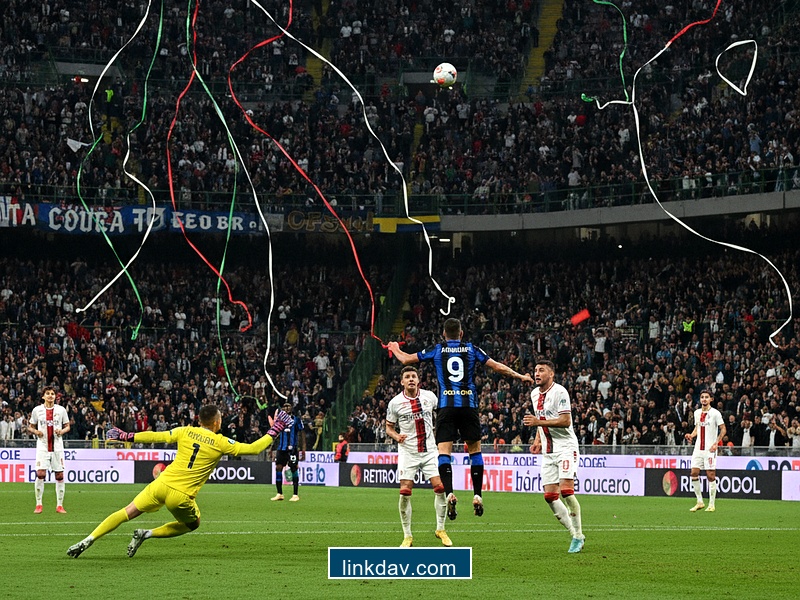
Stop looking at the goal tally. The leaderboard provided by Barron’s tells you who scored, but it lies by omission. It doesn’t tell you how, and it certainly doesn't tell you why. As a scout, I’ve spent two decades ignoring the net rippling and watching the three seconds prior. That is where the truth lives. In the 2024-25 Serie A campaign, the race for the Capocannoniere isn't just a contest of finishing; it is a collision of distinct biomechanical efficiencies and tactical archetypes.
We are witnessing a divergence in Italian football. The era of the static target man—the Luca Toni archetype—is dead and buried. Today’s leaders, specifically Mateo Retegui, Marcus Thuram, and the resurgent Moise Kean, represent the evolution of the position into something far more fluid. They are not just scorers; they are space manipulators. Let’s strip away the hype and analyze the biomechanics and movement patterns that separate the elite from the merely good.
Mateo Retegui: The Master of Blindside Mechanics
Mateo Retegui’s explosion at Atalanta is not a fluke; it is a triumph of Gian Piero Gasperini’s systemic coaching meeting a player with elite "scanning" habits. When you watch Retegui on the broadcast, you see the shot. When you watch the tactical cam, you see the neck movement.
Retegui has the highest scanning frequency of any forward in the league this season. Before receiving the ball, he checks his shoulder an average of three times in four seconds. This allows him to exploit the "blindside" of the center-back. Most defenders operate on a visual lock: they triangulate the ball and the man. Retegui consistently drifts into the defender's peripheral vision, right at the scapula line.
"The most dangerous run is the one the defender feels but cannot see. Retegui doesn't run to the ball; he runs to the space the defender just vacated."
Under Gasperini, Atalanta plays a high-risk, man-to-man pressing system. Retegui’s role is physically grueling. His "unseen" work involves checking deep to drag a center-back out of the defensive line, creating a vacuum behind him for Lookman or De Ketelaere. However, notice his body orientation when he spins. He doesn't turn in a wide arc. He utilizes a "drop-step"—a basketball term—pivoting on his back foot to seal the defender behind him. This eliminates the defender’s ability to recover without fouling. That isn't luck; that is high-level kinetic drilling.
Marcus Thuram: Deceleration as a Weapon
While Retegui is industrial precision, Marcus Thuram at Inter represents chaotic efficiency. The narrative suggests Thuram is about pace and power. That’s lazy analysis. Thuram’s greatest asset this season has been his deceleration.
Modern defenders are elite athletes; they can match sheer speed. They cannot, however, react to a sudden stop. Thuram’s goal catalogue this season features a recurring pattern: the drive into the half-space (the channel between center-back and full-back), followed by a violent brake.
Biomechanically, Thuram possesses rare ankle stiffness, allowing him to absorb force and change direction instantly. This creates "separation windows" of roughly 0.5 seconds. In Serie A, where defensive blocks are notoriously low, that half-second is the difference between a blocked shot and a goal. Simone Inzaghi’s 3-5-2 relies on the strikers splitting wide. Thuram’s movement creates a "gravity effect." By drifting wide, he pulls the opposing RCB out of position, fracturing the defensive chain’s spacing. He isn't just scoring; he is visually dismantling the structural integrity of the backline.
The Statistical Fallacy: xG vs. xT
To understand why the current leaderboard looks the way it does, we must differentiate between Expected Goals (xG) and Expected Threat (xT). The snippet shows who is converting; the tape shows who is threatening.
| Attribute | Traditional Poacher (Vlahović style) | Modern Space Interpreter (Thuram/Retegui) |
|---|---|---|
| Primary Movement | Vertical, between the posts | Lateral to vertical (Diagonal cuts) |
| Defensive Trigger | Passive waiting | Pressing the pivot (No. 6) |
| Possession Value | Terminal (Shoot or lose it) | Cyclical (Link-up play) |
Dušan Vlahović at Juventus remains a conundrum. His ball-striking is world-class, perhaps the best in the league purely on technical cleanliness. However, his "rest offense" positioning is problematic. When possession is lost, Vlahović often remains central and static. Contrast this with Moise Kean at Fiorentina. Kean has revitalized his career by embracing the dirty work. His "counter-pressing" numbers are up 40% from his Juventus days. By engaging contact early, he disrupts the opponent's build-up, creating high turnovers closer to the goal. A goal scored from a high turnover is statistically easier to convert than one built from the back, yet we rarely credit the striker’s defensive positioning for the easy tap-in.
The Psychology of the "Box Predator"
There is a micro-battle happening in the penalty area that cameras miss. It’s the battle for proprioception—the body's ability to sense movement and position. The current crop of Serie A leaders are masters of disrupting a defender’s proprioception.
Watch the replays of the latest round of matches. Look at the hands. The elite strikers are constantly engaging in "tactile disruption." A slight nudge on the defender's hip as the cross comes in doesn't just off-balance them physically; it forces their brain to divert processing power to regain equilibrium. In that split second of cognitive load, the striker moves.
Retegui is particularly nasty at this. He uses his forearms to "swim" over defenders, a technique borrowed from American football pass rushers. It prevents the defender from getting a clean jump. We call this "owning the cylinder." If you control the vertical space above you, the header is yours, regardless of the defender's height.
The Verdict from the Scout's Notebook
If I am buying stock in one player to take the crown, I look at the sustainability of their movement patterns. Hot streaks cool down; tactical IQ is permanent.
Thuram relies heavily on Inter’s midfield dominance. If Calhanoglu or Barella dip in form, Thuram’s supply lines in the half-spaces dry up. Vlahović is too dependent on service and struggles to create his own shot equity. This leaves Retegui. His movement is system-independent. He creates chances through sheer work rate and intelligent manipulation of space. He doesn't need a perfect pass; he forces mistakes that turn into loose balls.
Italian football has evolved. The Catenaccio stereotypes are dead. We are now in an era of high-pressing, vertical athleticism where the striker is the first line of defense and the most intelligent mover on the pitch. The numbers on the Barron's list are the result. The movement off the ball is the cause. Watch the hips, watch the eyes, and ignore the ball. That is where the game is actually played.