
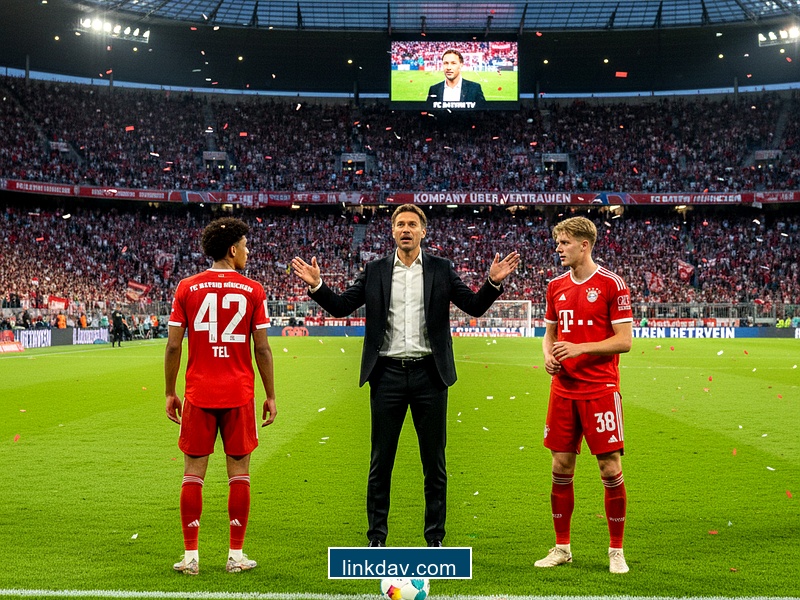
When Vincent Kompany was unveiled at the Allianz Arena, the collective eyebrows of the European football intelligentsia didn't just raise; they practically detached. Here was a man who had just overseen Burnley’s relegation from the Premier League, tasked with correcting the trajectory of a Bavarian superclub that treats second place as a firing offense. Yet, following his recent comments emphasizing the "trust factor" regarding two key debuts, the fog of skepticism is beginning to lift, revealing the distinct outline of a philosophy that is far more radical than his predecessor's pragmatic conservatism.
Kompany’s insistence on trust is not the usual post-match platitude offered to journalists to fill column inches. In the context of Bayern Munich, a club historically termed "FC Hollywood" for its volatile mix of ego and power politics, prioritizing trust over pedigree is a counter-cultural insurgency. The "Project" here isn't just about winning the Meisterschale back from Bayer Leverkusen; it is about stripping down the tactical rigidity of the Tuchel era and replacing it with a fluid, high-risk humanism.
The Anatomy of the "Trust" Philosophy
To understand why Kompany’s comments on these debuts matter, we must dissect the tactical implication of the word "trust" in his system. Kompany is a disciple of Guardiola, yes, but he is not a clone. While Pep views players as chess pieces to be moved into zones of maximum efficiency, Kompany views them as distinct pressure points. His system at Burnley—despite the lack of quality to sustain it—relied heavily on players making autonomous decisions under extreme duress.
Giving debuts to unproven commodities in a Bayern shirt is a calculated gamble. It signals to the dressing room that the hierarchy is fluid. Under Thomas Tuchel, the hierarchy was rigid, almost calcified. You played if you were a senator of the squad. Kompany is dismantling that aristocracy. By thrusting new blood into the fray, he is validating the millions Bayern invested in "The Campus" (their youth academy), an asset that has been criminally underutilized since its inauguration in 2017.
"Trust isn't about hoping a player performs. It's about knowing the system supports their failure if they try to do the right thing. Kompany is betting that the system protects the individual."
This approach mirrors the early managerial days of Louis van Gaal at Bayern. It was Van Gaal who famously said, "Muller always plays," trusting a gangly, unorthodox youth player over established stars. That trust created a decade-long dynasty. Kompany seems to be hunting for his own Muller, a foundational piece that owes their career trajectory entirely to his bravery.
Tactical Suicide or Modern Necessity?
The sustainability of this project hangs on a razor's edge. Kompany’s philosophy demands a defensive line so high it often induces vertigo. This requires a goalkeeper who acts as a libero and center-backs who are comfortable defending 50 yards of empty green grass behind them. When he speaks of trusting debutants, he is often asking them to step into a system that exposes them to terrifying isolation.
Historically, the Bundesliga punishes naivety. We saw this with Peter Bosz at Dortmund—a high line with no pressure on the ball leads to ruin. However, Kompany’s trust is distinct because it is coupled with an aggressive counter-press that Bayern has lacked since the Hansi Flick sextuple era. The "trust" is that the forward line will sprint back, and the midfield will collapse the space.
Comparing the Managerial DNA
The shift from Tuchel to Kompany represents a violent swing in organizational philosophy. We can visualize the stark differences in their operational mandates:
| Metric | Thomas Tuchel (The Previous Regime) | Vincent Kompany (The Current Project) |
|---|---|---|
| Squad Hierarchy | Rigid, Veteran-reliant | Meritocratic, Youth-integrated |
| Possession Style | Risk-averse, U-shape passing | Vertical, Central penetration |
| Defensive Line | Mid-block stability | Aggressive High-line |
| Reaction to Errors | Public criticism | Internal "Trust" reinforcement |
The Political Economy of Munich
We cannot analyze the manager's philosophy without acknowledging the shark tank he swims in. Uli Hoeneß and Karl-Heinz Rummenigge, even from the shadows of the supervisory board, wield immense influence. They demand attractive football. The dour, suffering-focused football of the previous season was anathema to the Bavarian soul. They want "Mia San Mia"—arrogance, dominance, flair.
Kompany’s rhetoric about trust plays perfectly into this. It suggests bravery. The Bayern board will tolerate a 4-3 loss if the team played with courage (see: the Nagelsmann era's beginning). They will not tolerate a 1-0 loss where the team looked afraid. By backing debutants, Kompany is buying political capital. He is telling the board, "I am building the future assets of this corporation." It is a smart play. If the debutants succeed, he is a genius. If they fail, he can frame it as necessary development pains for the club's long-term health.
The Shadow of Leverkusen
The context of these debuts is framed by the specter of Xabi Alonso’s Bayer Leverkusen. Last season, Leverkusen didn't just beat Bayern; they rendered Bayern's style obsolete. Alonso’s team was fluid, brave, and technically secure. Kompany was hired specifically to match that modernity.
Alonso succeeded by trusting players like Florian Wirtz and Piero Hincapié to play complex roles. Kompany knows he cannot beat Leverkusen by being a more conservative version of Tuchel. He has to out-football them. Trusting new players to interpret space rather than follow rigid tramlines is the only way to generate the unpredictability required to break down the low blocks Bayern faces in 30 out of 34 league games.
Is This Sustainable?
Here lies the crux of the editorial. Can "trust" survive a November slump? It is easy to hand out debuts in the honeymoon phase or early cup rounds. It is much harder to trust a 19-year-old when you are trailing Dortmund away and the press is sharpening their knives.
Kompany’s Burnley tenure offers a warning. He stuck to his principles—playing out from the back—even when his defenders were incapable of executing it against Premier League elites. That stubbornness led to relegation. At Bayern, the players are capable, but the psychological pressure is heavier.
If Kompany refuses to compromise, we are looking at one of two outcomes: a revolutionary season where Bayern plays the most attractive football in Europe, or a catastrophic implosion by Christmas. There is no middle ground with this philosophy. The "trust" he emphasizes creates a binary outcome. Either the players run through walls for him because he backed them, or they lose faith in a system that demands perfection and leaves them exposed.
Ultimately, these debuts are not just about squad rotation. They are a manifesto. Vincent Kompany is telling the world that Bayern Munich is done playing it safe. He is betting his reputation that the talent in the locker room, unleashed from tactical shackles and emboldened by absolute trust, is enough to conquer Europe. It is a terrifyingly high-wire act, but for the first time in two years, the Allianz Arena feels alive.