
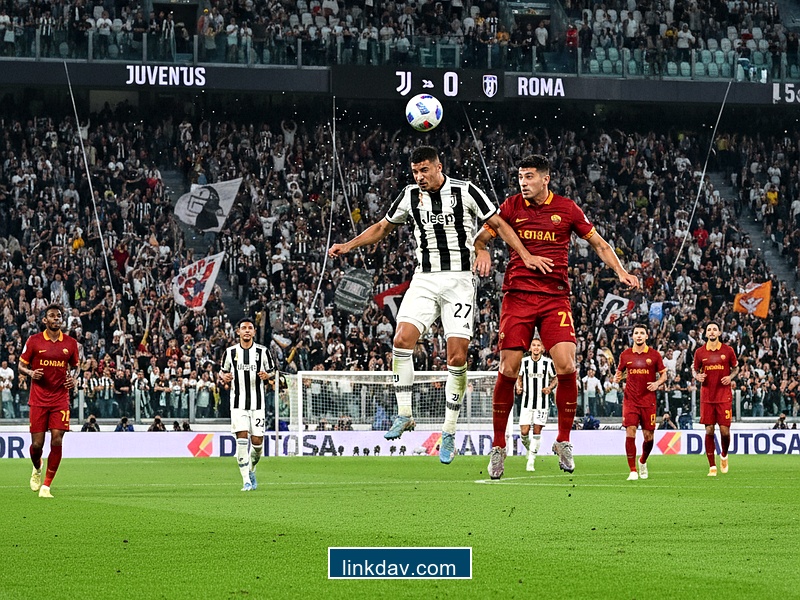
The scoreboard is a liar. To the casual observer checking their phone notifications, a deadlock between Juventus and Roma reads as a failure of entertainment. To the professional eye—trained to ignore the ball and watch the space—it was a masterclass in structural nullification. We just witnessed ninety minutes of high-stakes chess played on grass, where the Checkmate wasn't the goal; the goal was removing the opponent's Queen from the board entirely.
Thiago Motta’s Juventus project is still in its embryonic phase, oscillating between brilliance and sterility. Against a Roma side fighting for identity, the narrative wasn't about who scored. It was about who suffocated whom. I spent the match watching the hips and eyes of the defensive lines, not the trajectory of the ball. Here is what the cameras missed.
The Motta Blueprint: Rotations over Positions
Modern football has moved past static formations. Motta does not play a 4-2-3-1; he plays a fluid organism. In scouting terms, we look for "functional interchanges." Throughout the first half, the body language of the Juventus full-backs was telling. They weren't looking to overlap; they were looking to invert.
The intent was to overload the central corridor, forcing Roma’s defensive block to narrow. Once narrowed, the theoretical space opens on the flanks for the isolation wingers. However, the execution revealed the friction in this new Juventus engine. Dusan Vlahovic’s frustration was palpable not because of service quality, but service timing.
"Watch a striker’s hands when the press is triggered. Vlahovic spent more time gesturing to his midfield to verticalize than he did scanning the defensive line. That is a biomechanical tell of a disconnect in trust."
When Vlahovic drops deep to link play, he requires runners to exploit the space he vacates—the "third man run." Under Motta’s predecessor, Allegri, this was discouraged in favor of low-risk retention. Old habits die hard. Several times, Kenan Yildiz made the blind-side run, checking his shoulder to ensure he was in the defender's shadow, only for the midfield pivot to recycle possession safely. The unseen work of Yildiz—his deceleration mechanics to stay onside, his scanning frequency (checking his surroundings every 3 seconds)—was elite, yet entirely wasted by a risk-averse midfield engine.
Roma’s Mid-Block: The Art of Space Constriction
Roma did not park the bus. That is a lazy colloquialism. They executed a disciplined mid-block with specific "pressing triggers." A trigger is an event that tells the team to swarm—a poor touch, a pass to a center-back facing his own goal, or a ball played into the sideline trap.
Defensively, Roma’s shape morphed into a 4-4-2 out of possession, but the spacing between the lines was the critical metric. A functional block requires vertical compactness of no more than 25-30 meters. Roma maintained this rigid distance, effectively choking the "Zone 14" (the area just outside the penalty box). By denying Juventus entry into Zone 14, they forced the play into a U-shape—harmless circulation around the perimeter.
The physical toll of this strategy is often underestimated. While sprinting requires explosive energy, the constant micro-adjustments of a defensive block—shuffling three steps left, two steps right, checking the line—creates immense cognitive load. Look at the Roma center-backs in the 80th minute. They weren't gasping for air; they were mentally exhausted from the concentration required to hand off marking responsibilities against Juve’s fluid front line.
The Half-Space War
The most sophisticated battle occurred in the "half-spaces"—the vertical corridors between the wing and the center. This is where modern football is won. Motta wants his interiors to occupy these zones to pin the opposition full-backs.
However, Roma’s defensive comportment was astute. Their midfielders did not track the man; they screened the passing lane. This is "shadow cover." By positioning themselves specifically to block the ball trajectory rather than standing on the opponent, they allowed Juventus to have the ball but denied them progression. It is a risky gamble. If a passer has the vision to thread the needle, the defense collapses.
Juventus failed to exploit this because their tempo was mono-rhythmic. To break a shadow cover, you need "la pausa"—the ability to slow down, draw the defender out, and then accelerate. Juventus played at one speed. It was efficient, safe, and entirely predictable for a seasoned defense.
Body Language and the Psychological Stalemate
Let’s analyze the "unseen" communication. In the closing stages, watch the recovery runs of the Juventus wingers. A recovery run is the sprint back to defense after losing possession. In the first 20 minutes, these were full sprints. By minute 75, they became jogs.
This deceleration indicates a team that does not fear the opponent's counter-attack enough to suffer. It suggests a subconscious acceptance of the draw. Conversely, Roma’s players engaged in what scouts call "tactical fouling" high up the pitch. These weren't malicious challenges; they were disruptions of rhythm designed to allow the defensive shape to reset. It shows a pragmatic maturity that De Rossi has instilled, moving away from the emotional volatility of the Mourinho era toward a colder, more cynical efficiency.
Historical Context: The Shadow of Calcio
To understand this match, you must understand the league’s DNA. In the Premier League, chaos is currency. In Serie A, control is king. This match was a throwback to the tactical rigors of the 1990s, updated for the pressing era. It wasn't Catenaccio (the door-bolt defense); it was Gegenpressing neutralization.
Historically, Juve vs. Roma clashes—think the Boniek era or the Totti-Del Piero duels—were defined by moments of individual magic breaking structural rigidity. Today, the structures have become so sophisticated that individual magic is suffocated before it can breathe. The systems are becoming stronger than the players.
The Verdict
From a scouting perspective, the standout performance wasn't a player, but a unit: Roma’s central defensive partnership. Their ability to read the "trigger movements" of Vlahovic—stepping up when he dropped deep, dropping off when he looked to spin—was textbook.
For Juventus, the concern is the disconnect between Motta’s philosophy and the players' instincts. They look like a team trying to remember a complex dance routine while the music is playing too fast. The movement is there, but the fluidity is mechanical, not organic.
We saw 22 athletes running over 10 kilometers each, yet the ball spent the majority of the time in safe zones. This wasn't a boring match; it was a canceled check. Both managers prioritized structural integrity over risk. In the long war of a Serie A season, a point against a rival is often valued higher than the risk of zero. But for those of us watching the spaces, the silence was deafening.