
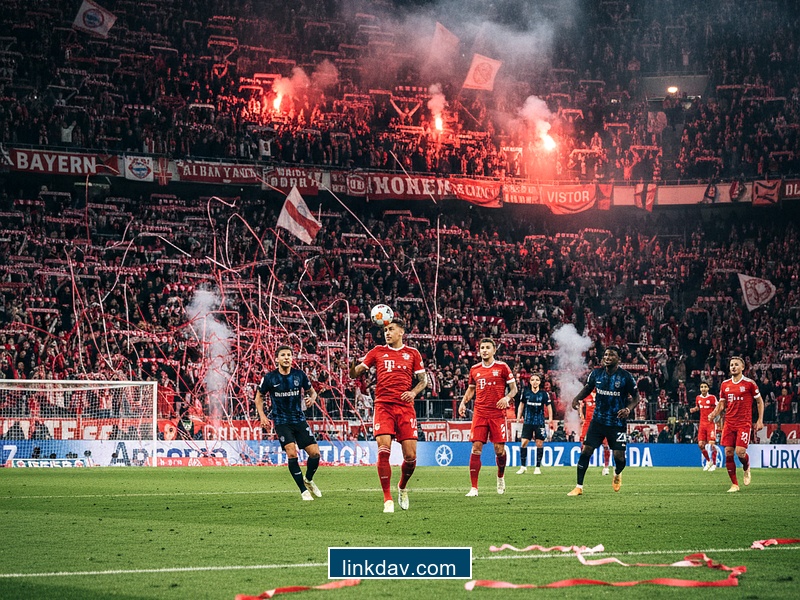
The Hinrunde is over, the winter coats are out in Munich, and for the first time in eighteen months, the Allianz Arena doesn't feel like a funeral home waiting for a casket. Looking at the Bavarian Football Works recap of the first half of the season, the raw numbers suggest stabilization. But statistics are a drunkard’s lamppost—used for support rather than illumination. To understand what is actually happening at Säbener Straße under Vincent Kompany, we must look past the league table and stare directly into the tactical soul of this team.
We are witnessing a fascinating, terrifying experiment. After the dour, joyless pragmatism of Thomas Tuchel—a tenure that felt like watching paint dry in a burning building—Kompany has reinstated a philosophy that predates the modern era. This isn't just about winning; it is about the restoration of Bayern's inherent arrogance. The Mia San Mia swagger is back, but it is walking a tightrope without a safety net.
The Ghost of the High Line: Risk vs. Reward
The defining feature of this Hinrunde has been the defensive line. Calling it "high" is an understatement; at times, Dayot Upamecano and Kim Min-jae are practically sharing a postcode with Harry Kane. It is aggressive, suffocating, and aesthetically pleasing.
However, it evokes memories of a specific, volatile era: the Louis van Gaal tenure of 2009-2011. Van Gaal, much like Kompany, was obsessed with possession and pitch compression. He laid the foundation for the dominance of the 2010s, but his refusal to adapt led to defensive suicide against swift counter-attacks (recall the Inter Milan Champions League final defeat in 2010). Kompany’s Bayern presses with a ferocity that mirrors the 2013 Jupp Heynckes treble winners, yet the backline vulnerability feels more like the Jürgen Klinsmann disaster of 2008.
When it works, Bayern looks like the 2015 Pep Guardiola machine—suffocating opponents in their own third. When it fails, as seen in the sporadic defensive lapses this autumn, they look exposed. The difference between glory and catastrophe in the Rückrunde (second half) will not be the attack; it will be whether Kim and Upamecano can emulate the telepathic understanding of Jerome Boateng and Dante. Right now, they are physically superior but lack the icy composure Boateng possessed in his prime.
Harry Kane and the Luca Toni Parallel
Harry Kane’s numbers remain absurd. He is normalizing greatness in a way that is frankly boring to report on, which is the highest compliment a striker can receive. But tactically, his role has shifted. He is dropping deeper, pinging balls to the wingers, and operating as a false nine and a true nine simultaneously.
The historical comparison here isn't Robert Lewandowski. Lewandowski was a cyborg, a terminator designed to finish moves. Kane’s influence on the sheer vibe of the squad feels more like Luca Toni in the 2007/08 season. When Toni arrived, Bayern was in the UEFA Cup (the dark ages), licking its wounds after a fourth-place finish. Toni didn't just score; he brought a world-class gravity that lifted the morale of everyone around him. He dragged a mediocre team to a domestic double.
Kane is doing something similar but with a better supporting cast. He is exorcising the ghost of the 2023/24 season where Bayern finished trophyless for the first time since 2012. The desperation in Kane’s game—that hunger for silverware—mirrors the collective psyche of the 2012/13 squad that rebounded from the "Finale dahoam" tragedy. That team played with a chip on its shoulder the size of the Alps. Kane is the embodiment of that chip.
The Robbery Succession: Musiala and Olise
For a decade, Bayern Munich’s identity was tied to "Robbery"—Arjen Robben and Franck Ribéry. They were pure chaos agents, wingers who dominated through isolation and 1v1 humiliation. For years, the club struggled to replace them, cycling through Douglas Costa, Kingsley Coman, and Serge Gnabry with mixed long-term success.
This Hinrunde has solidified Jamal Musiala and Michael Olise as the heirs apparent, but the profile is different. Musiala is not a winger in the traditional Ribéry sense; he is a Raumdeuter (space investigator) with the dribbling of a street footballer. He is closer to a turbocharged Mehmet Scholl than a Ribéry. Olise, meanwhile, brings a cerebral playmaking element to the flank that we haven't seen since James Rodríguez had his brief Munich interlude, though Olise has far more pace.
The concern, however, is grit. In the ugly, muddy games of February and March, Robben and Ribéry possessed a nasty streak. They would fight, scrap, and dive if necessary. The current crop is elegant, perhaps too elegant. We have yet to see if Musiala can grab a game by the scruff of the neck in a Champions League semi-final against a team like Real Madrid, the way Stefan Effenberg would have demanded twenty years ago.
The Engine Room Conundrum
The midfield remains the Bermuda Triangle of Bayern’s squad planning. Joshua Kimmich has looked rejuvenated under Kompany, freed from the existential crisis of the Tuchel era where he was constantly told he wasn't a "Holding Six." Yet, the structural flaw remains.
Look back at the two greatest Bayern teams of this century: the 2001 Champions League winners and the 2013 Treble winners. Both had a designated destroyer. In 2001, it was Jens Jeremies, a man who tackled with his face if needed. In 2013, it was Javi Martínez, a €40 million signing who anchored the midfield so Schweinsteiger could shine.
Aleksandar Pavlović is a revelation—a homegrown gem with the passing range of a young Toni Kroos. But a pairing of Kimmich and Pavlović is offensively brilliant and defensively suspect against elite transition teams. We saw glimpses of this vulnerability against Frankfurt and Barcelona. They lack the cynical edge of a Mark van Bommel. Kompany’s solution has been to press so high that the midfield doesn't need to defend deep, but against Europe's elite, that is a gamble of historic proportions.
"Bayern is never about the status quo. It is about the permanent crisis of not winning by enough goals."
The Verdict: A Beautiful Glass Cannon
Vincent Kompany has done the impossible: he has made the Bundesliga fun again for neutrals, not because Bayern is losing, but because they are winning in a way that suggests they could lose at any moment. It is high-wire football.
The Hinrunde suggests Bayern is back to being Germany’s undisputed alpha. But the shadow of Bayer Leverkusen (despite their regression) and the looming threat of the Champions League knockouts requires more than just good vibes. The current squad has the offensive firepower to rival the 1970s teams of Müller and Hoeneß, but they lack the pragmatic shut-down mode of the Ottmar Hitzfeld era.
We are watching a team built to score four goals because they are terrified they might concede three. It makes for incredible television, and the Bavarian Football Works report rightfully highlights the entertainment value. But titles are rarely won by glass cannons. Unless Kompany discovers his inner Hitzfeld to balance his inner Guardiola, the spring could bring heartbreak just as easily as it brings silverware.