
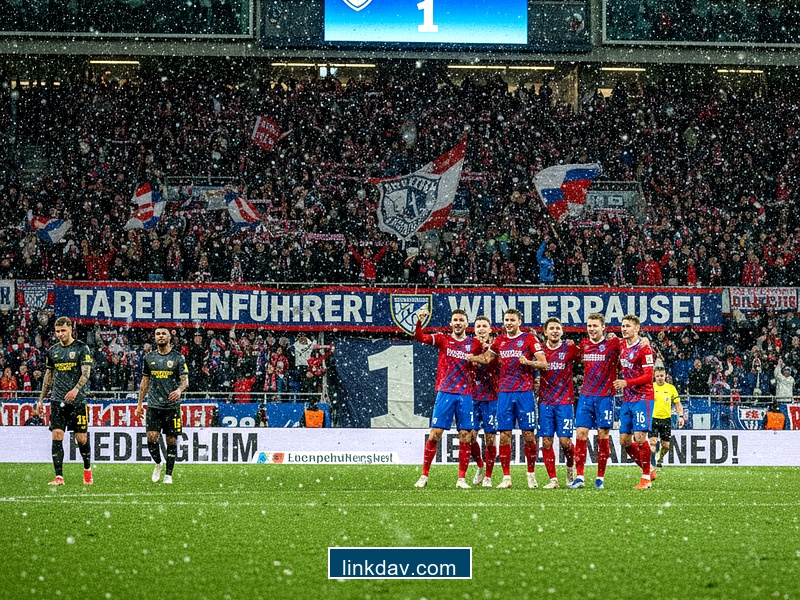
The snow has settled on the Bundesliga for the winter break, and order, as the Bavarians see it, has been restored. The victory over Heidenheim was not a glitzy exhibition of footballing excess; it was a cold, calculated procedural event that secured the Herbstmeisterschaft (Autumn Championship). For the casual observer, Bayern Munich sitting atop the table in December is as predictable as a Munich beer hall serving pretzels. However, to dismiss this current iteration of Die Roten as simply "business as usual" is to ignore the tactical revolution occurring under the hood.
This isn't the fragile, neurotic Bayern of the Thomas Tuchel interregnum, nor is it the heavy metal chaos of the Julian Nagelsmann experiment. As we head into 2025, Vincent Kompany’s side is beginning to exhibit a specific kind of menacing control that we haven’t seen at the Allianz Arena for over a decade. To understand where this team is going, we have to look back at the gold standard of German football: the 2012/13 treble-winning side under Jupp Heynckes.
The Redemption Arc: 2013 vs. 2025
History rarely repeats, but it often rhymes. The 2012/13 season was born out of trauma. Borussia Dortmund had humiliated Bayern for two consecutive years, prompting a "never again" mentality in the Säbener Straße boardroom. Fast forward to the present day, and the catalyst is Bayer Leverkusen. The pain of watching Xabi Alonso’s invincibles tear up the script last season has triggered a similar metabolic reaction in the Bayern organism.
The win against Heidenheim solidified a defensive stability that mirrors the Heynckes era. In the first half of the 2012/13 season, Bayern conceded a miserly seven goals. While the current defensive unit hasn't quite matched that statistical anomaly, the underlying metrics of control are eerily similar. The difference lies in the method. Heynckes achieved solidity through a muscular double pivot (Schweinsteiger and Martinez) and defensive wingers. Kompany achieves it through possession strangulation.
"The 2013 team would beat you up and then outscore you. This 2025 team simply refuses to let you have the ball until you suffocate."
Heidenheim, a team designed to frustrate via low blocks and set pieces, was rendered impotent not by tackles, but by positioning. This is the evolution of the "Bavarian suppression."
Harry Kane and the Evolution of the Number Nine
If we are drawing parallels, the most glaring divergence is at the tip of the spear. In 2013, Mario Mandžukić was the embodiment of defensive pressing from the front. He was a battering ram, a nuisance, a player who sacrificed personal glory for the collective structure. Mario Gomez, the poacher supreme, was phased out for this grittier profile.
Harry Kane, however, represents a synthesis of three different generations of Bayern strikers. He possesses the box predation of Gomez, the link-up intelligence of Robert Lewandowski, and the work rate of Mandžukić. Against Heidenheim, Kane’s movement dropped deep into the number 10 spaces, dragging centre-backs into uncomfortable territory—a tactical luxury Heynckes never utilized.
In the 2010s, the system served the striker. Today, Kane is the system. His ability to function as a quarterback in the final third allows the wingers to invert with a freedom that Arjen Robben and Franck Ribéry often had to manufacture through pure individual brilliance.
The Wing Play: Re-imagining "Robbery"
For a decade, Bayern lived and died by the "Robbery" (Robben and Ribéry) paradigm. It was isolation football at its finest: get the ball wide, beat the man, cut inside, score. It was predictable, yet unstoppable.
The current setup, solidified in this winter run, offers a more complex geometry. With Michael Olise and Jamal Musiala operating in the half-spaces rather than hugging the touchline, Bayern has moved away from pure width. In the Heidenheim match, notice how often the full-backs provided the width while the "wingers" operated almost as dual number 10s.
This is where the comparison to the 2013 vintage becomes a contrast of philosophy. Heynckes’ wingers were sprinters; Kompany’s wide men are technicians. The 2013 team thrived on the counter-attack—the "switch" from defense to offense took seconds. The current squad prefers to dismantle teams methodically, a style that reduces variance but demands higher technical precision. This reduces the risk of the "banana skin" games that plagued the team in recent winters.
The Midfield Engine: Pavlovic is the New Architect
Perhaps the most significant development of this Hinrunde (first half of the season) is the emergence of Aleksandar Pavlovic as the heartbeat of the midfield. To find a comparison, one must look past the physicality of Leon Goretzka or the dynamism of Arturo Vidal. Pavlovic is channeling the ghost of a young Bastian Schweinsteiger, circa 2010, but with the press-resistance of a La Masia graduate.
In the 2013 Champions League final, Javi Martinez was the destroyer. He broke up play. Today, Bayern defends with the ball. The need for a pure destroyer has diminished because the counter-press is so immediate. Against Heidenheim, the midfield didn't need to win tackles; they simply intercepted poor clearances forced by the relentless pressure of the front four.
The Curse of the Herbstmeister
German football statisticians love the "Herbstmeister" title. Historically, roughly 67% of teams leading at Christmas go on to lift the Meisterschale in May. However, Bayern’s conversion rate is significantly higher, hovering near 85%.
Yet, there is a distinct difference in the feeling of this lead compared to the Nagelsmann years. In 2021 and 2022, Bayern led at the break, but the performances felt brittle—high scores masking defensive fragility. This winter, the lead feels earned through structural integrity. The Heidenheim match wasn't a thriller, and that is exactly why it was terrifying for the rest of the league. Boring dominance is the hardest type of dominance to overthrow.
The Road Ahead: Europe is the True Metric
Domestic success is the baseline requirement in Munich; it is not the ambition. The 2013 team is legendary not because they won the Bundesliga, but because they crushed Barcelona 7-0 on aggregate and conquered Europe.
The skepticism surrounding this current squad remains valid until the spring. Can this high line survive against the pace of a Vinícius Júnior or the transition speed of Liverpool? The 2013 team sat deeper against superior opposition. Kompany’s philosophy suggests he won't compromise his high line. That is the gamble.
Beating Heidenheim seals the winter crown, but it also seals the expectations. The "transition year" excuse is dead. The squad is settled, the key players (Kane, Musiala, Kimmich) are in their prime or approaching it, and the tactical identity is clear. They have matched the ruthlessness of the Heynckes era; now they must match the silverware.
Winter champions? Yes. But in Bavaria, nobody remembers who led the race in December. They only remember who is standing on the Marienplatz balcony in May. Based on the cold efficiency displayed in Heidenheim, the booking for that balcony should be made sooner rather than later.