
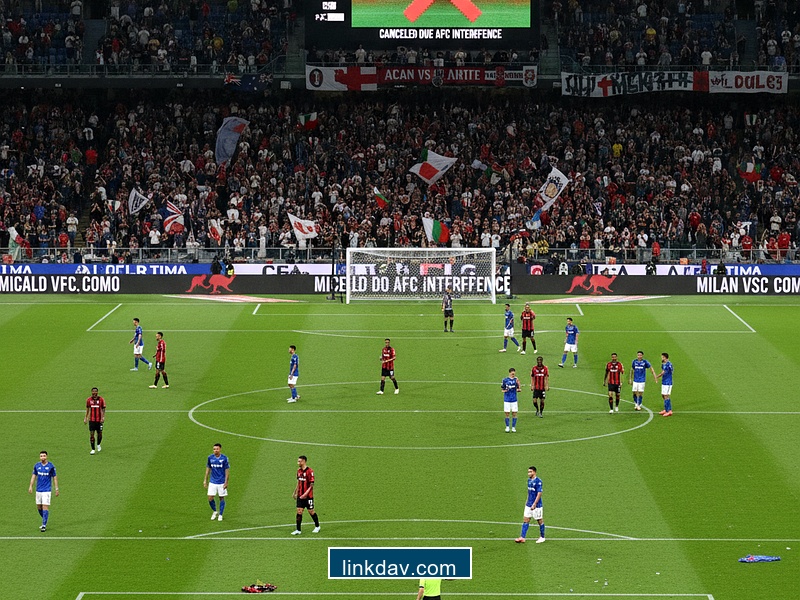
The recent collapse of the proposed Serie A fixture between AC Milan and Como 1907 in Perth, Australia, is not merely a logistical hiccup. It is a humiliation. Blocked by the Asian Football Confederation (AFC), this failed experiment exposes the desperation currently rotting the foundations of Calcio. While the official line cites regulatory interference, the subtext is far more damning: the once-mighty Italian league is now reduced to hawking its heritage like a traveling circus, only to be turned away at the border.
For those of us who covered the peninsula’s football two decades ago, the contrast is nauseating. The Serie A of the early 2000s did not need to export meaningful fixtures to Perth or Pennsylvania to generate revenue. It commanded the world’s attention through sheer, undeniable technical superiority. Now, we watch a league attempting to bypass FIFA statutes just to scrape together a few million euros, sacrificing sporting integrity on the altar of brand expansion.
The Ghost of Richard Scudamore
To understand the gravity of this blunder, we must look back to 2008. Richard Scudamore, the then-chief of the Premier League, proposed the infamous "Game 39"—an extra round of league matches played internationally. The backlash was immediate and visceral. Fans revolted, FIFA threatened expulsion, and the idea was shelved.
Serie A, arriving 16 years late to a party that was shut down by the police, thought they could circumvent the "Game 39" stigma by simply moving a regular-season match. The naivety is staggering. The AFC’s intervention is grounded in the protection of their own domestic ecosystem, primarily the A-League. But legally, they stood on the bedrock of FIFA Article 71, which strictly regulates matches played outside a confederation's territory. Italy’s administrators acted with the arrogance of the 1990s but the leverage of the 2020s—a fatal combination.
Milan: From Emperors to Content Creators
The participation of AC Milan in this farce is particularly dispiriting. Compare the current ownership’s strategy under RedBird Capital to the Milan of the mid-2000s under Silvio Berlusconi. In 2005 or 2007, when Carlo Ancelotti walked the touchline, Milan was an institution of intimidation.
Look at the 2005 roster. You had Paolo Maldini, Alessandro Nesta, Jaap Stam, and Cafu in defense alone. Andriy Shevchenko was winning the Ballon d'Or. Kaka was an artist operating at a velocity no one else could match. That team didn't need to play Como in Australia to build a brand; their brand was the Champions League final. They were cultural exporters through excellence.
"The Milan of 2005 exported fear and awe. The Milan of 2024 is attempting to export 'content' and 'engagement' to close a financial gap they cannot bridge on the pitch."
Today, the Rossoneri are a project of algorithms and American franchise theory. The signing of Christian Pulisic, while successful on the pitch, was celebrated in the boardroom primarily for the spike in North American shirt sales. Attempting to drag the team to Australia mid-season speaks to a disconnect between the sporting directorate and the commercial department. Maldini would never have boarded that plane for a league game. The modern Milan, however, views 90 minutes of football as a scalable asset rather than a sacred competitive event.
Como 1907: The Artificial Fairy Tale
On the other side of this canceled ticket was Como 1907. The media loves to paint Como as a fairytale—the lakeside setting, the glamour, the celebrity ownership group involving Cesc Fàbregas and Thierry Henry. But let us strip away the varnish. Como is the antithesis of the provincial Italian clubs that made Serie A the toughest tactical school in the world 15 years ago.
Recall the Chievo Verona side of the early 2000s, the "Flying Donkeys." Under Luigi Delneri, they were a miracle of tactical discipline and local grit. They didn't have billionaires or World Cup winners in the directors' box; they had Luciano and Eugenio Corini. They survived and thrived because they mastered the dark arts of Italian defensive organization.
Como represents the gentrification of Calcio. Backed by the Hartono brothers (the richest owners in Italian football), they are a boutique club designed for Instagram reels. Their willingness to move a home fixture to the other side of the planet betrays a lack of respect for the local fanbase that stuck with them through bankruptcy and Serie D. Chievo belonged to a neighborhood in Verona; Como, it seems, belongs to a global marketing deck.
The Economics of Desperation
Why attempt this logistical nightmare? The numbers tell the story. The Premier League’s domestic and international TV rights generate approximately €4 billion annually. Serie A struggles to clear €1 billion. The gap has become an abyss.
In the golden era (1990-2005), the "Sette Sorelle" (Seven Sisters) of Italian football could outspend anyone. Parma could break transfer records for Hernán Crespo. Lazio could buy Juan Sebastián Verón for fees that still water the eyes. Today, Italian clubs are feeder teams for the English mid-table. Bologna’s Riccardo Calafiori leaving for Arsenal or Sandro Tonali moving to Newcastle would have been unthinkable in 2004. Back then, you left Italy only if you were retired or rejected.
This aborted Australian fixture was a hail mary. Italian executives know they cannot catch the Premier League through traditional broadcast deals. The product has become too slow, the stadiums too dilapidated, and the officiating too controversial to command premium rates. So, they attempt to franchise the league, treating matchdays like NBA Global Games.
The AFC's Protective Wall
The AFC deserves credit for seeing this for what it was: a colonialist attempt to extract revenue from a developing market without contributing to it. The Asian Confederation has spent decades trying to legitimize the AFC Champions League and strengthen domestic competitions like the J-League and A-League. Allowing European leagues to play competitive fixtures on their soil undermines the local product.
It sets a precedent that the A-League is merely a support act, a pre-show entertainment before the "real" football arrives from Europe. By blocking the move, the AFC has asserted territorial sovereignty that FIFA has long been hesitant to enforce strictly.
A League Losing Its Soul
The cancellation saves Serie A from itself. Had the game gone ahead, the fatigue on the players would have impacted the integrity of the remaining domestic fixtures. But the reputational damage is done. It signals to the world that Serie A is for sale, piece by piece.
We are watching the erosion of the specific cultural markers that made Italian football legendary. The smell of flares at the San Siro, the tactical obsession of a wet Wednesday in Bergamo, the distinct regional hostilities that define the peninsula. You cannot box that up and ship it to Perth. When you try, you don't export the magic; you dilute it until it tastes like nothing at all.