
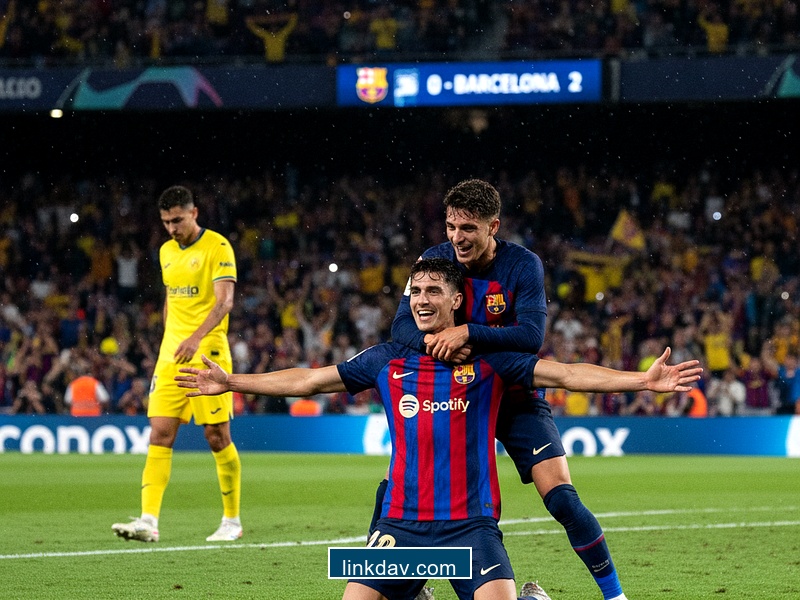
The scoreboard at the Estadio de la Cerámica read 0-2, a result that the morning papers will likely attribute to moments of individual brilliance or clinical finishing. They are wrong. To the untrained eye, Barcelona’s victory to close out 2025 was a standard smash-and-grab against a Villarreal side that has historically made life hell for the Blaugrana. But if you take your eyes off the ball and watch the negative space—the grass where the ball wasn’t—you see the terrifying evolution of this squad.
I spent ninety minutes ignoring the possession stats and watching the hips and shoulders of the Barcelona backline. What Hansi Flick has engineered here isn't just a winning machine; it is a masterclass in Restverteidigung—the German concept of rest defense. This wasn't a victory of possession; it was a victory of positioning.
The Art of the Proactive Shadow
Professional scouting is often less about what a player does with the ball and more about what they do three seconds before they receive it. In this fixture, the spotlight belongs to the defensive pairing, specifically in their body orientation during Barcelona's attacking phases.
Historically, Barcelona defenders were tasked with recycling possession. Tonight, the center-backs operated as aggressive sweepers in a high-wire act. Watch the tape from the 23rd minute. As Pedri drives into the final third, look at Pau Cubarsí. He doesn't watch the ball. His head is on a swivel, scanning the space behind him, identifying Álex Baena’s movement in the transition channel.
Cubarsí’s body shape is open, half-turned toward his own goal, ready to sprint backward, yet his momentum is inching forward. This is the "proactive shadow." By compressing the space, he suffocates Villarreal’s counter-attack before a pass is even attempted. It’s a psychological war; Baena stopped making the runs because the passing lanes were mentally closed off by the sheer proximity of the Barcelona high line. That is how you keep a clean sheet at La Cerámica—not by tackling, but by removing the oxygen from the opposition's transition game.
Decoding the Midfield Scanning Frequency
The modern game is decided in the half-spaces, that vertical corridor between the wing and the center. Tonight, Gavi and Pedri didn’t just occupy these zones; they weaponized them through elite scanning frequency. A study from the University of Geir Jordet suggests that elite midfielders scan the field 0.6 to 0.8 times per second. Watching Pedri tonight, the rate seemed closer to 1.0.
There was a moment leading up to the first goal that epitomized this. Before the ball left the boot of the passer, Pedri had checked his shoulder three times. He knew exactly where the Villarreal pivot, Parejo, was shifting his weight. By receiving the ball on his back foot—a technical nuance lost on television broadcasts—Pedri eliminated two defenders with a single touch.
"Football is played with the brain. Your feet are just the tools." — Andrea Pirlo. Tonight, Barcelona’s midfield tools were sharp, but their cognitive processing speed was frightening.
This is a departure from the horizontal, mesmerizing, but sometimes toothless "tiki-taka" of the early 2010s. This 2025 iteration is vertical, ruthless, and relies on receiving the ball under immense pressure while already knowing the escape route. Villarreal’s press failed not because of a lack of effort, but because they were pressing ghosts; the ball was gone before they arrived.
The Trigger Mechanisms of the Front Three
Let’s talk about the "dirty work" of the forward line. In professional coaching circles, we talk about "pressing triggers"—specific cues that tell a team when to abandon shape and hunt the ball. Tonight, Lamine Yamal’s maturity was on full display, not in his dribbling, but in his curved runs.
A straight run at a defender is easy to bypass. A curved run cuts off the passing angle to the sideline, forcing the play inside where the midfield trap is waiting. Yamal executed this "shadow cover" perfectly in the 55th minute, forcing Villarreal’s goalkeeper into a hurried clearance that led directly to the second goal sequence.
When you watch the replay, look at Yamal’s hands. He points to the space he wants his fullback to cover while he initiates the press. This is communication at an elite level. It signals a team that is autonomous, self-correcting, and tactically fluid. They aren’t waiting for instructions from the technical area; they are reading the game’s flow in real-time.
Historical Context: The Ghost of Riquelme Exorcised
To understand the magnitude of a controlled 0-2 win here, you must respect history. For the better part of two decades, Villarreal has been the thorn in the side of La Liga’s giants. From the days of Juan Román Riquelme to the tactical rigidity of Unai Emery’s tenure, the Yellow Submarine has specialized in dragging Barcelona into chaotic, high-scoring shootouts. The 4-4 draw in 2019 or the frantic 3-4 win in 2023 come to mind.
Those games were defined by chaos. Tonight was defined by order. To come to this stadium, against a Marcelino-coached side that thrives on vertical chaos, and impose a tempo of absolute sterility is a statement. It suggests that Barcelona has finally solved the riddle of their away form against top-tier pressing teams. They no longer need to outscore the chaos; they simply strangle it.
The Physicality of the "Unseen"
There is a physical toll to playing this way that stats don't cover. It’s the braking distance. The sheer eccentric load on the hamstrings required to stop and start as Barcelona’s midfield did tonight is immense. We often praise distance covered, but scout reports value "high-intensity braking" and "change of direction" far more.
Frenkie de Jong, coming off the bench to stabilize the final twenty minutes, showcased this durability. His ability to carry the ball—breaking the first line of pressure through dribbling rather than passing—destroyed Villarreal’s remaining will to fight. It forces the opposition to collapse their shape, opening the wide channels. It’s a physical dominance disguised as technical elegance.
Verdict: The 2025 Standard
As we close out the year, the table will show three points. But the scout’s notebook shows something far more dangerous for Real Madrid and the rest of Europe: Consistency in the invisible phases of the game.
Barcelona has always had players who could paint masterpieces with the ball. Now, they have a collective unit that understands the geometry of the game without it. They have mastered the dark arts of space manipulation, rest defense, and pressing triggers. Villarreal didn't lose tonight because they were outplayed in possession; they lost because they were outthought in the spaces between the play.
If this is the baseline for 2026, the league title won't be decided by who scores the most goals, but by who controls the silence best. Right now, the silence belongs to Barcelona.