
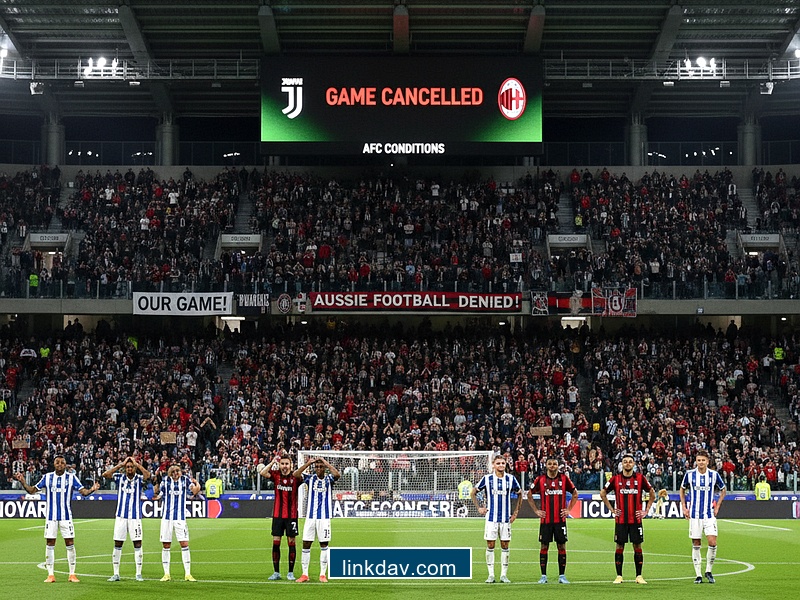
The news that plans for a Serie A fixture in Australia have been abandoned due to Asian Football Confederation (AFC) conditions is not merely a disappointment for ticket holders; it is a missed educational opportunity for the entire Australian football ecosystem. As a scout, I look for patterns, movement, and the unseen work that dictates results. In this instance, the administrative body language of the AFC suggests a defensive rigidity—a bureaucratic Catenaccio—that has stifled the creative potential of the game Down Under.
We are not simply talking about a cancelled friendly or a failed commercial activation. We are talking about the denial of access to the highest level of tactical sophisticated currently operating in Europe. When you analyze the breakdown of these negotiations, it mirrors a team playing with a deep defensive line, refusing to engage, and killing the rhythm of the opponent. The AFC has effectively parked the bus against the globalization of Calcio.
The Administrative Rest Defense
To understand why this cancellation matters, we must look at the "game tape" of the negotiation. The AFC, functioning as the governing body, employs a strict zonal marking system regarding foreign leagues playing competitive or high-profile matches within their territory. This is codified in their regulatory statutes—specifically the protection of domestic leagues and the Asian Champions League schedule. While the intent is to protect the local ecosystem (the A-League), the execution is a tactical error.
The "conditions" cited in the breakdown are likely related to timing and exclusivity. Just as a defensive midfielder cuts passing lanes to starve the playmaker, the AFC restricts the windows in which these games can occur to ensure they don't overshadow local competitions. However, in modern scouting terms, this is a failure to recognize "verticality." By blocking the entry of elite Serie A sides, the AFC isn't protecting the A-League; they are isolating it. They are preventing the local game from measuring itself against a superior press.
Scouting the Unseen: What We Missed
Let’s strip away the politics and focus on the pitch. What exactly does Australia lose by not having Italian giants rotating possession on the turf of Optus Stadium or the MCG? We lose the chance to observe the "unseen work" that defines modern Serie A.
Italian football has evolved drastically from the defensive stereotypes of the 1990s. Today, it is the tactical laboratory of Europe. Watching a team like Inter, Milan, or Bologna live offers a masterclass in body orientation and scanning frequency—metrics that television cameras often miss because they follow the ball, not the space.
"The camera shows you the pass. The live eye shows you the three movements that created the passing lane. That is what Australian coaches and young players have been denied."
In the A-League, the game is often transitional—end-to-end, relying on athleticism and swift counter-attacks. It is exciting, but often tactically loose. Serie A sides, conversely, operate with a suffocating compact structure. A scout watching these teams live would notice the Rest Defense (the positioning of players while their team is attacking). When a Serie A team attacks with five players, the remaining five are not watching; they are actively closing potential counter-attack vectors before the ball is even lost. This proactive prophylaxis is something Australian football desperately needs to study close-up.
The Evolution of the Half-Space
One of the specific tactical trends we are missing is the Italian utilization of the half-spaces (the vertical channels between the wing and the center). In the Premier League, this is often about speed. In Serie A, it is about La Pausa—the ability to wait.
Had this game proceeded, spectators would have witnessed the modern interpretation of the Mezzala (the half-winger midfielder). Unlike the traditional box-to-box runners we often see in the AFC region, the elite Serie A midfielder creates distinct movement patterns designed to manipulate the opponent's "Cover Shadow." They drift laterally, dragging defensive midfielders out of position, creating passing lanes that didn't exist two seconds prior. This is the "dark arts" of possession: moving not to receive the ball, but to move the defender.
Physicality vs. Intelligence
There is a misconception that European teams in exhibitions play at 50% intensity. A professional scout knows that elite movement patterns are habitual. You cannot turn off "scanning."
A specific area of interest would have been the duel mechanics. In Australian football, physical duels are often contested with brute force—shoulder charges and aerial leaps. In Serie A, the physicality is applied earlier. It is the subtle nudge to off-balance a defender just as the ball is arriving. It is the use of the hips to shield the ball, lowering the center of gravity to draw a foul.
We call this "game management" or, more cynically, "referee education." Seeing how top-tier Italian professionals communicate with officials, how they manage the tempo of the game by killing time in possession, and how they use tactical fouling to break momentum without receiving a yellow card is a curriculum in itself. It’s cynical, yes, but it is a vital part of winning at the international level—something the Socceroos often struggle with against wily South American or European opponents.
The Cost of Isolation
The AFC’s decision to enforce strict conditions acts as a low-block defense that refuses to be drawn out. By prioritizing the sanctity of schedule over the influx of quality, they are prioritizing a clean sheet over a win.
High-performance environments thrive on osmosis. When A-League academy players see the warm-up routines of a Serie A club—the specific dynamic activation, the rondo intensity where the ball never leaves the grass—it sets a new benchmark. When local coaches see how a manager like Simone Inzaghi or Thiago Motta adjusts their pressing triggers in real-time from the sideline, it elevates the domestic tactical discourse.
This cancellation is a victory for bureaucracy but a loss for football intelligence. We remain stuck in our own tactical echo chamber, denied the opportunity to test our eyes against the best "off-the-ball" movement in the world. The AFC may have successfully defended their territory, but in doing so, they’ve ensured the game in this region remains static, unable to break the lines of its own limitations.