
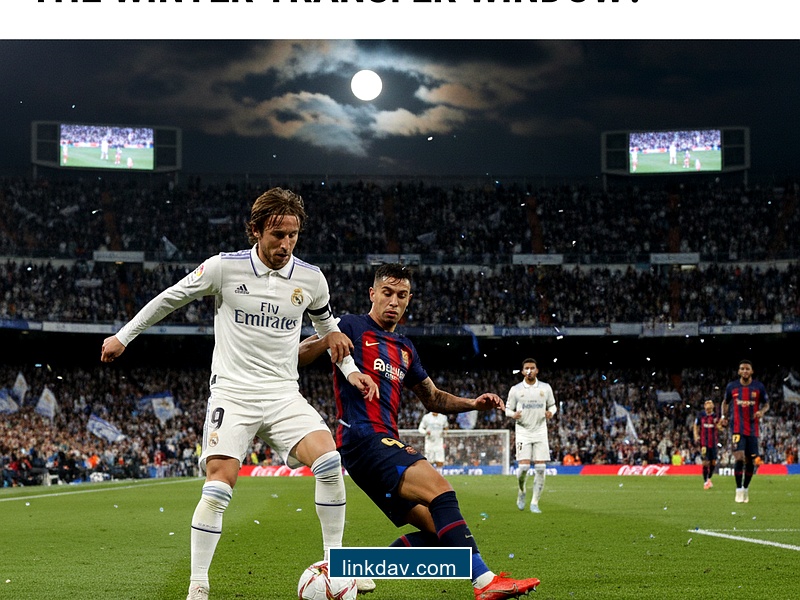
There is a specific, terrified look in the eyes of a central defender who knows he has no cover. I saw it in Antonio Rüdiger’s body language during the closing stages of the Champions League group phase. It isn't fatigue; it is the frantic scanning of a man realizing the space between him and the full-back is the size of a landing strip. Real Madrid enters the winter transfer window not with a shopping list, but with a gaping tactical wound that Florentino Pérez seems determined to ignore.
The murmurs from Valdebebas suggest a quiet January. The club rhetoric focuses on "trusting the squad" and waiting for the summer. From a scouting perspective, this is bordering on negligence. The metrics don't lie, and the biomechanics of the current backline are screaming for reinforcement. If Madrid thinks they can navigate the Champions League knockouts with a makeshift defense, they are misreading the modern game’s physical demands.
The Anatomy of the Crisis: It’s Not Just Numbers
To understand why Madrid must act, you have to look past the injury list. Yes, David Alaba is a ghost, and Éder Militão’s ACL tear has robbed the backline of its recovery pace. But the real issue is "Rest Defense"—the structure the team adopts while attacking to prevent counter-attacks.
Without a natural right-back since Dani Carvajal’s injury, the structural integrity of the defensive line has collapsed. Lucas Vázquez, for all his heart, defends like a converted winger. Watch his hip orientation when isolated 1v1 against a high-tier winger. He opens his gate too early, inviting the attacker inside. He lacks the defensive instinct to "show outside" and pin the opponent against the touchline. This forces the right-sided center-back (Rüdiger) to step out of the central channel to cover, creating a massive severance in the middle of the pitch.
"You don't scout a player by what they do with the ball. You scout them by how quickly they recognize danger when their team loses it. Right now, Madrid's reaction time in transition is glacial."
The Ghost of Winters Past
Historically, the Bernabéu boardroom treats the winter window like a contagious disease. There is a deep-seated institutional trauma stemming from past January failures. We remember the disastrous acquisition of Antonio Cassano (2006), whose metabolic conditioning was nonexistent, or the bizarre loan of Julien Faubert (2009), who famously fell asleep on the bench. Even the heavy-hitting Thomas Gravesen (2005) was a tactical square peg in a round hole.
However, clinging to these historical anomalies is a logical fallacy in 2025. The physical load of the modern calendar has increased the "packing rate"—the number of defenders bypassed by a single pass—exponentially. Defending today requires elite athleticism and rotation. Relying on Aurélien Tchouaméni to drop into defense is a stop-gap, not a strategy. When Tchouaméni plays CB, his receiving angles are wrong. He naturally looks to receive the ball facing forward (midfielder habit), whereas a center-back must be comfortable receiving while facing his own goal under high press. This subtle biomechanical difference slows down Madrid's build-up by split seconds—an eternity in elite football.
The Trent Alexander-Arnold Mirage
The noise surrounding Trent Alexander-Arnold is deafening, but let’s analyze this with a scout’s eye, not a fan’s heart. TAA is a generational playmaker, but his defensive stance is problematic for a team that already lacks structure. He tends to stand too upright in defensive transitions, reducing his ability to change direction explosively against agile wingers.
If Madrid waits until summer for him, they surrender this season. But more importantly, is he what they need now? Madrid doesn't need another conductor; they need a bouncer. They need a defender who enjoys the dark arts of the game—blocking channels, winning aerial duels in Zone 14, and physically intimidating opponents. The profile required is closer to a young Sergio Ramos or a prime Pepe: aggressive, fast, and defensively arrogant.
The "La Fábrica" Gamble
There is a romantic notion that Raúl Asencio or Jacobo Ramón can step up from the academy. I have watched the Castilla tapes. While Asencio possesses excellent ball-playing ability, his "scan frequency"—the number of times he checks his shoulder before receiving—is adequate for the Primera Federación, not the Champions League.
Young defenders often suffer from "ball-watching" syndrome. When the cross comes in from the opposite flank, they stare at the flight of the ball rather than checking the blind-side run of the striker. In a La Liga match against Leganés, you might survive that. Against Manchester City or Bayern Munich, that split-second lapse is a goal. Promoting youth is noble, but throwing them into a defensive crisis without a veteran partner is ruining them before they start.
The Laporte Solution: Why it Makes Sense
If the club were operating with pure footballing logic, Aymeric Laporte would be wearing white by February 1st. Forget the Saudi League stigma for a moment and look at his movement patterns during the Euros. His ability to break lines with his left foot is the antidote to Madrid’s stagnant build-up.
Currently, with Rüdiger (right-footed) often forced to play the left-sided center-back role, the passing angles are choked. He has to cut inside to pass, narrowing the field and allowing the opposition to press easier. A left-footed center-back like Laporte opens the entire left flank, allowing the left-back (Mendy or Garcia) to push higher. It’s simple geometry, yet Madrid seems content to play with one hand tied behind their back.
The Midfield Disconnect
We cannot discuss the defense without addressing the midfield's failure to screen. Since Toni Kroos departed, the "tempo" is erratic. Fede Valverde and Eduardo Camavinga are elite athletes, but they are runners, not holders. They chase the ball rather than holding space.
A scout looks for "defensive shadows"—how a player positions himself to block passing lanes without tackling. Madrid’s current midfield allows too many vertical passes to slice through them. This exposes the under-manned backline to direct runners. Strengthening the defense isn't just about buying a defender; it's about acquiring a vocal leader at the back who can scream at the midfield to hold their shape. Rüdiger tries, but he is too busy fighting fires to organize the station.
The Verdict
Real Madrid’s plan appears to be a high-stakes game of poker: bluffing that their heritage and "DNA" can mask the cracks in their squad. But biomechanics and tactical structure do not care about history. The players look heavy-legged. The unseen work—the tracking back, the shuttling to cover gaps—is dropping off because the mental fatigue of playing out of position is setting in.
If Florentino Pérez refuses to sign a center-back and a right-back in January, he is effectively conceding the season. The squad is one Rüdiger injury away from fielding a defense that wouldn't look out of place in the Europa League. The winter window is often called a market of desperation, but sometimes, desperation is the only rational response to a crisis.