
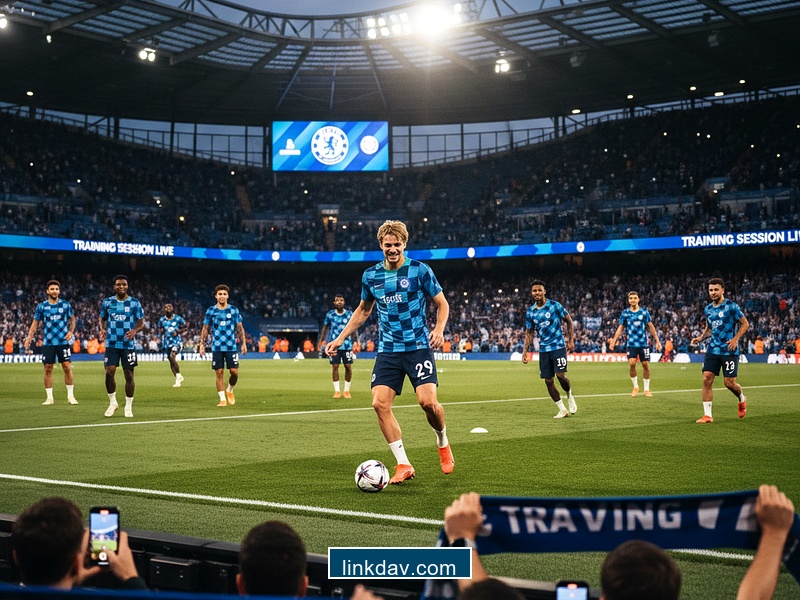
The footage released from London Colney this week was brief, but its implications are seismic. Seeing Kai Havertz back in full training does more than just fill a slot on the team sheet; it restores the structural integrity of Mikel Arteta’s entire tactical blueprint. While the headlines scream about "injury boosts," the true story here requires a deeper lens—one that looks past the immediate fixture list and peers into the DNA of title-winning sides from two decades ago.
In the modern Premier League, availability is the best ability. But Havertz offers something far more specific: he is the chaotic variable that allows the rest of Arteta’s equation to function. To understand why his return creates a "selection dilemma" rather than a simple selection, we must abandon the notion of fixed positions and look at historical precedents that define English football dominance.
The Resurrection of the "Target-Man Technician"
We need to talk about the physical profile of this Arsenal side compared to the spectres of the past. For over a decade—specifically the barren trophy years between 2008 and 2018—Arsenal were technically gifted but physically fragile. They were bullied at the Britannia Stadium; they were outmuscled at Old Trafford. The introduction of Kai Havertz marked the final death knell of that era.
Havertz stands at 6'4". He wins aerial duels at a rate that would make a traditional number nine blush, yet he possesses the touch of a number ten. This duality is rare, but it is not without precedent in North London. When we look back at Arsène Wenger’s 1997-98 Double-winning side, we see a distinct parallel not with Dennis Bergkamp, but with the tactical utility of Emmanuel Petit and the movement of Nicolas Anelka combined.
The 1998 and 2002 teams were giants. Patrick Vieira, Petit, Adams, Bould—they were physically imposing. Arteta has rebuilt this land of giants with Saliba, Gabriel, Rice, and Havertz. Havertz’s return signifies that Arsenal can once again play "over" a press, not just through it. When the passing lanes are choked by a low block, Havertz offers the "out ball"—the chest control in the center circle that allows the wingers to invert. Without him, the team often looks pretty but toothless; with him, they possess a vertical threat that mirrors the direct devastation of the early 2000s.
"People talk about the Invincibles' technique, but they forget that they were absolute monsters in the tunnel. You lost the game before you stepped on the pitch because of their size. Havertz brings that fear factor back."
The Wengerian Dilemma: A Nice Problem to Have
The reports indicate a "selection dilemma" for Arteta. This is code for squad depth, a luxury Arsenal fans haven't truly enjoyed since the 2001-02 campaign. That season, Wenger had to juggle Sylvain Wiltord, Kanu, Dennis Bergkamp, and Thierry Henry. Wiltord, often marginalized in historical retrospectives, was vital—he played on the right, up top, and in the hole. He scored the goal that won the league at Old Trafford.
Havertz is the modern Wiltord, but with better aerial ability. His versatility creates a tactical headache that opposing managers hate. If Arteta deploys Havertz as a "False 9," he gains an extra midfielder in the build-up. If he plays him as a left-sided "8," he gains a late-arriving box crasher who ghosts in at the back post.
This creates a friction point with Gabriel Jesus. Ten years ago, the narrative would have been about "saving" a player's confidence. Today, the ruthlessness of the league demands that sentimentality be stripped away. The statistical reality is that Arsenal’s points-per-game average is significantly higher when Havertz starts centrally compared to when the attack relies solely on intricate floor passing. The "dilemma" is simply whether Arteta wants control (Havertz at 9, Rice/Merino at 8) or chaos (Jesus at 9, Havertz at 8).
The Shadow of the Treatment Room
While the return of the German international is cause for optimism, the accompanying news of a "frustrating injury setback" for another star serves as a grim check on reality. This is the persistent narrative of Arsenal’s modern history—the specter of Abou Diaby or Jack Wilshere. The "one week away" timeline that stretches into months is a psychological drain on a squad.
However, the tactical insulation Arteta has built is designed to mitigate this. In 2007-08, when Eduardo’s leg was broken and Rosicky’s hamstrings failed, the title challenge collapsed because the system relied on individuals. Today, the system relies on zones. Even with a defensive setback, the return of Havertz allows for a reshuffle that maintains the structural integrity. If a defender is out, Partey can invert, Rice drops deep, and Havertz occupies the space Rice vacated. It is a fluid machine, reminiscent of the Total Football concepts Ajax exported, but hardened by Premier League steel.
Tactical Theory: The Raumdeuter in the Premier League
We often throw around the term "Raumdeuter" (space interpreter) regarding Thomas Müller, but Havertz is the closest Premier League equivalent. His movement is non-linear. Watch the training footage closely; he rarely runs in straight lines. He arcs his runs to blindside defenders.
This contrasts sharply with the static target men of the past. Comparing him to Olivier Giroud is lazy. Giroud was a lamppost you played off; Havertz is a ghost you play through. The 2015-16 Arsenal side that finished second to Leicester City lacked this dynamism. They had Mesut Özil creating chances at a record rate, but the finishing was static. Havertz provides the chaotic movement that Özil desperately needed ahead of him.
There is a specific tactical trigger Havertz activates: the "Rest Defense." When Arsenal attacks, Havertz is often the first line of defense immediately after possession loss. His counter-pressing numbers are elite. He harasses center-backs, forcing long balls that Saliba and Gabriel inevitably feast upon. This defensive contribution from a forward is what separates pretenders from champions.
The Final Verdict
The excitement surrounding Kai Havertz’s return isn't just about a player recovering from a knock. It represents the maturation of Mikel Arteta’s project. We are no longer watching a team of promising youngsters hoping to nick a result. We are watching a juggernaut that can beat you with beauty or beat you with brute force.
Arteta stands on the precipice of achieving what the Emirates era failed to do: marrying the technical sublime with the physically ridiculous. Havertz is the embodiment of that marriage. The dilemma of where to play him is the exact kind of problem Sir Alex Ferguson and Arsène Wenger used to relish. It means the bench is strong, the options are varied, and the fear is gone. Havertz is back, and with him returns the genuine belief that this team is built not just to compete, but to conquer.