
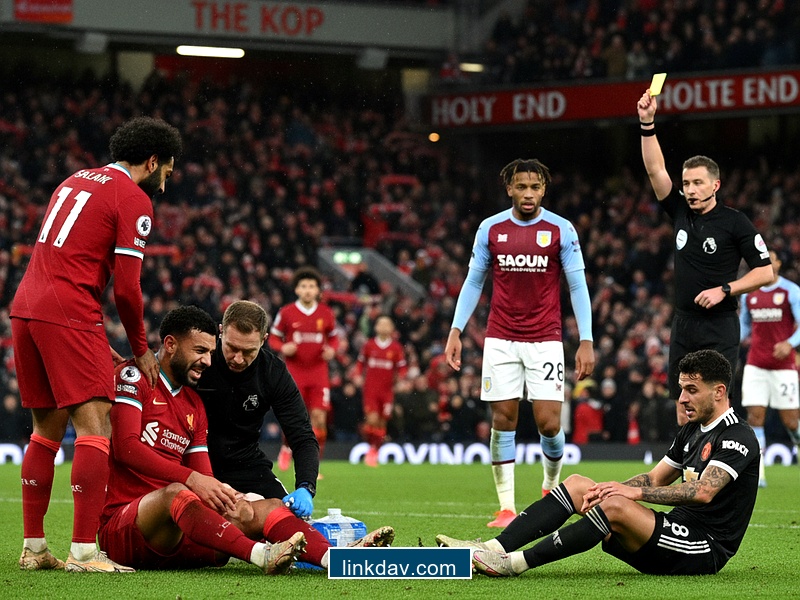
The news dropping from Merseyside this morning does more than darken the mood at the AXA Training Centre; it fundamentally alters the geometry of this Premier League title race. Liverpool confirming ankle surgery for Alexander Isak is a hammer blow that echoes the ghostly frustrations of the Rafa Benítez era. Simultaneously, 80 miles down the M6, Manchester United’s capitulation at Aston Villa—compounded by a significant injury to Bruno Fernandes—marks the final disintegration of a team operating on nostalgia rather than structure.
As a columnist who covered the breathless intensity of the mid-2000s, the parallels are impossible to ignore. We are witnessing history rhyme with a cruel, jagged cadence. Liverpool have once again bet the house on a mercurial, fragile number nine, while Manchester United have lost their only remaining link to world-class creativity, exposing a soft underbelly that Roy Keane would have cannibalized in a training session.
The Torres Echo: Isak and the fragility of the focal point
Alexander Isak’s arrival at Anfield was supposed to represent the final piece of the post-Klopp evolution (or the tactical shift under the current regime). He offers a silkiness that Darwin Núñez lacks and a verticality that Cody Gakpo rarely provides. However, the confirmation of ankle surgery brings a shudder of recognition to anyone who watched the 2008-09 season.
We are looking at the Fernando Torres paradox all over again. In his pomp, El Niño was unplayable, a striker who could terrorize Nemanja Vidić with sheer pace. Yet, his Liverpool legacy is defined as much by the games he missed as the goals he scored. In that fateful 2008-09 campaign, where Liverpool finished four points behind Manchester United, Torres started only 20 league games due to hamstring and ankle issues. Liverpool drew 11 games that season—matches where a moment of magic was required but their talisman sat in the stands.
"Liverpool have replaced the heavy metal football of the past with a philharmonic orchestra, but they just lost their first violinist. Without Isak, the melody breaks."
Isak shares Torres’s physiological profile: tall, lean, explosive, and worrying biomechanics that seem susceptible to the Premier League’s meat-grinder intensity. Tactically, this forces Liverpool to revert. They must now rely on chaos rather than control. The ankle surgery suggests a minimum three-month absence. By the time Isak returns, the title mathematics may already be unsolvable.
Villa Park: The Graveyard of United's Ambition
If Liverpool’s issue is a cracked diamond, Manchester United’s problem is a rotten foundation. Losing to Aston Villa away is no longer a shock; Unai Emery has turned Villa Park into a fortress reminiscent of the O’Neill era. The shock is the manner of the defeat and the injury to Bruno Fernandes.
For five years, Fernandes has been the tactical duct tape holding a fractured institution together. He is the modern equivalent of Bryan Robson in the 1980s—carrying a dysfunctional team on his back until his spine inevitably snaps. His injury is not just a muscular failure; it is a structural indictment of the club.
Let us contextualize this loss against the United of 15 years ago. On a visit to Villa Park in the 2007-08 season, Sir Alex Ferguson deployed a midfield that controlled space and tempo with ruthless efficiency. Today's United midfield is a transit zone, allowing opposition runners to bypass them with terrifying ease.
The De-Evolution of the Red Devils
The contrast between the spine of the 2008 Champions League winners and the current crop exposed at Villa Park is stark enough to induce vertigo.
| Attribute | 2008 Era (Carrick/Scholes/Hargreaves) | Current Era (Fernandes/Mainoo/Casemiro) |
|---|---|---|
| Defensive Transition | Compact, aggressive, tactical fouling. | Porous, reactive, large gaps between lines. |
| Possession | Patient circulation, waiting for the overload. | Erratic, reliance on "Hero Ball" from Fernandes. |
| Leadership | Shared responsibility (Ferdinand, Vidić, Evra). | Sole reliance on the captain (Fernandes). |
| Result at Villa | Dominant wins (e.g., 4-0 in March 2008). | Tactical submission. |
Without Fernandes, United loses their primary ball progressor. He leads the league in chances created and progressive passes for his side. Without him, they are not a top-six side; they are a mid-table team with a high wage bill. The reliance on a single player to link defense and attack is tactical suicide in modern football, where systems like Manchester City’s or Arsenal’s are designed to function regardless of individual absentees.
The Medical Reality: Why the modern game breaks players
We must look beyond the immediate headlines to the root cause. Why are Isak and Fernandes breaking down? The game has accelerated beyond human biology. In 2004, the average high-intensity sprinting distance for a Premier League midfielder was roughly 800 meters per game. Today, that number has nearly doubled.
Isak’s ankle surgery is likely a result of the torque required to press high and change direction instantly—a demand that didn't exist for the likes of Robbie Fowler or Ian Rush, who were poachers first and athletes second. Fernandes’s injury is pure wear and tear; he has played more minutes than almost any professional footballer in Europe since 2020.
The Tactical Ramifications
For Liverpool, the solution is imperfect but available. They will likely shift Salah centrally or trust Núñez to stop hitting the woodwork. It changes their build-up; Isak drops deep to link play (a la Harry Kane), whereas Núñez stretches defenses vertically. Liverpool will lose control but gain unpredictability. It might be enough for a cup run, but for the league? History suggests that without your primary number nine, you hit a ceiling.
For United, the outlook is bleak. The loss at Villa exposed that without Fernandes pressing from the front and demanding the ball, the team hides. We saw it in the body language of the wingers and the isolation of the striker. There is no Michael Carrick coming off the bench to calm the storm. There is no Paul Scholes to dictate the tempo. There is only a void.
A Winter of Discontent
These two headlines, arriving simultaneously, signal the end of the "phony war" phase of the season. The attrition rates are climbing. Liverpool’s title challenge has taken a puncture to the hull that reminds us ominously of the Torres years—brilliant but brittle. They are a Ferrari with a flat tire.
Manchester United, conversely, are a broken-down sedan on the side of the motorway. The loss at Villa was the smoke billowing from the engine; Fernandes’s injury is the driver walking away from the vehicle. We are watching the painful, slow-motion collapse of a once-great sporting institution that has failed to protect its most valuable assets.
The managers will talk about squad depth and resilience in the coming press conferences. Do not believe them. In the Premier League, you are only as strong as your spine. Today, Liverpool’s spine cracked, and United’s was removed entirely.